 RaphaelItalian, 1483–1520
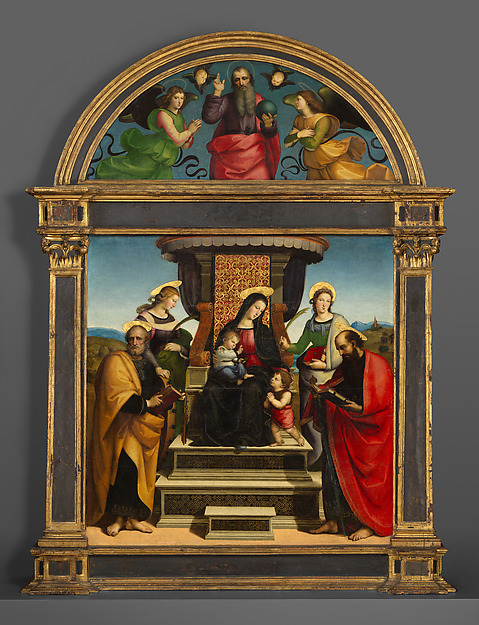
Madonna and Child Enthroned with Saints
May one see it?
Yes, receiving visitors

The Metropolitan Museum of Art
Room609New York, United States
On public display.
- Checked
- 4 hours ago
- In this state since
- Sep 26, 2026
- Source
- The museum's own collection data
About the painting
The Madonna and Child Enthroned with Saints (Young Baptist and Saints Peter, Catherine, Lucy, and Paul), also known as the Colonna Altarpiece, is a painting by the Italian High Renaissance artist Raphael, executed c. 1503-1505. It is housed in the Metropolitan Museum of Art of New York City. It is the only altarpiece by Raphael in the United States.
The collection of Metropolitan Museum of Art also contains a painting of the Agony in the Garden from the predella of the altarpiece. Other panels from the predella can be found in the collections of the National Gallery, London, the Isabella Stewart Gardner Museum, in Boston, and Dulwich Picture Gallery, in London. A preparatory drawing by Raphael for the composition of the agony in the garden is in the collection of the Morgan Library New York.
Read on
The pieces of the predella were separated from the altarpiece and sold to Queen Christina of Sweden, from where they reached the Orleans Collection, while the main panels themselves were eventually sold to the aristocratic Colonna family in Rome, from whom the altarpiece takes its name. The painting eventually passed to the House of Bourbon-Two Sicilies and was sold by the estate of Francis II of the Two Sicilies to Martin Henry Colnaghi in 1896, who sold it on to Charles Sedelmeyer. The Altarpiece was the last Raphael altar in private hands when J.P. Morgan purchased it from Sedelmeyer in the early 20th century for a record price.
The painting depicts Christ sitting on Mary and blessing a young John the Baptist, with Saint Peter, Catherine of Alexandria, an unknown female saint, and Saint Paul in the background. It was painted for the Franciscan convent of Sant'Antonio da Padova in Perugia, who may have made the unique request for Christ Child and John the Baptist to be fully clothed. Some believe the lunette was completed after the central panel, as Peter and Paul are depicted in a much more modern appearance, perhaps inspired by Raphael's first visit to Florence and his exposure to the work of Fra Bartolomeo and Leonardo da Vinci.
Particulars
- Accession number
- 16.30ab
What it shows
Sources
- The Metropolitan Museum of Art: the museum's own open data · fetched 4 days ago
- Image: The Metropolitan Museum of Art — Open Access (CC0)
Meanwhile, in the life of Raphael
The whole lifec. 1501 – c. 1502 · Workplace
Perugia
1502
To Siena at Pinturicchio's invitation
Another pupil of Perugino, Pinturicchio, “being a friend of Raphael and knowing him to be a draughtsman of the highest quality”, invited him to Siena to help with the cartoons, and very likely the designs, for the frescoes of the Piccolomini Library in Siena Cathedral.
c. 1503 – c. 1504 · Workplace
Siena
late 1504
Meets Leonardo and Michelangelo
Having moved to Florence, Raphael met Leonardo da Vinci, Michelangelo and Bartolomeo della Porta and closely studied Leonardo's sfumato. His first Florentine commission, portraits of Agnolo Doni and his wife, was painted under the clear impression of the “Mona Lisa”.
1504
Friendship with Baldassare Castiglione
In Urbino Raphael met the philosopher, writer and patron Count Baldassare Castiglione; they formed a firm friendship and correspondence, including the famous letters about the fresco “The Triumph of Galatea”.
October 1504
To Florence, to study
The mother of the next Duke of Urbino gave Raphael a letter of recommendation to the Gonfaloniere of Florence: “The bearer of this will be found to be Raphael, painter of Urbino, who, being greatly gifted in his profession has determined to spend some time in Florence to study.” She called him “a sensible and well-mannered young man”.