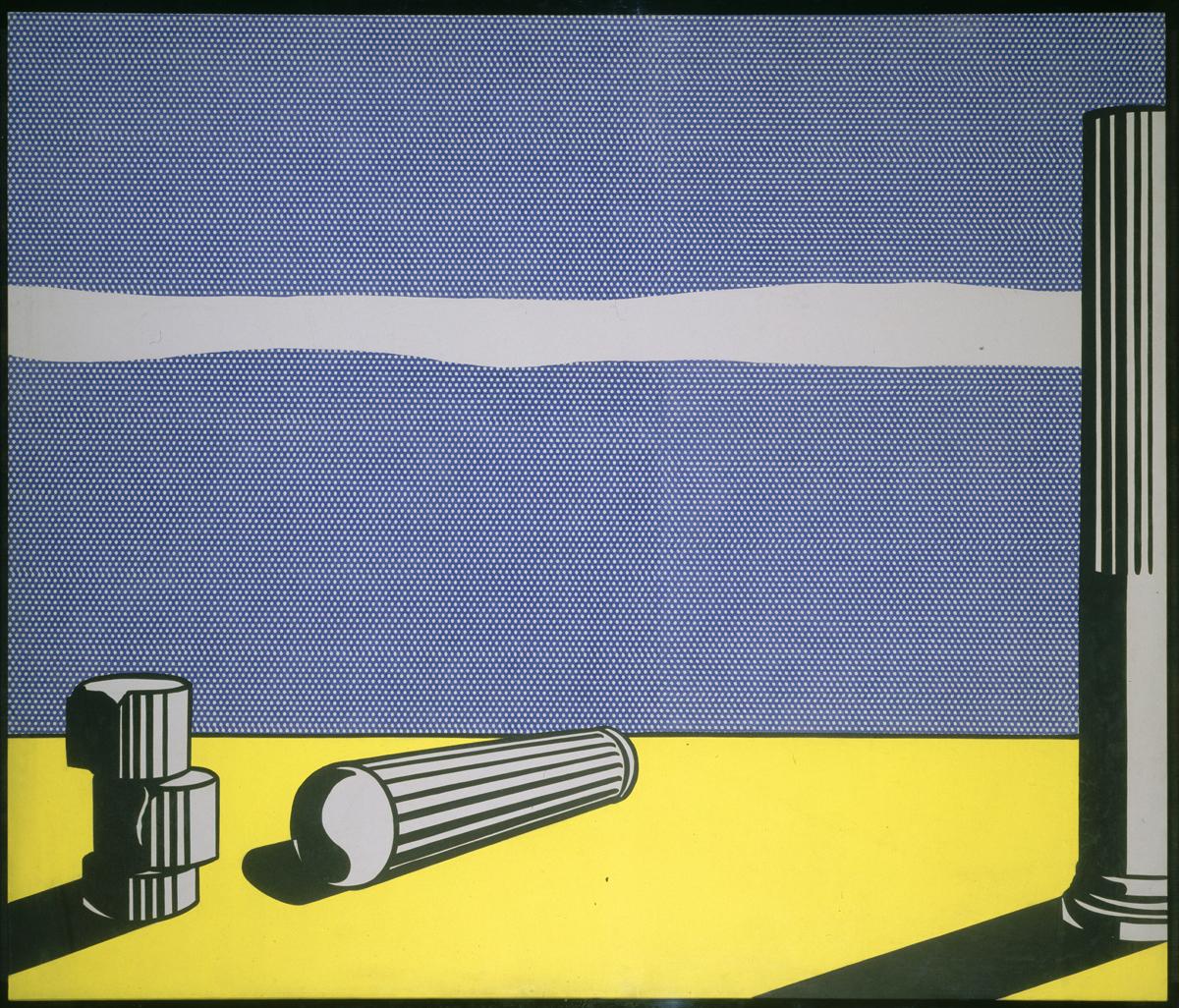
 Roy LichtensteinAmerican, 1923–1997
Руины
About the painting
In the museum's own words — in Russian
Руины и пейзаж сведены к простым геометрическим формам. Картина относится к серии работ, в которых художник исследует соотношение света и тени. В этой связи он часто выбирает архитектурные сюжеты. В данном произведении фрагменты колонн на переднем плане отсылают зрителя к античной классике. Лихтенштейн, известнейший представитель поп-арта, использует и здесь характерный для него стилистический прием, взятый из комиксов. Изготовленные способом массовой печати, комиксы, если их разглядывать через лупу, оказываются составленными из типичных растровых точек, которые, проходя через глаз зрителя, конструируются в форму и цвет. Лихтенштейн возводит эти растровые точки в принцип своего художественного творчества, создавая тем самым легко узнаваемую собственную марку. В этом смысле его работы можно считать изображениями печатных изображений.
Read on
Подобно Джасперу Джонсу, он стремится объединить предметность и абстракцию, однако его творческая установка имеет отчетливую общественно-критическую доминанту, в то время как Джаспер Джонс в гораздо большей степени занят художественно-теоретическими вопросами.
State Russian Museum

Particulars
- Accession number
- HT-273
Meanwhile, in the life of Roy Lichtenstein
The whole life1963–1964
Leaves Rutgers and returns to New York
In September 1963 Lichtenstein took a leave of absence from Douglass College at Rutgers; in 1964 he moved back to New York to be at the centre of the art scene and resigned from Rutgers to concentrate on his painting.
1964
The first American to exhibit at the Tate Gallery
Lichtenstein became the first American to exhibit at the Tate Gallery in London, in the show “’54–’64: Painting and Sculpture of a Decade”.
1964
Life magazine asks: “Is He the Worst Artist in the U.S.?”
When Lichtenstein’s work was first exhibited, many critics challenged its originality and called it vulgar and empty; a Life magazine article of 1964 was headed “Is He the Worst Artist in the U.S.?”. The artist replied that the closer his work is to the original, the more threatening and critical its content.
1965
Divorce from Isabel
The brutal upstate winters, where Lichtenstein had been teaching since 1958, took a toll on him and his wife. They sold the family home in Highland Park, New Jersey, in 1963 and divorced in 1965.
1967
First museum retrospective in Pasadena
In 1967 the Pasadena Art Museum in California held Lichtenstein’s first museum retrospective.


![Untitled [pyramid], Roy Lichtenstein, c. 1970](https://whitneymedia.org/assets/artwork/61776/2019_234_14_cropped.jpg)
![Untitled [pyramid], Roy Lichtenstein, c. 1970](https://whitneymedia.org/assets/artwork/61778/2019_234_16_cropped.jpg)
![Untitled [pyramid], Roy Lichtenstein, c. 1970](https://whitneymedia.org/assets/artwork/61777/2019_234_15_cropped.jpg)
![Untitled [pyramid], Roy Lichtenstein, c. 1970](https://whitneymedia.org/assets/artwork/61763/2019_234_1_cropped.jpg)
![Untitled [pyramid], Roy Lichtenstein, c. 1970](https://whitneymedia.org/assets/artwork/61774/2019_234_12_cropped.jpg)