 Mikhail Vrubel1856–1910
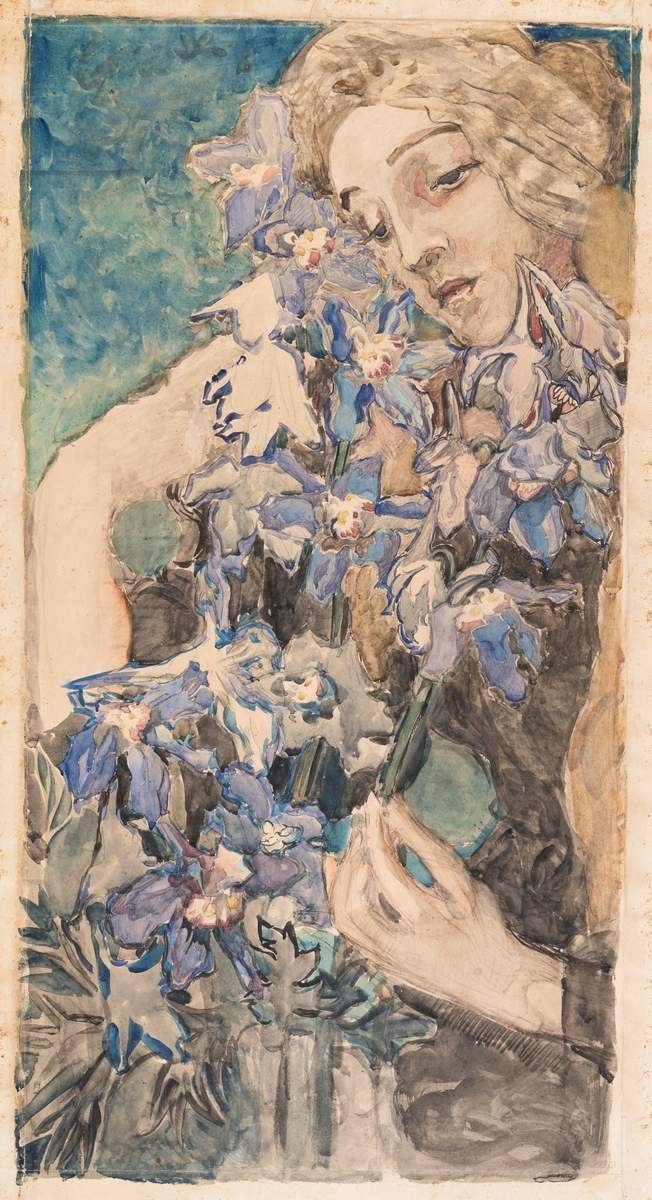
Примавера
Can I see it?
Unknown
Where is “Примавера” now? Collection: State Russian Museum, Saint Petersburg. Unknown.

Saint Petersburg, Russia
The owner is known; whether it is on view today is not.
- In this state since
- Source
- The museum
About the work
Museum text in Russian
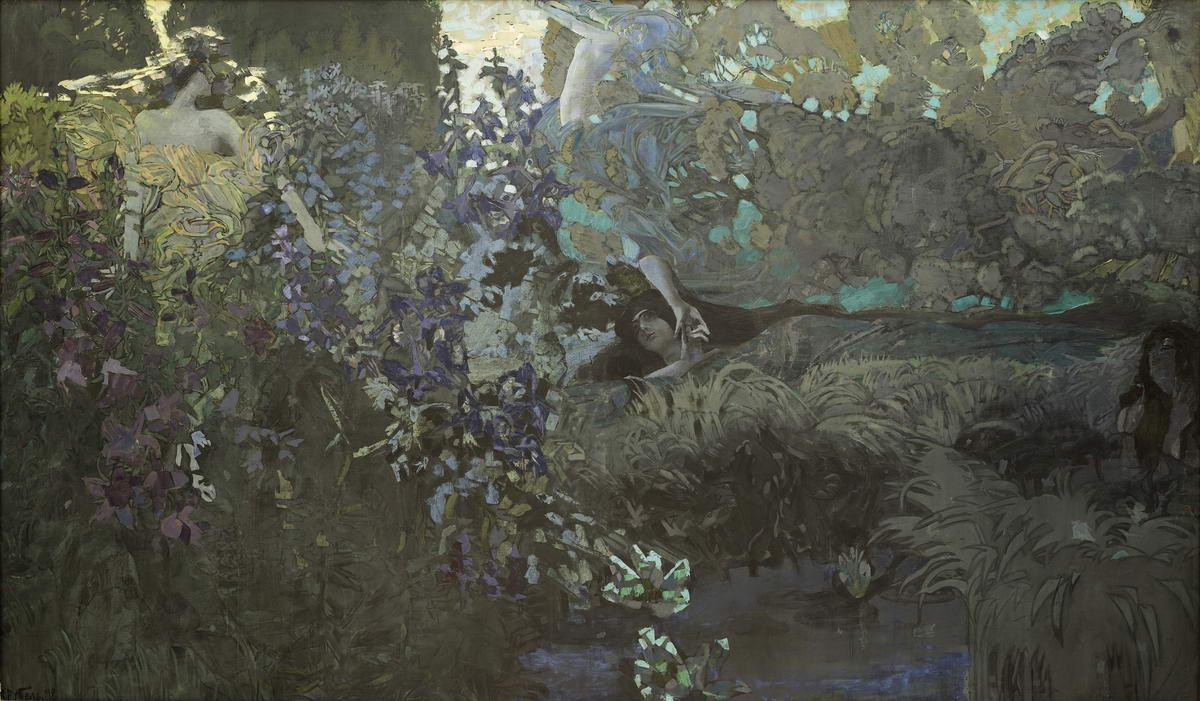
Авторское название неизвестно. Традиционно утвердилось «Примавера» — по выставке «Салон» (СПб, 1909. № 39. Этюд к Primavera) и публикации в журнале «Аполлон» (1909. № 3. Между с. 32–33). Первые биографы Врубеля дают название акварели описательно: «Женское лицо посреди синих цветов» (Ге), «Женщина среди цветов» (Яремич, 1911), «Эскиз к „Утру“. Женская фигура с цветами» (Иванов, 1912). Е. И. Гаврилова (1974) связывает акварель с работами предыдущего года: панно «Маргарита» из триптиха «Фауст». Юлия Солонович // Михаил Врубель из собрания Русского музея. СПб, 2006. С. 290.
Read on
В самом начале 1896 года состоялась встреча Врубеля с его будущей женой и музой — певицей Надеждой Забелой. Ее одухотворенный, почти эфемерный облик с тех пор становится одним из лейтмотивов творчества художника. В московскую, безмятежную пору их жизни он претворился в акварелях «Морская царевна» (1898, ГРМ, Р-14997), «Прощание Царя Морского с Царевной Волховой» (1898, ГТГ, инв. 11056), «Гензель и Гретель» Э. Хумпердинка (1895–1896, ГРМ, Р-5858), «Примавера». Удивительно, но среди относящихся к этому времени портретов Надежды Забелы-Врубель нет ни одного, на котором она была бы изображена в реальной обстановке, в современном костюме, в обычном интерьере. Врубель словно живет в зачарованном мире фантазии, былины, сказки. И даже линии рисунка, движения кисти в этих акварелях приобретают напевную плавность. / Юлия Солонович. Графика Михаила Врубеля // Михаил Врубель. К 165-летию со дня рождения. СПб, 2022. С. 22‑23.
Авторский вариант композиции — Абрамцево (ранее — собрание Т. В. Гельцер).
State Russian Museum
Details
- Accession number
- Р-14991
What it shows
In the catalog
Sources
- State Russian Museum
- Image: State Russian Museum — © State Russian Museum
In the life of Mikhail Vrubel
The whole lifeearly 1896
Meeting Nadezhda Zabela
In St Petersburg Vrubel stepped in for the ailing Korovin as designer of Humperdinck’s opera “Hansel and Gretel”, which Mamontov was financing, and at a rehearsal he first heard, then saw, the singer of Gretel — Nadezhda Zabela. Rushing up to her in the interval with the cry “What a lovely voice!”, he proposed almost on the day they met, and later told his sister that had she refused, he would have killed himself on the spot.
22 May 1896
The Academy rejects his Nizhny Novgorod panels
Mamontov secured Vrubel a commission for two huge panels for the art section of the All-Russian Exhibition — “Mikula Selyaninovich” and “The Princess of the Dream”, a hundred square metres in three months. But the academician Albert Benois, in charge of the pavilion, demanded sketches, a telegram went to St Petersburg — “Vrubel’s panels are monstrous, they must be removed” — the Academy’s commission ruled them unfit to show, and on 22 May the works were carried out of the pavilion.
July 1896
Mamontov’s pavilion for the “rejected” panels
Mamontov bought both panels for 5,000 roubles: Polenov and Korovin finished “Mikula”, Vrubel completed “The Princess of the Dream” in a shed at the Abramtsevo pottery, and in time for the imperial couple’s visit on 15–17 July the canvases were shown in a specially built pavilion signposted “Exhibition of decorative panels by the artist M. A. Vrubel, rejected by the jury of the Imperial Academy of Arts” — the words naming the Academy’s jury soon had to be painted over. A newspaper battle followed: Nikolai Garin-Mikhailovsky offered the first balanced analysis of Vrubel’s art, while Maxim Gorky mocked his panels in five articles.
28 July 1896
Marries Nadezhda Zabela in Geneva
Meeting Zabela’s family went badly — the age gap troubled them (he was 40, she 28), and the bride herself knew that Vrubel drank and squandered money — but on 28 July the couple were married in the Cathedral of the Exaltation of the Holy Cross in Geneva. They spent their honeymoon in a guesthouse in Lucerne, where Vrubel went on working on panels for A. V. Morozov’s Gothic study: by the wedding he was literally penniless and had walked from the station to his bride’s.
summer 1898
First symptoms of illness
During a summer stay in Ukraine the first symptoms of his future illness appeared: his migraines grew so severe that he took phenacetin in huge quantities — up to 25 grains or more, according to his sister-in-law. A previously unknown irritability set in too, especially when someone disagreed with his opinion of a work of art.
January 1898
“Morning” at Diaghilev’s exhibition
In St Petersburg Ilya Repin advised Vrubel not to destroy his panel “Morning”, which a client had turned down, but to show it at an exhibition. So the canvas went into Sergei Diaghilev’s exhibition of Russian and Finnish artists at the museum of the Stieglitz School.