.png?width=96) Katsushika HokusaiJapanese, 1760–1849
Katsushika HokusaiJapanese, 1760–1849Priest
Can I see it?
Not on view at present
Where is “Priest” now? Collection: Minneapolis Institute of Art, Minneapolis. Not on view at present. Checked September 29, 2026.

Minneapolis, United States
It belongs to the collection, but is not on display at present.
- Checked
- In this state since
- Source
- The museum
About the work
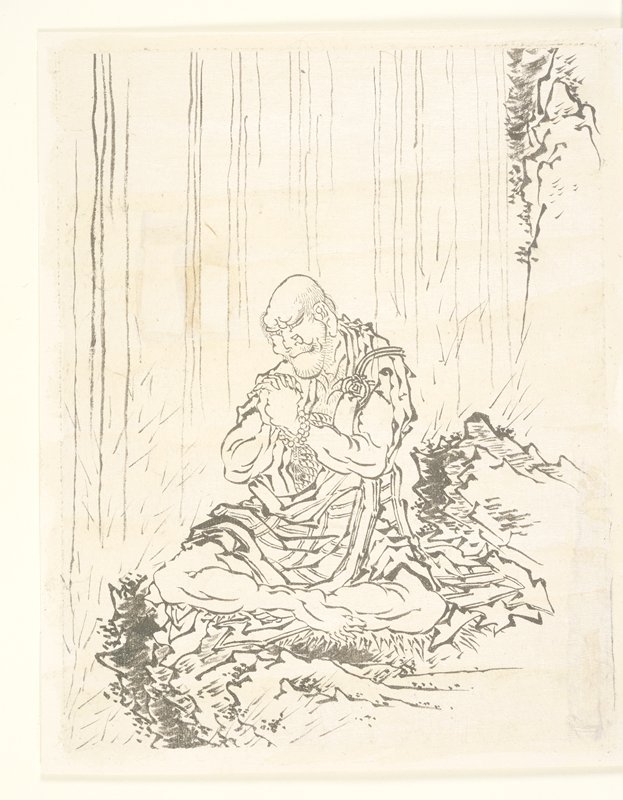
Prayer beads, or rosaries, are used in many religious traditions as aids for prayer and recitation. In this drawing by Hokusai, prayer beads are shown encircling the wrist of a Buddhist as he devotes himself to asceticisms near a waterfall. Buddhist practitioners use rosaries to count the repetitions of sacred texts and appeals. These rosaries are traditionally composed of 108 beads. Each bead represents a bonnō –a negative mental state such as jealousy or depression. Additionally, the number 108 holds astronomical significance as it is the product of the four phases of the moon and the twenty-seven constellations (4 x 27 = 108).
Minneapolis Institute of Art
Details
- Accession number
- 74.1.316
In the catalog
Sources
- Minneapolis Institute of Art
- Image: Minneapolis Institute of Art — public domain
In the life of Katsushika Hokusai
The whole life1804–1815
Illustrating the novels of Takizawa Bakin
Hokusai illustrated books by the popular novelist Takizawa Bakin; the fantasy novel Chinsetsu Yumiharizuki (Strange Tales of the Crescent Moon, 1807–1811), about Minamoto no Tametomo, made him especially famous. After thirteen works the partnership broke up, whether over clashing personalities or over how the illustrations should be drawn.
1811
Takes the name Taitō
At 51 Hokusai changed his name to Taitō and entered the period of the Hokusai Manga and his drawing manuals. The first of them, Quick Lessons in Simplified Drawing, appeared in 1812, meant to earn money and attract pupils.
1812
Friendship with the artist Bokusen
Hokusai began a close friendship with the artist Bokusen (1775–1824), thanks to which the Hokusai Manga albums came out in Nagoya between 1814 and 1834.
1812
Journey to the Kansai region
The sketches Hokusai made on a journey to the Kansai region so amazed his pupils Maki Bokusen, Hokuun and Hokutei that they persuaded their teacher to publish them as a book — the origin of the Hokusai Manga.
1814
The first volume of the Hokusai Manga
The first 54-page volume of the Manga, signed Tamekazu, appeared in Edo and Nagoya and sold out within about a week. This diary in drawings — city scenes, people, animals — grew to twelve volumes in the artist's lifetime and is called an “encyclopedia of the Japanese people”.
1820
The name Iitsu and fame throughout Japan
Hokusai changed his name yet again, to Iitsu, opening the period in which he became famous as an artist throughout Japan.