 Max BeckmannGerman, 1884–1950
Perseus's Last Duty
May one see it?
Yes, receiving visitors

On public display.
- Checked
- In this state since
- Source
- The museum
About the painting
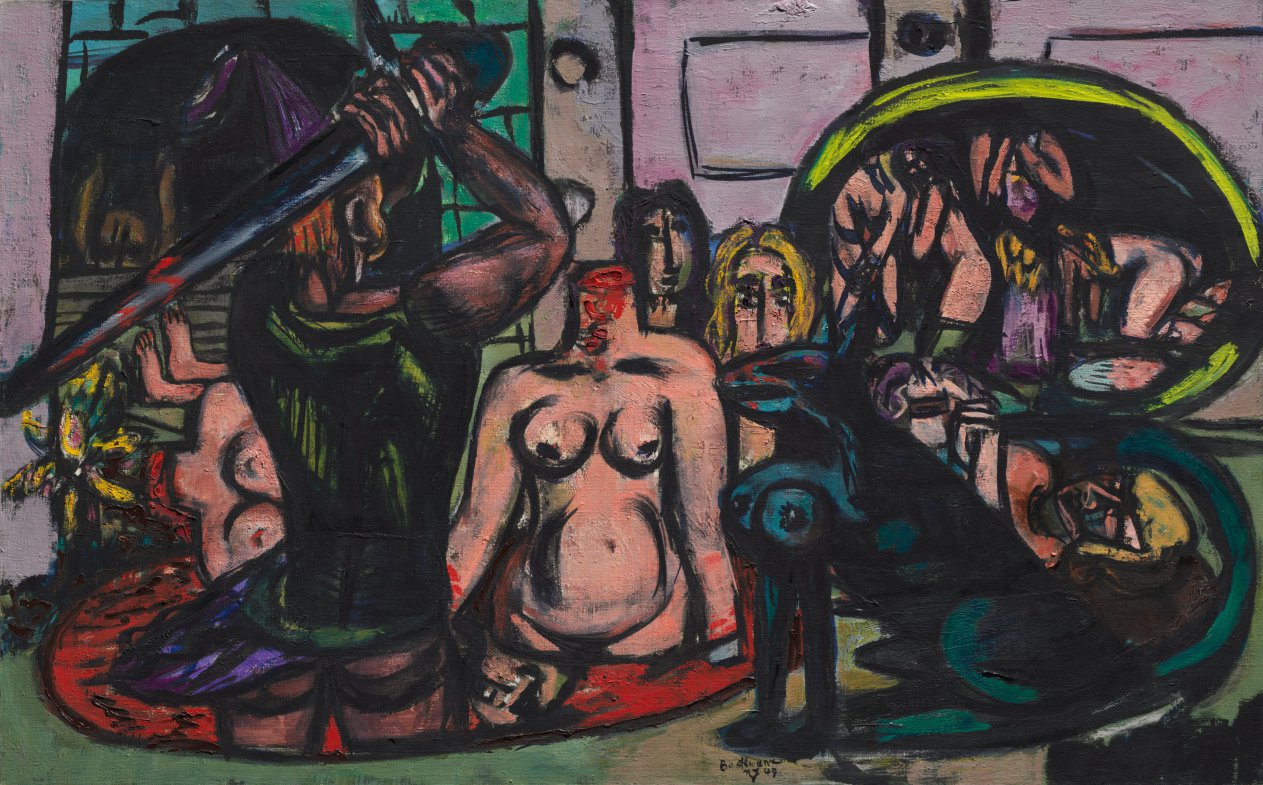
This painting depicts Perseus, a celebrated warrior from Greek mythology whose name derives from the Greek word "to waste, ravage, sack, destroy." Perseus’s most famous feat was cutting off Medusa’s head. Yet, the mass slaughter depicted here is not found in the ancient myth, but instead suggests a nightmarish allegory filled with private, enigmatic symbols, perhaps reflecting Beckmann’s experience of barely surviving two world wars. Traumatized while serving as a medical orderly during WWI, Beckmann later became the target of Nazi persecution. In 1947 he immigrated to the United States. Created in the aftermath of the Holocaust and under the Cold War threat of nuclear annihilation, this painting suggests a bitter critique of mankind’s propensity for destruction. Presenting Perseus in female dress subverts the hypermasculine glamorization of military heroes common to national historical myths.
The Cleveland Museum of Art
Particulars
- Accession number
- 2013.7
In the catalog
Sources
- The Cleveland Museum of Art
- Image: The Cleveland Museum of Art — Museum open access
Meanwhile, in the life of Max Beckmann
The whole life1937–1947
Ten years of exile in Amsterdam
Beckmann lives in Amsterdam in self-imposed exile, making desperate but failed attempts to obtain a visa for the United States.
1947
Moving to the United States to teach in St. Louis
In 1947 Beckmann and his wife finally cross the ocean: at the invitation of Perry T. Rathbone, director of the Saint Louis Art Museum, he takes a teaching post at the St. Louis School of Fine Arts at Washington University, a vacancy left by Philip Guston, who had taken a leave.
1947–1949
Morton May: patron and student
In St. Louis Morton D. May, an avid amateur photographer and painter, becomes Beckmann's patron and student; the artist also helps him learn to appreciate Oceanian and African art.
1948
The first retrospective in the United States
The first Beckmann retrospective in the United States takes place in 1948 at the City Art Museum in St. Louis.
1950
A one-man show at the Venice Biennale
Beckmann has a one-man show at the Venice Biennale of 1950, the year of his death.
27 December 1950
Died