 Rosa BonheurFrench, 1822–1899
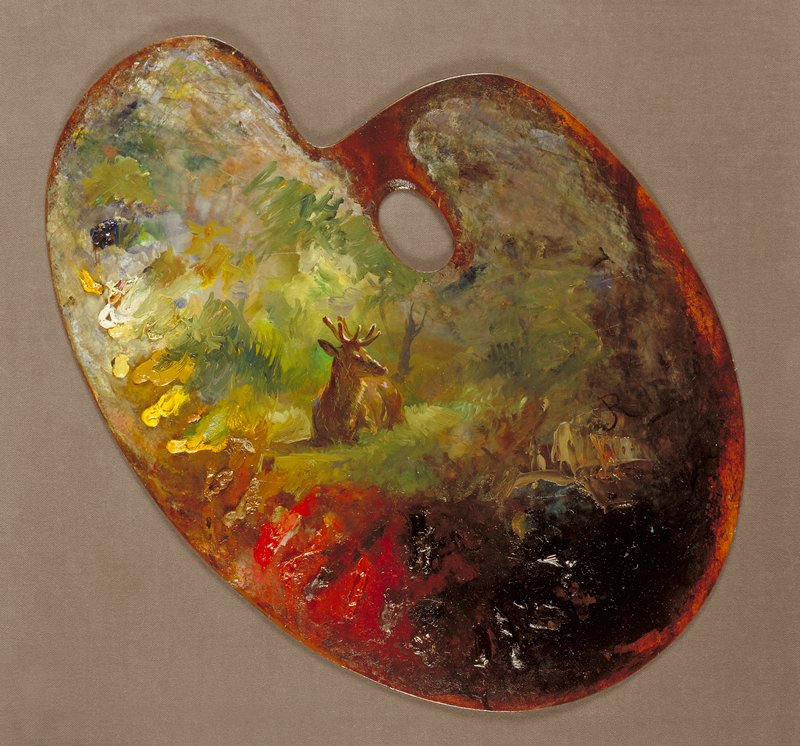
Palette
May one see it?
Not receiving at present

Minneapolis Institute of Art
Minneapolis, United States
It belongs to the collection, but is not on display at present.
- Checked
- In this state since
- Source
- The museum
About the painting
The French painter Rosa Bonheur specialized in pictures of animals, which were celebrated for their vivacity and realism. She achieved international fame and became the first woman admitted to the French Legion of Honor in 1865. She was also openly gay, making her path to success in a male-dominated profession that much more groundbreaking.
This was reportedly her personal painting palette for decades. When she completed a celebrated picture in 1855, her godson asked if he could have it. She quickly painted a deer in the forest on the palette's surface for him.
Minneapolis Institute of Art
Particulars
- Accession number
- 92.74
In the catalog
Sources
- Minneapolis Institute of Art
- Image: Minneapolis Institute of Art — public domain
Meanwhile, in the life of Rosa Bonheur
The whole life1848
First medal and a 3,000-franc state commission
Bonheur won a first medal for “Oxen and Bulls of the Cantal”, which brought her a 3,000-franc state commission — for “Ploughing in the Nivernais”.
1849
“Ploughing in the Nivernais” at the Salon
Painted for the government, the picture was shown at the Salon and won a First Medal — Bonheur's first major success (other sources give that honour to “The Horse Fair”).
March 1849
Death of her father, Raymond Bonheur
Her father died, and Rosa took his place as teacher at the free drawing school for girls. She often told her pupils: “Follow my advice, and I will make you Leonardos in skirts.”
1853
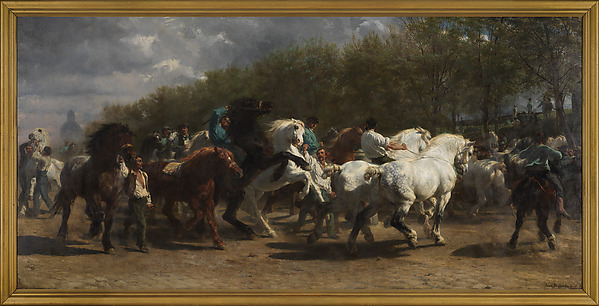
“The Horse Fair” at the Salon
Begun in 1851, the huge canvas (2.4 × 4.9 m) of the horse market on the boulevard de l'Hôpital sparked debate among critics and collectors at the Salon and brought Bonheur into the international art world; she herself refuted the Comte de Nieuwerkerke's hint that it was a state commission.
by 1855
Gambart buys “The Horse Fair” for 40,000 francs
Gambart took the painting to an exhibition of French art in England, where William Rossetti praised it and Queen Victoria had it brought to Buckingham Palace for a while; this dispelled doubts that Bonheur had painted it herself and paved the way for her success.
1859
Moves to the Château de By near Fontainebleau
Her success allowed Bonheur to settle at the Château de By, where she lived for the rest of her life; Jules Saulnier designed a large studio and an enclosure there for bulls, horses, mouflons, deer, boars and rams — her models.