 Utagawa HiroshigeJapanese, 1797–1858
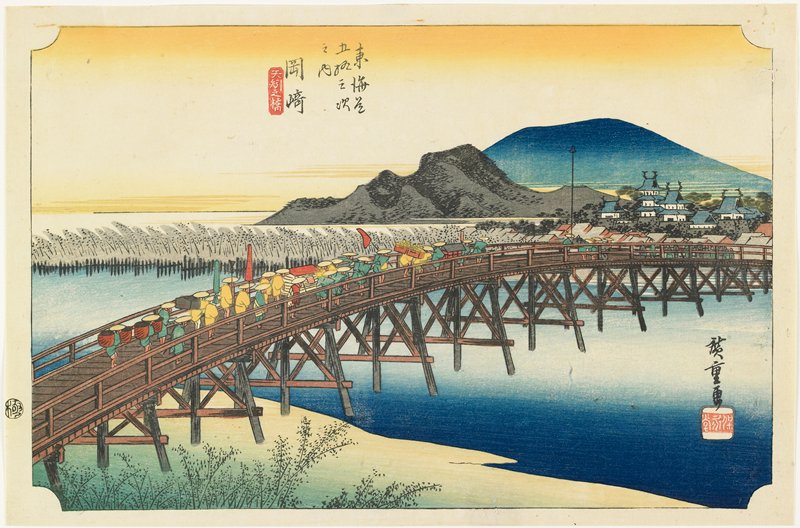
Okazaki--Yahagi Bridge
Can I see it?
Not on view at present
Where is “Okazaki--Yahagi Bridge” now? Collection: Minneapolis Institute of Art, Minneapolis. Not on view at present. Checked September 29, 2026.

Minneapolis, United States
It belongs to the collection, but is not on display at present.
- Checked
- In this state since
- Source
- The museum
About the work
Running along the Pacific coastline, the Tōkaidō road was interrupted by many rivers. But there were only a few bridges. This was partly because builders lacked the expertise to construct bridges that could withstand frequent floods. Another reason was that rivers were effective natural barriers. Fording a swift waterway would thwart enemy troops marching toward the government stronghold in Edo. Yahagi bridge, spanning some 1250 feet, was therefore exceptional, and no doubt astonishing to travelers.
Read on
This composition includes a view of Okazaki castle, the birthplace of Tokugawa Ieyasu, founder of the Tokugawa shogunate, which ruled Japan from 1603 until 1867. After Ieyasu’s death and deification, the castle was considered sacred, and only high-ranking lords with close connections to the Tokugawa family were appointed to occupy it. Perhaps that was why the government allowed the impressive bridge to be constructed. Hiroshige’s print shows a feudal lord’s procession making its way across the bridge en route to the castl
Minneapolis Institute of Art
Details
- Accession number
- 74.1.265
In the catalog
Sources
- Minneapolis Institute of Art
- Image: Minneapolis Institute of Art — public domain
In the life of Utagawa Hiroshige
The whole life1809–1832
Post: dōshin
1829–1830
The turn to landscape: “Eight Views of Ōmi”
Until then Hiroshige had worked in the usual ukiyo-e themes: book illustrations, beauties and kabuki actors. It was not until 1829–1830 that he began to produce the landscapes he is known for, such as the series “Eight Views of Ōmi”, and he also made an increasing number of bird and flower prints.
1832
Journey to Kyoto along the Tōkaidō
As a fire warden he was entitled to minor privileges reserved for low-ranking samurai, which is how he secured an invitation to join an official procession to Kyoto and travelled the Tōkaidō route linking the two capitals. He sketched the scenery along the way.
![Shinano Province, Moon Reflected in the Sarashina Paddy-fields, Mount Kyōdai (Shinano, Sarashina tagoto no tsuki, Kyōdaisan), from the series Famous Places in the Sixty-odd Provinces [of Japan] ([Dai Nihon] Rokujūyoshū meisho zue), Utagawa Hiroshige 歌川広重, Edo period, 1853 (Kaei 6, 8th month)](https://nrs.harvard.edu/urn-3:HUAM:CARP04802_dynmc/full/!2400,2400/0/default.jpg)