 Jean-Auguste-Dominique IngresFrench, 1780–1867
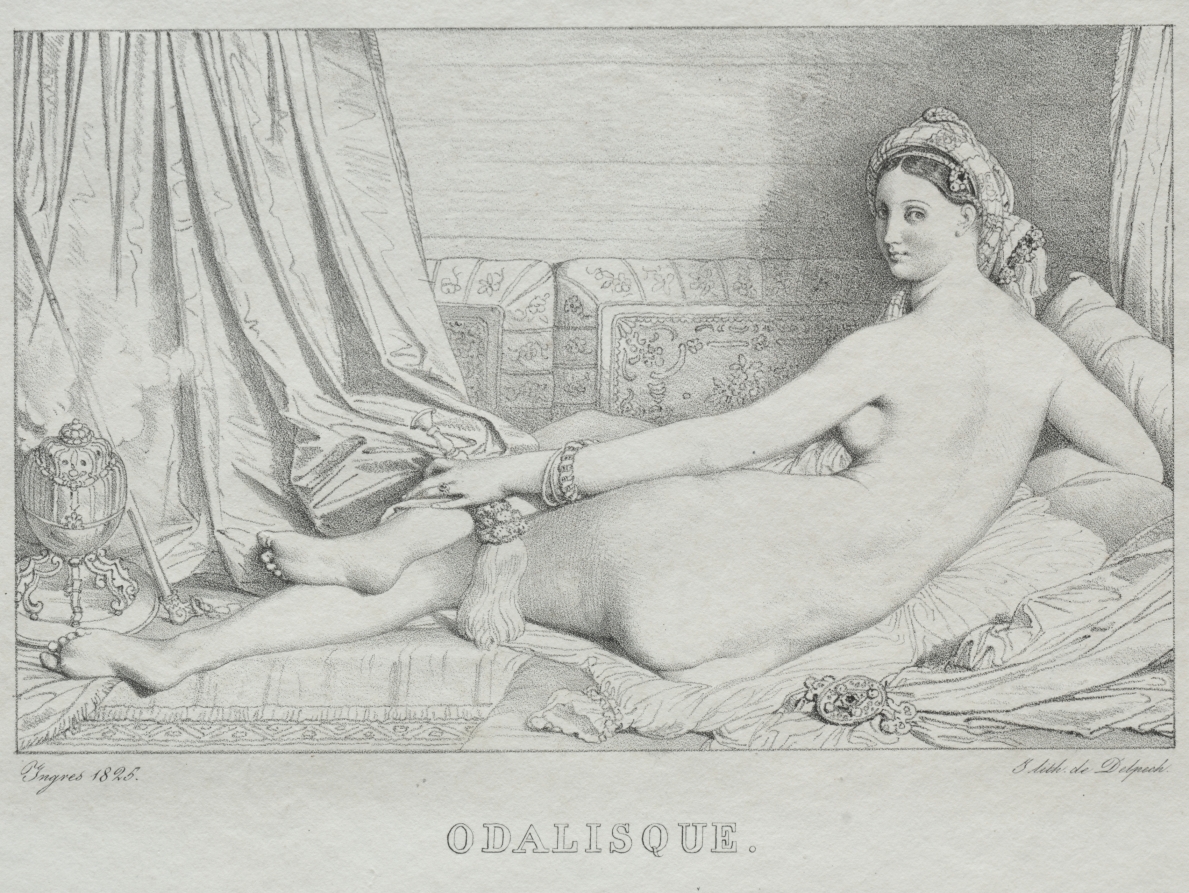
Odalisque
Can I see it?
Not on view at present
Where is “Odalisque” now? Collection: The Cleveland Museum of Art, Cleveland. Not on view at present. Checked September 29, 2026.

Cleveland, United States
It belongs to the collection, but is not on display at present.
- Checked
- In this state since
- Source
- The museum
About the work
Ingres executed this lithograph to reproduce and publicize an important picture that he had previously painted. However, the lithograph also represents experimentation with an unfamiliar medium, but the artist's assured draftsmanship makes the print successful.
The Cleveland Museum of Art
Details
- Accession number
- 1943.177
In the catalog
Sources
- The Cleveland Museum of Art
- Image: The Cleveland Museum of Art — Museum open access
In the life of Jean-Auguste-Dominique Ingres
The whole life1824
The start of the feud with Delacroix
The confrontation at the Salon of 1824 began Ingres's feud with Delacroix, who embodied the opposite aesthetic. Ingres called Delacroix his “anti-self” and used the administrative resources at his disposal to keep him out of the Institut de France.
12 November 1824
“The Vow of Louis XIII” at the Salon of 1824
Ingres showed the picture to which he had given four years at the Salon on 12 November 1824, alongside Delacroix's Massacre at Chios, and it was dubbed the “Salon of the Romantic battle”. Admirers and critics alike said the same of him: “the Raphael of our day” and “the best antidote to the Romantic threat”.
c. 1824 – 1825
His own drawing school in Paris
Soon after the Salon closed Ingres rented a studio on the rue des Marais-Saint-Germain and opened a school for young artists there; the first pupil was Amaury-Duval, and within a year as many as a hundred could attend. He called it the “School of Drawing”.
1827
The Salon of 1827: the “Apotheosis” against “Sardanapalus”
Unable to finish the Apotheosis of Homer, Ingres showed it in grisaille at the Salon of 1827, which became a confrontation between his Neoclassicism and a new manifesto of Romanticism, Delacroix's Death of Sardanapalus. Ingres joined the battle with enthusiasm, calling Delacroix “the apostle of ugliness”.