 Utagawa HiroshigeJapanese, 1797–1858
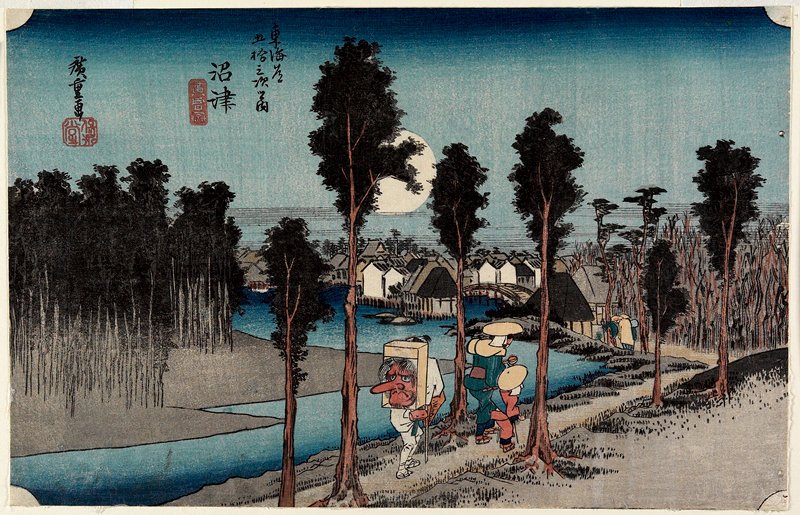
Numazu: Twilight Picture
Can I see it?
Not on view at present
Where is “Numazu: Twilight Picture” now? Collection: Minneapolis Institute of Art, Minneapolis. Not on view at present. Checked September 29, 2026.

Minneapolis, United States
It belongs to the collection, but is not on display at present.
- Checked
- In this state since
- Source
- The museum
About the work
This print illustrates travelers approaching the town of Numasu, near Mt. Fuji, just as the full moon rises on the horizon. One of the travelers is a pilgrim journeying to (or returning from) Kompira Shrine on Shikoku Island. The shrine is dedicated to the deity Omono-nushi-no-Mikoto, a patron saint of seafarers. The shrine is located high atop Mt. Kotohira, and hence was a popular destination of yamabushi, wandering priests who venerate mountains. In the popular imagination, yamabushi became associated with tengu, mythical birdlike creatures that live deep in mountain forests. Hence, this print shows a pilgrim dressed in white carrying a portable shrine on his back that has been adorned with a tengu mask, believed to offer talismanic protection.
Minneapolis Institute of Art
Details
- Accession number
- 17.205.13
In the catalog
Sources
- Minneapolis Institute of Art
- Image: Minneapolis Institute of Art — public domain
In the life of Utagawa Hiroshige
The whole life1809–1832
Post: dōshin
1829–1830
The turn to landscape: “Eight Views of Ōmi”
Until then Hiroshige had worked in the usual ukiyo-e themes: book illustrations, beauties and kabuki actors. It was not until 1829–1830 that he began to produce the landscapes he is known for, such as the series “Eight Views of Ōmi”, and he also made an increasing number of bird and flower prints.
1832
Journey to Kyoto along the Tōkaidō
As a fire warden he was entitled to minor privileges reserved for low-ranking samurai, which is how he secured an invitation to join an official procession to Kyoto and travelled the Tōkaidō route linking the two capitals. He sketched the scenery along the way.
![Shinano Province, Moon Reflected in the Sarashina Paddy-fields, Mount Kyōdai (Shinano, Sarashina tagoto no tsuki, Kyōdaisan), from the series Famous Places in the Sixty-odd Provinces [of Japan] ([Dai Nihon] Rokujūyoshū meisho zue), Utagawa Hiroshige 歌川広重, Edo period, 1853 (Kaei 6, 8th month)](https://nrs.harvard.edu/urn-3:HUAM:CARP04802_dynmc/full/!2400,2400/0/default.jpg)









