In 1966–1967 Smithson produces proposals for the Dallas–Fort Worth Regional Airport as concepts for “aerial art” — monumental-scale earthworks to be seen by air travellers. They were never realised.
1967
Explores the industrial areas of New Jersey
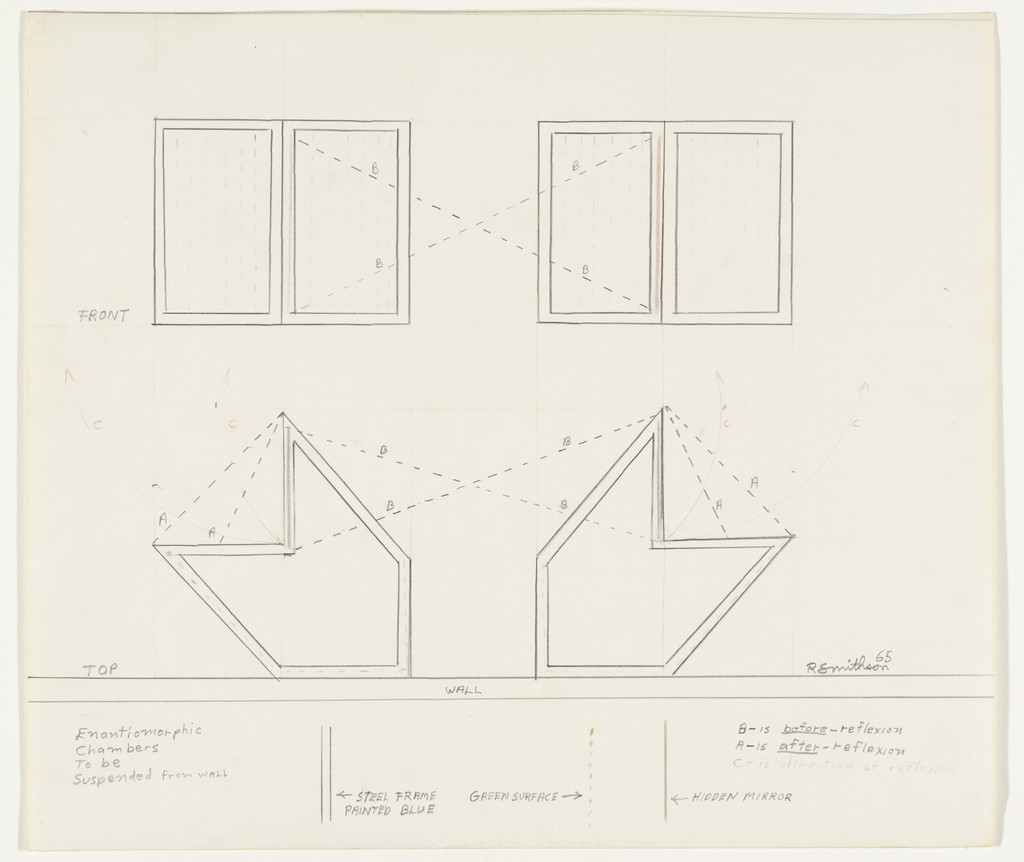
In 1967 Smithson begins exploring industrial areas around New Jersey: dump trucks excavating tons of earth and rock fascinate him, and in an essay he describes them as the equivalents of the monuments of antiquity. This gives rise to the series of “non-sites” — earth and rocks collected from a specific place are installed in the gallery as sculptures, often combined with mirrors or glass; he considers the best sites for “earth art” to be those disrupted by industry, reckless urbanization or nature’s own devastation.
1968
First trip to the American West
In 1968 Smithson visits the American West for the first time with Nancy Holt and Michael Heizer — to Virginia City, Nevada, and Lone Pine, California. Such journeys become central to his practice: his non-sites often include maps and aerial photographs of a place along with geological artifacts displaced from it.
September 1968
Essay “A Sedimentation of the Mind: Earth Projects”
In September 1968 Smithson publishes in Artforum an essay promoting the work of the first wave of land artists. He writes a great deal in general — theoretical and critical texts for Arts Magazine and Artforum, visual-text works such as “A Heap of Language”, and in the late 1960s his work also appears in the avant-garde magazine “0 to 9”; for a period he is better known as a critic than as an artist.
1969
Begins making land art
In 1969 Smithson starts producing land art pieces, developing concepts gained from his reading of William S. Burroughs, J. G. Ballard and George Kubler.
1969
Mirror travel in the Yucatán
In 1969 Smithson sets up a series of temporary mirror sculptures at various places on the Yucatán Peninsula; the photographs of “Mirror Displacements” illustrate his essay “Incidents of Mirror-Travel in the Yucatan” — part travelogue, part critical rumination, in which his interest in time as a cornerstone of his work is plain.


![Ginevra de' Benci [obverse], Leonardo da Vinci, c. 1474/1478](https://api.nga.gov/iiif/8f29e3c9-a289-4d53-abf0-31a66e9e98fa/full/!2400,2400/0/default.jpg)
![Wreath of Laurel, Palm, and Juniper with a Scroll inscribed Virtutem Forma Decorat [reverse], Leonardo da Vinci, c. 1474/1478](https://api.nga.gov/iiif/ff62e8d0-45c4-498f-ad36-6358de827e04/full/!2400,2400/0/default.jpg)


