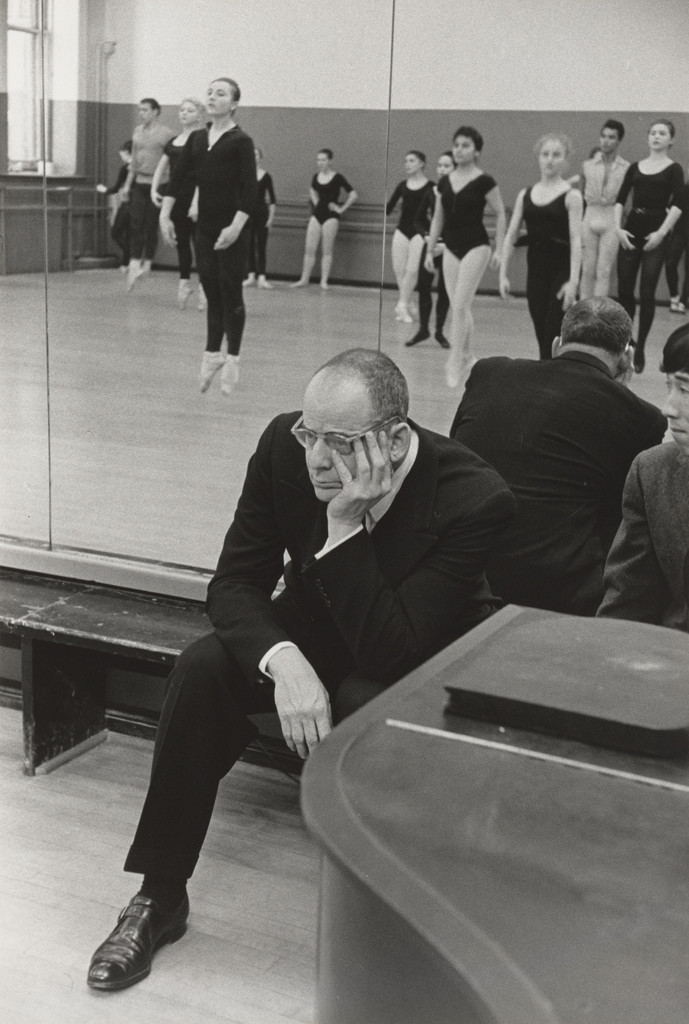
 Henri Cartier-BressonFrench, 1908–2004
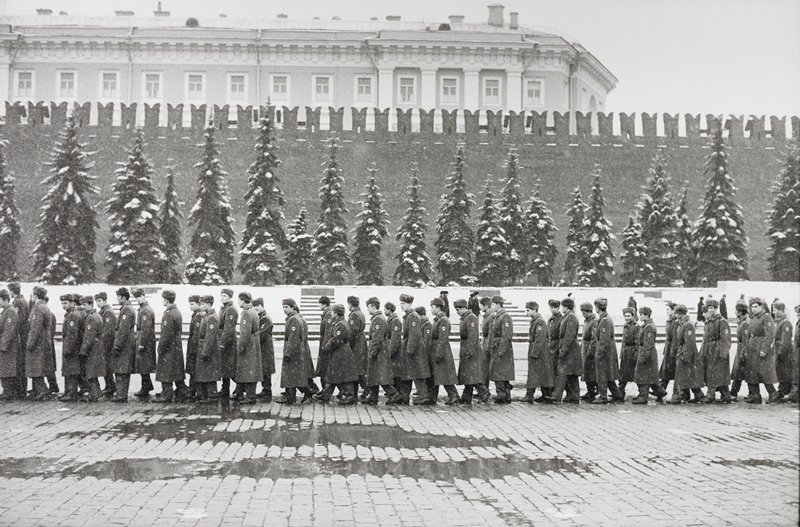
Moscow
Can I see it?
Not on view at present
Where is “Moscow” now? Collection: Minneapolis Institute of Art, Minneapolis. Not on view at present. Checked October 12, 2026.

Minneapolis, United States
It belongs to the collection, but is not on display at present.
- Checked
- In this state since
- Source
- The museum
Details
- Accession number
- 2007.35.275
In the catalog
Sources
- Minneapolis Institute of Art
- Image: Minneapolis Institute of Art — ©Henri Cartier-Bresson / Magnum Photos
In the life of Henri Cartier-Bresson
The whole life1929–1930
Harry Crosby gives him his first camera
His squadron commander put him under house arrest for hunting without a licence, and the American expatriate Harry Crosby, who had him released into his custody for a few days, gave him his first camera; they took and printed pictures at Crosby’s home, Le Moulin du Soleil, in Ermenonville.
1931–1932
Munkácsi’s photograph, a Leica and the choice of photography
Recovering in Marseille, he saw Martin Munkácsi’s photograph “Three Boys at Lake Tanganyika” and “suddenly understood that a photograph could fix eternity in an instant”; he gave up painting and bought a Leica with a 50 mm lens, darkening its shiny parts to stay unnoticed.
c. 1943
The third escape succeeds: a farm in Touraine
He twice tried to escape the camp and failed, and was punished with solitary confinement; the third attempt succeeded — he hid on a farm in Touraine and obtained false papers that let him travel in France.
early 1947
Magnum Photos is founded
In early 1947, with Robert Capa, David Seymour, William Vandivert and George Rodger, he founded Magnum — a cooperative picture agency owned by its members; he was assigned India and China, and later also travelled to Pakistan, Burma, Indonesia, Mexico, Japan, Cuba, Canada and the USSR.
1952
The book “The Decisive Moment”
His book “Images à la sauvette” was published, titled “The Decisive Moment” in English: 126 photographs from East and West, a cover drawn by Henri Matisse and a 4,500-word philosophical preface taking as its keynote Cardinal de Retz: “There is nothing in this world that does not have a decisive moment”.
1968
Turning away from photography, back to drawing
In 1968 he began to turn away from photography and return to his passion for drawing and painting; he admitted that perhaps he had said all he could through photography.