Ivan Aivazovsky1817–1900
Море
Can I see it?
Unknown
Where is “Море” now? Collection: Yaroslavl Art Museum, Yaroslavl. Unknown.
Yaroslavl, Russia
The owner is known; whether it is on view today is not.
- In this state since
- Source
- The museum
About the painting
Museum text in Russian
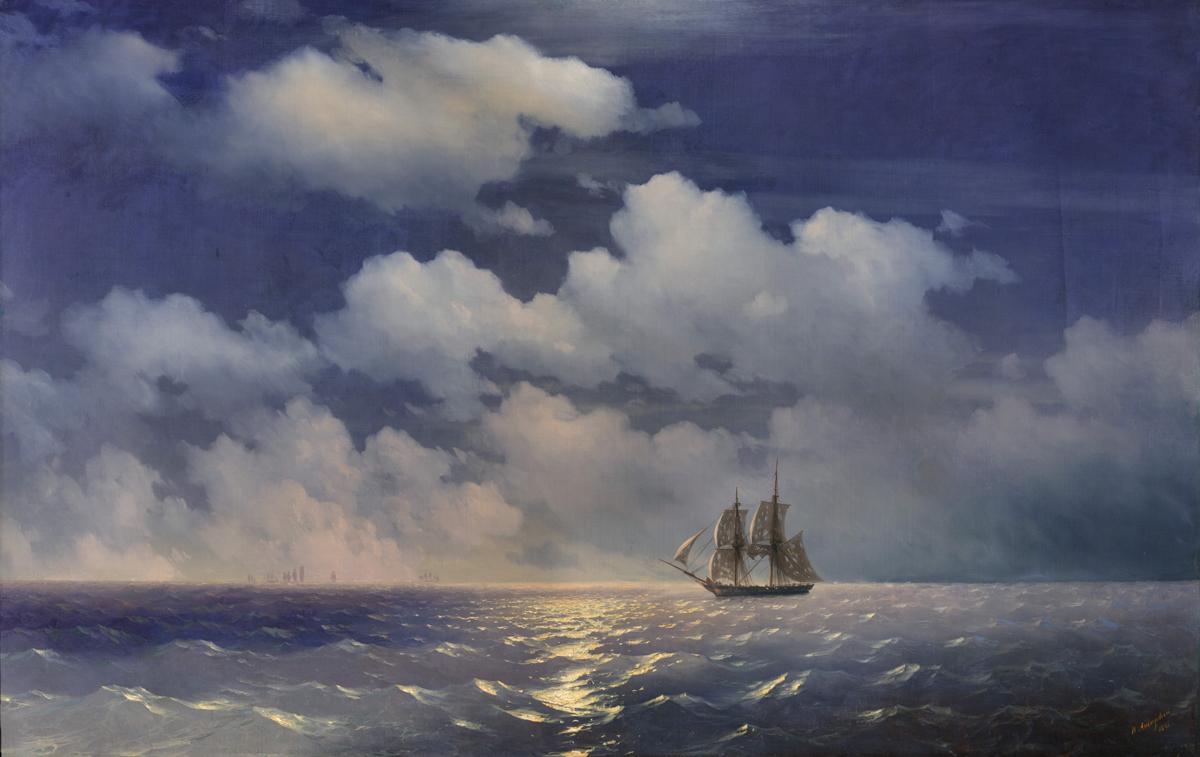
Морской пейзаж, слева по диагонали песчаный берег, к берегу плывет шлюпка с гребцами, правее в центре трехмачтовый корабль. Небо голубое. Подписи, надписи: Слева внизу подпись: Айваз 1872 На обороте вверху ярлык с надписью галловыми чернилами: 72.
Yaroslavl Art Museum
Details
- Accession number
- Ж-128
In the catalog
Sources
- The State Catalogue of the Museum Fund of Russia
- Image: Yaroslavl Art Museum — © Ярославский художественный музей · Госкаталог музейного фонда РФ
In the life of Ivan Aivazovsky
The whole life1860–1877
Separation from Julia Graves and divorce
After twelve years of marriage his wife leaves Aivazovsky; the marriage is dissolved only in 1877, with the Armenian Church's permission, since Graves was a Lutheran. The cause of the divorce is given as Aivazovsky's systematic physical abuse of his wife.
1871
The museum of antiquities on Mount Mithridates
In 1871 Aivazovsky takes up the building of a new museum of antiquities for Feodosia on Mount Mithridates, modelled on an ancient Greek temple of the Doric order (at his own expense and to his own design, with a memorial to P. S. Kotlyarevsky).
1874
A commission from Sultan Abdülaziz
In 1874 Aivazovsky makes his third trip to Constantinople. Sultan Abdülaziz, to whom Sarkis Bey Balyan had given one of his paintings, liked it so much that he ordered ten canvases of views of the city and the Bosphorus; while working on the commission the painter was constantly at the palace, befriended the sultan and painted about thirty pictures.
1874–1876
Self-portraits for the Uffizi and the Palazzo Pitti
In 1874 the Florence Academy of Fine Arts asks Aivazovsky for a self-portrait to hang in the Uffizi (a show of his work is held in Florence the same year); in 1876 he is made a member of the academy and becomes the second Russian artist, after Orest Kiprensky, to paint a self-portrait for the Palazzo Pitti.