 Utagawa HiroshigeJapanese, 1797–1858
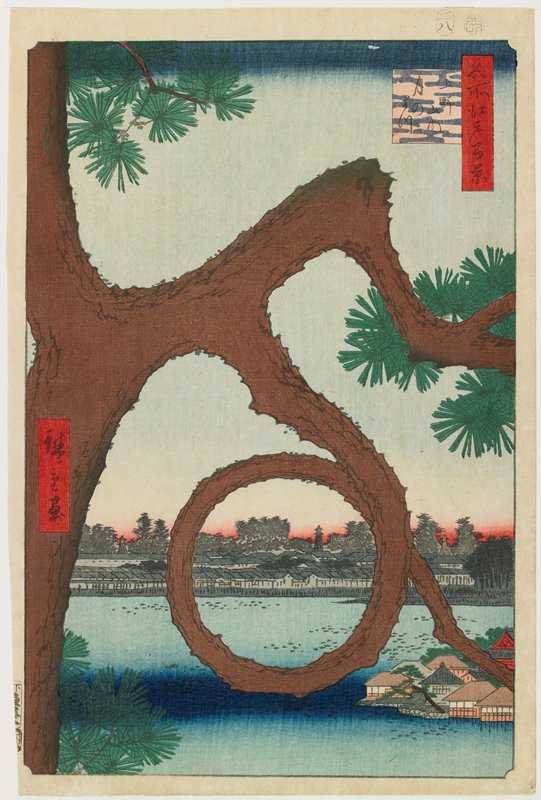
Moon Pine in Ueno Park
Can I see it?
Not on view at present
Where is “Moon Pine in Ueno Park” now? Collection: Minneapolis Institute of Art, Minneapolis. Not on view at present. Checked September 29, 2026.

Minneapolis, United States
It belongs to the collection, but is not on display at present.
- Checked
- In this state since
- Source
- The museum
About the work
One of the most iconic close-up views of this series is the so-called Moon Pine (Tsuki no matsu), which had a branch that was trained, bonsai-like, to grow in the form of a circle. The pine was located outside the Kiyomizu Hall on Mount Tōei (Tōeizan), part of the Kan’eiji Temple complex in what is today Tokyo’s Ueno Park. The circular branch works almost like a telescope to frame the samurai residences in the Hongō district, in the far distance, across Shinobazu Pond.
Moon Pine fell victim to a typhoon in the early Meiji era (1868–1912), but in 2011 a new tree with a similar circular branch was planted in the same spot.
Minneapolis Institute of Art
Details
- Accession number
- 96.146.194
In the catalog
Sources
- Minneapolis Institute of Art
- Image: Minneapolis Institute of Art — public domain
In the life of Utagawa Hiroshige
The whole life1856
He becomes a Buddhist monk
In 1856 Hiroshige “retired from the world”, becoming a Buddhist monk; this was the year he began his “One Hundred Famous Views of Edo”.
1856
Luxury editions with the publisher Uoya Eikichi
Working with the publisher Uoya Eikichi, Hiroshige created a series of luxury edition prints using the finest printing techniques: true gradation of color, mica for an iridescent effect, embossing, fabric printing, blind printing and glue printing.
1856–1858
One Hundred Views of Edo: a priest pays up front
His great “One Hundred Famous Views of Edo” was paid for up front by a wealthy Buddhist priest in love with the daughter of the publisher Uoya Eikichi, a former fishmonger. Hiroshige was usually poorly paid per series, yet he remained capable of remarkable art when the conditions were right.
1858
The cholera epidemic in Edo
Hiroshige died aged 62 during the great Edo cholera epidemic of 1858; whether the epidemic killed him is unknown.
1858
A farewell poem and a will that settles his debts
Just before his death Hiroshige left a farewell poem. He was never wealthy: his income amounted to about twice a day labourer's wages, and his will left instructions for the payment of his debts.
12 October 1858
Died
![Shinano Province, Moon Reflected in the Sarashina Paddy-fields, Mount Kyōdai (Shinano, Sarashina tagoto no tsuki, Kyōdaisan), from the series Famous Places in the Sixty-odd Provinces [of Japan] ([Dai Nihon] Rokujūyoshū meisho zue), Utagawa Hiroshige 歌川広重, Edo period, 1853 (Kaei 6, 8th month)](https://nrs.harvard.edu/urn-3:HUAM:CARP04802_dynmc/full/!2400,2400/0/default.jpg)









