 Lourens Alma TademaDutch, 1836–1912
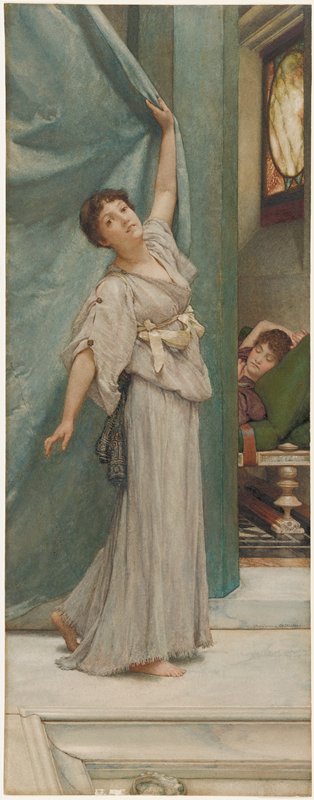
Midday Slumbers
Can I see it?
Not on view at present
Where is “Midday Slumbers” now? Collection: Minneapolis Institute of Art, Minneapolis. Not on view at present. Checked October 12, 2026.

Minneapolis, United States
It belongs to the collection, but is not on display at present.
- Checked
- In this state since
- Source
- The museum
About the work
Lawrence Alma-Tadema achieved spectacular success in England producing dreamy, mildly erotic paintings of languorous Victorian beauties in gorgeously appointed antique spaces—Roman baths and markets, colonnaded Grecian terraces, Egyptian houses. His house in London was almost as renowned as his paintings. Reports describe classically inspired architecture, ornament, and mosaics, all designed by the artist himself. Paintings and house alike were informed by a deep knowledge of and fervent fascination with antiquity.
Read on
Alma-Tadema’s compositions present distant worlds with startling immediacy. Strong vertical elements here tightly crop the space, giving the viewer a sense of privileged intimacy in this glimpse of a woman indulging in a midday nap in a private back room of a house. An excellent colorist, Alma-Tadema was adept at representing the subtle effects of light and shadow in watercolor. Note, for instance, how the warm, diffuse afternoon light coming through the onyx windowpane contrasts with the dark shadows on the cold marble floor.
Minneapolis Institute of Art
Details
- Accession number
- 75.51
In the catalog
Sources
- Minneapolis Institute of Art
- Image: Minneapolis Institute of Art — public domain
In the life of Lourens Alma Tadema
The whole life1883–1886
The Tissot house in St John's Wood: a £70,000 rebuilding
In 1883 he bought a house that had belonged to Jacques Tissot and radically rebuilt it to his own design: the work took the middle of the 1880s and cost £70,000, and he began to live there in 1886. The house had 66 rooms, three studios — his, Laura's and his daughter Anna's — collections of Japanese and Chinese art and of Greco-Roman antiquities, an entrance modelled on Pompeian porticoes, and an inscription “Ars longa, vita brevis” in the apse of the studio.
after 1886
The musical salon: Joachim, Paderewski, Caruso
After the rebuilding was finished the house became above all a musical centre of London: a passionate music lover, Alma-Tadema was friends with many instrumentalists, singers and actors, who also served as his models. Regular visitors included the violinist Joseph Joachim, the composer Ignacy Paderewski, Enrico Caruso and Eleonora Duse, and a close friend was the Dutch violinist Maurice Sons.
1889
“The Dedication to Bacchus” sold for £5,880
Shown at the Academy exhibition, the painting turned a bacchanal into a decorous festival with women and children and was sold at once for £5,880 — the highest price for an Alma-Tadema picture sold in Britain in his lifetime.









