 Albrecht DürerGerman, 1471–1528
Melencolia I
Can I see it?
Not on view at present
Where is “Melencolia I” now? Collection: Minneapolis Institute of Art, Minneapolis. Not on view at present. Checked September 29, 2026.

Minneapolis, United States
It belongs to the collection, but is not on display at present.
- Checked
- In this state since
- Source
- The museum
About the work
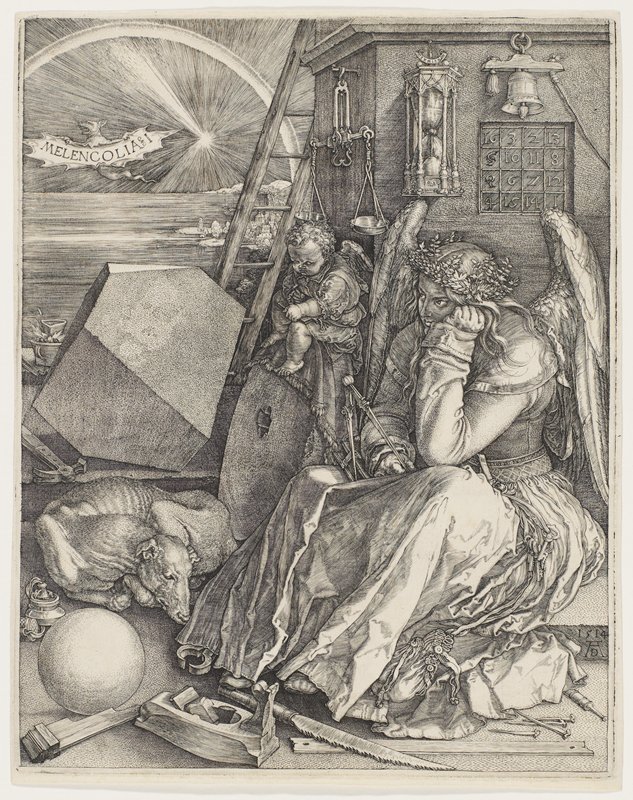
By any measure, Melencolia I is an arresting image. A magnificent, laurel-crowned angel sits brooding in the foreground. In its hand and strewn about are the tools and materials of physical creation—from hammer and nails to an alchemical crucible (vessel). Sitting on a millstone is a putto, scribbling away on a tablet. Models of ideal geometric forms, such as a sphere and a polyhedron, occupy the left side of the image, along with a sleeping dog. To the right we face the base of a windowless building, perhaps a tower. From it hang a weighing scale, an hourglass, and a bell whose pull-cord extends out of the image. A magic square is carved into the wall, and a ladder leans against the far side of the structure. In the background we see to a distant horizon. In the sky are a rainbow and a comet. A bat-like creature flies through the sky holding a banner reading MELENCOLIA I.
Read on
Little was written about Dürer’s engraving originally, but over time it became one of the most frequently discussed images in the history of art. In 1568, the pioneering art historian Giorgio Vasari wrote:
Then, having grown both in power and courage, as he saw that his works were prized, Albrecht executed some copper engravings that astonished the world. He also set himself to making an engraving, for printing on a half sheet of paper, of a figure of Melancholy, with all the instruments that reduce those who use them, or rather, all mankind, to a melancholy humor; and in this he succeeded so well that it would not be possible to do more delicate engraving with the burin.
We may never know the engraving’s full meaning, but we can be certain that it touches upon many of Dürer’s central interests: the role of the artist as creator; the relationships among the physical, intellectual, and spiritual realms; the study of the natural world; mathematics; esoteric knowledge; and self-awareness.
In essence, the engraving became a manifesto on knowing the unknowable and making the unmakeable.
Minneapolis Institute of Art
Details
- Accession number
- 2012.16
In the catalog
Sources
- Minneapolis Institute of Art
- Image: Minneapolis Institute of Art — public domain
In the life of Albrecht Dürer
The whole life1507–1528 · Workplace
Nuremberg
1512
Emperor Maximilian I becomes his chief patron
From 1512 Emperor Maximilian I was Dürer's chief patron. For him Dürer and his workshop produced the Triumphal Arch, a giant woodcut 295 × 357 cm printed from 192 blocks and modelled on the triumphal arches of ancient Rome.
3 January 1512
Nuremberg's privilege against forgeries
Nuremberg's city council granted Dürer a privilege for the sale of his prints, with penalties for anyone who forged them.
1513–1516
Three years without painting
Complaining that painting did not pay enough to justify the time compared with his prints, Dürer produced no paintings from 1513 to 1516.
1514
Death of his mother
In the year of Melencolia I and St Jerome in His Study, the artist's mother, Barbara Holper, died.
1515
A life pension from the emperor
The perpetually cash-strapped Maximilian could not pay on time and offered to exempt the artist from city taxes, which the Nuremberg Council opposed. At Dürer's request the emperor granted him a life pension of 100 guilders a year from the sums Nuremberg paid into the imperial treasury.
![Madonna and Child [obverse], Albrecht Dürer, c. 1496/1499](https://api.nga.gov/iiif/878db7e6-10ae-4cae-ba5d-6d6f5c413ae8/full/!2400,2400/0/default.jpg)
![Lot and His Daughters [reverse], Albrecht Dürer, c. 1496/1499](https://api.nga.gov/iiif/7565a449-f82a-414b-9bda-c93f55a51b4d/full/!2400,2400/0/default.jpg)