ART WIKI32,963 on view
MapCollectionArtistsMuseumsExhibitionsJournal
Sign in

ART WIKI

Where the masterpiece hangs, and when they let you in.

Collections: Art Institute of Chicago, Getty Villa, Harvard Art Museums, Hirshhorn Museum and Sculpture Garden, J. Paul Getty Museum, Minneapolis Institute of Art, Musée du Louvre, National Gallery of Art, National Museum of Asian Art, National Portrait Gallery (Smithsonian), Pushkin State Museum of Fine Arts, Rijksmuseum, Smithsonian American Art Museum, SMK — National Gallery of Denmark, State Hermitage Museum, State Russian Museum, The Cleveland Museum of Art, The Metropolitan Museum of Art, The Museum of Modern Art, Tretyakov Gallery, Victoria and Albert Museum, Whitney Museum of American Art, State Catalogue of the Museum Fund of Russia (274 museums), Europeana (19 museums), Wikidata (6 museums), Paris Musées (12 museums), and Joconde, the French Ministry of Culture's museum database (495 museums). Images belong to their rights holders.

Sections

  • Map
  • Search
  • Collection
  • Masterpieces
  • On view now
  • Artists

More

  • Museums & galleries
  • Exhibitions
  • Journal
  • Where the data comes from
  • Privacy & cookies
HomeMapBrowse
  1. Collection/
  2. Art Institute of Chicago/
  3. Last Day
Last Day, George Grosz, 1934
Grosz, George, portraitGrosz, GeorgeGerman, 1893–1959

Last Day

1934 · Drawing and Watercolor

May one see it?

Not receiving at present

Art Institute of Chicago

Chicago, United States

It belongs to the collection, but is not on display at present.

Checked
3 days ago
In this state since
Aug 19, 2026
Source
The museum
On the mapMuseum page

About the work

Grosz left Germany only eighteen days before Hitler seized power in January 1933. Because of his relentless political satire and criticism of the state, he would undoubtedly have been the target of persecution and execution by the new Nazi regime. Between 1933, when he arrived in New York, and 1936, he worked on a series of watercolors representing his first impressions of the me­tropolis. The Last Day does seem to be based on the Manhattan skyline, but Grosz's treahnent of it is more a fore­shadowing of his apocalyptic paintings of the late 1930s. Grosz mounted an exhibition of his watercolors at Alfred Stieglitz's An American Place gallery in 1934-35.

Art Institute of Chicago · CC BY 4.0

Particulars

1934 · aged 41
18931959
Accession number
1970.118

In the catalog

Drawings & watercolorsWatercolourModernism20th centuryUnited States

Sources

  • Art Institute of Chicago
  • Image: Art Institute of Chicago — © the artist or rights holder

Meanwhile, in the life of Grosz, George

The whole life
  1. 1928–1933 · Residence

    Wilmersdorf

  2. June 1932

    An invitation to teach in New York

    Bitterly anti-Nazi, Grosz accepts an invitation to teach the summer semester at the Art Students League of New York; in October 1932 he returns to Germany.

  3. 1933

    A break with the past: a new style and subjects

    In America Grosz resolves to make a clean break with his past and changes his style and subject matter: in place of his corrosive vision of the city he paints conventional nudes and many landscape watercolours. In his autobiography he writes that much that had frozen within him in Germany melted in America and that he deliberately destroyed a part of his past.

  4. 12 – 23 January 1933

    Emigration to the United States

    On 12 January 1933 Grosz and his family emigrate to the United States; their ship docks in New York on 23 January, a week before Hitler comes to power in Berlin.

  5. 1933–1945

    His work is classed as “degenerate art”

    In Nazi Germany Grosz's work is classed as 'degenerate art'.

  6. 1933–1955

    Teaching at the Art Students League

    Grosz teaches at the Art Students League of New York until 1955; his students include Romare Bearden, who was influenced by his collage style, Joseph Glasco and Robert Cenedella, whom he mentored from 1957 to 1959.
More by Grosz, George

All works
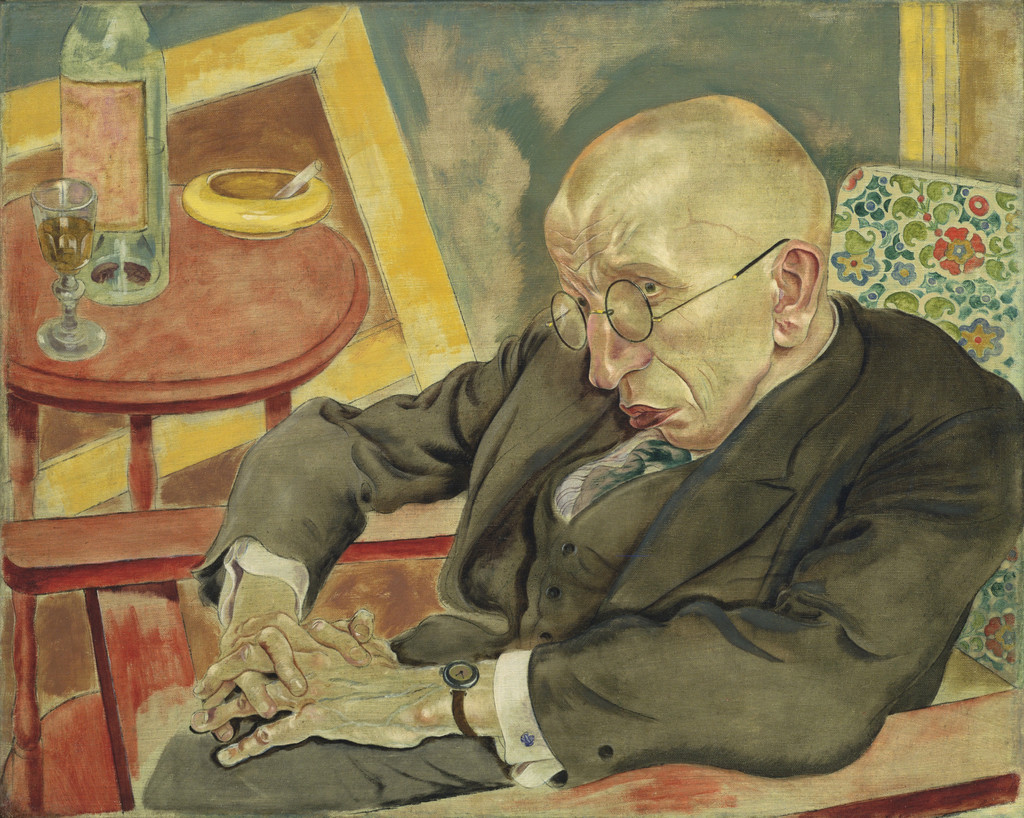
The Poet Max Herrmann-Neisse, George Grosz, 1927

The Poet Max Herrmann-Neisse

1927 · The Museum of Modern Art

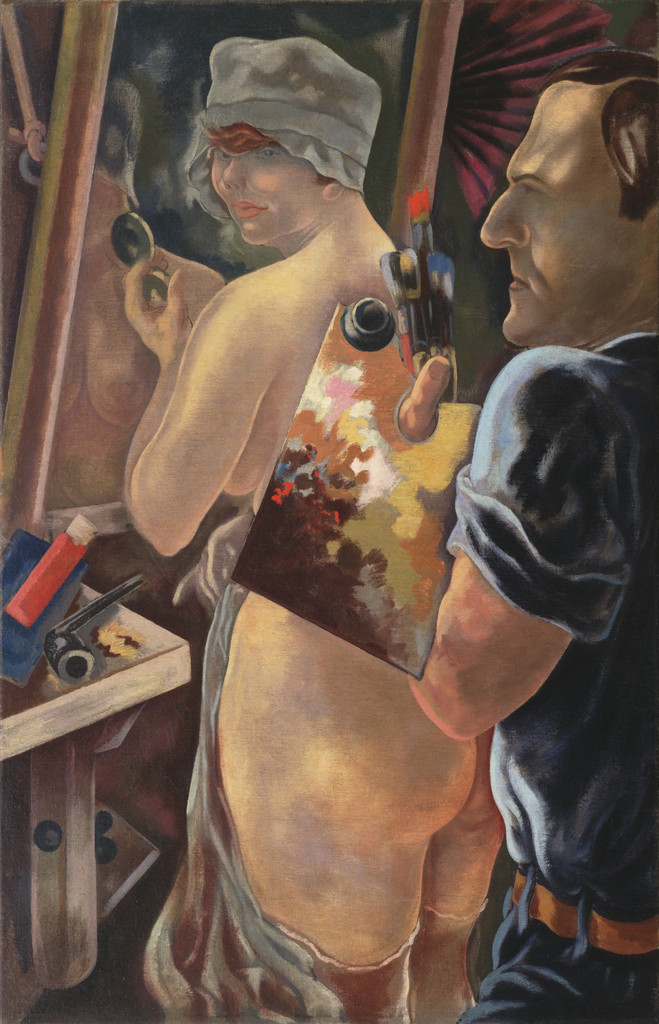
Self-Portrait with a Model, George Grosz, 1928

Self-Portrait with a Model

1928 · The Museum of Modern Art

A Woman Walking to the Left, George Grosz

A Woman Walking to the Left

Not on view · National Gallery of Art

In The Drawing Room [The Art Critics], George Grosz, late 1920s

In The Drawing Room [The Art Critics]

late 1920s · Not on view · National Gallery of Art

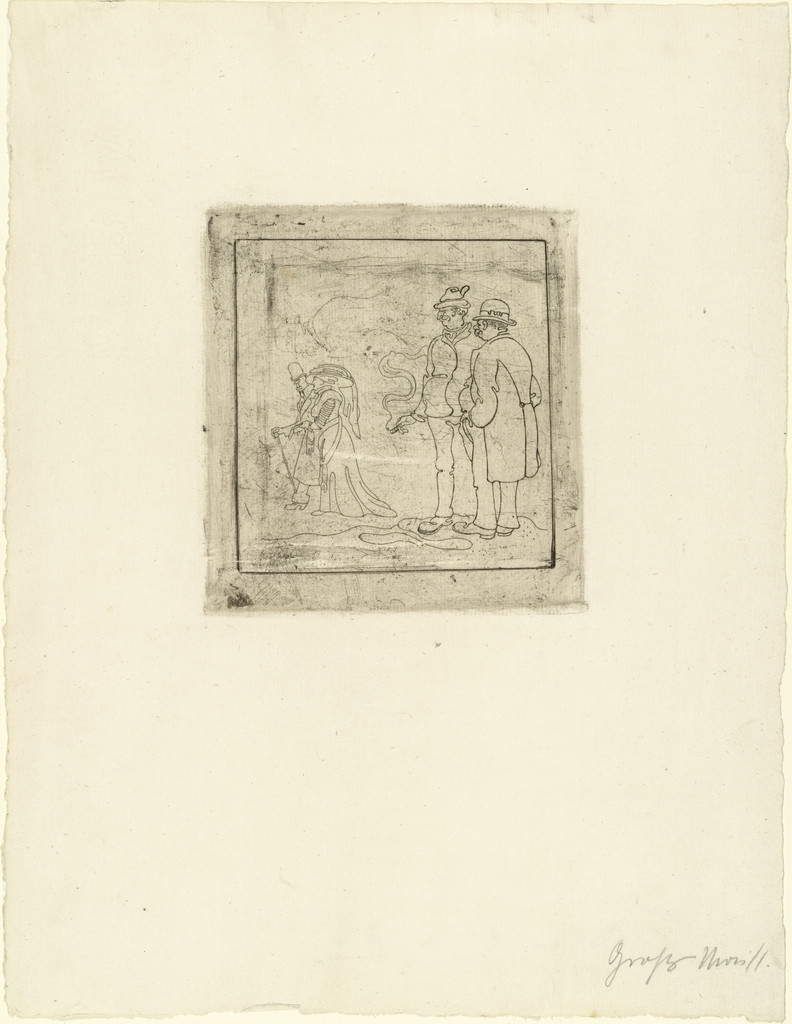
Two Men Watching a Couple (Zwei Männer in Betrachtung eines Paares), George Grosz, 1911

Two Men Watching a Couple (Zwei Männer in Betrachtung eines Paares)

1911 · Not on view · The Museum of Modern Art

Studies of a Male Nude, George Grosz, 1912

Studies of a Male Nude

1912 · Not on view · National Gallery of Art

The End of the Road (Out of Fear of Starvation) [Das Ende des Weges (Aus Nahrungssorgen)], George Grosz, 1913

The End of the Road (Out of Fear of Starvation) [Das Ende des Weges (Aus Nahrungssorgen)]

1913 · Not on view · The Museum of Modern Art

The Spider (Die Spinne), George Grosz, 1914

The Spider (Die Spinne)

1914 · Not on view · National Gallery of Art

Neighbors at Art Institute of Chicago

Museum page
The Bedroom, Vincent van Gogh, 1889

Vincent van Gogh

The Bedroom, 1889

A Sunday on La Grande Jatte — 1884, Georges Seurat, 1884–86, border added 1888–89

Georges Seurat

A Sunday Afternoon on the Island of La Grande Jatte, 1884–86, border added 1888–89

Paris Street; Rainy Day, Gustave Caillebotte, 1877

Gustave Caillebotte

Paris Street; Rainy Day, 1877

Two Sisters (On the Terrace), Pierre-Auguste Renoir, 1881

Pierre-Auguste Renoir

Two Sisters (On the Terrace), 1881

The Basket of Apples, Paul Cézanne, c. 1893

Paul Cézanne

The Basket of Apples, c. 1893

Stacks of Wheat (End of Summer), Claude Monet, 1890–91

Claude Monet

Stacks of Wheat (End of Summer), 1890–91

American Gothic, Grant Wood, 1930

Grant Wood

American Gothic, 1930

Nighthawks, Edward Hopper, 1942

Edward Hopper

Nighthawks, 1942