 Pietro PeruginoItalian, 1448–1523
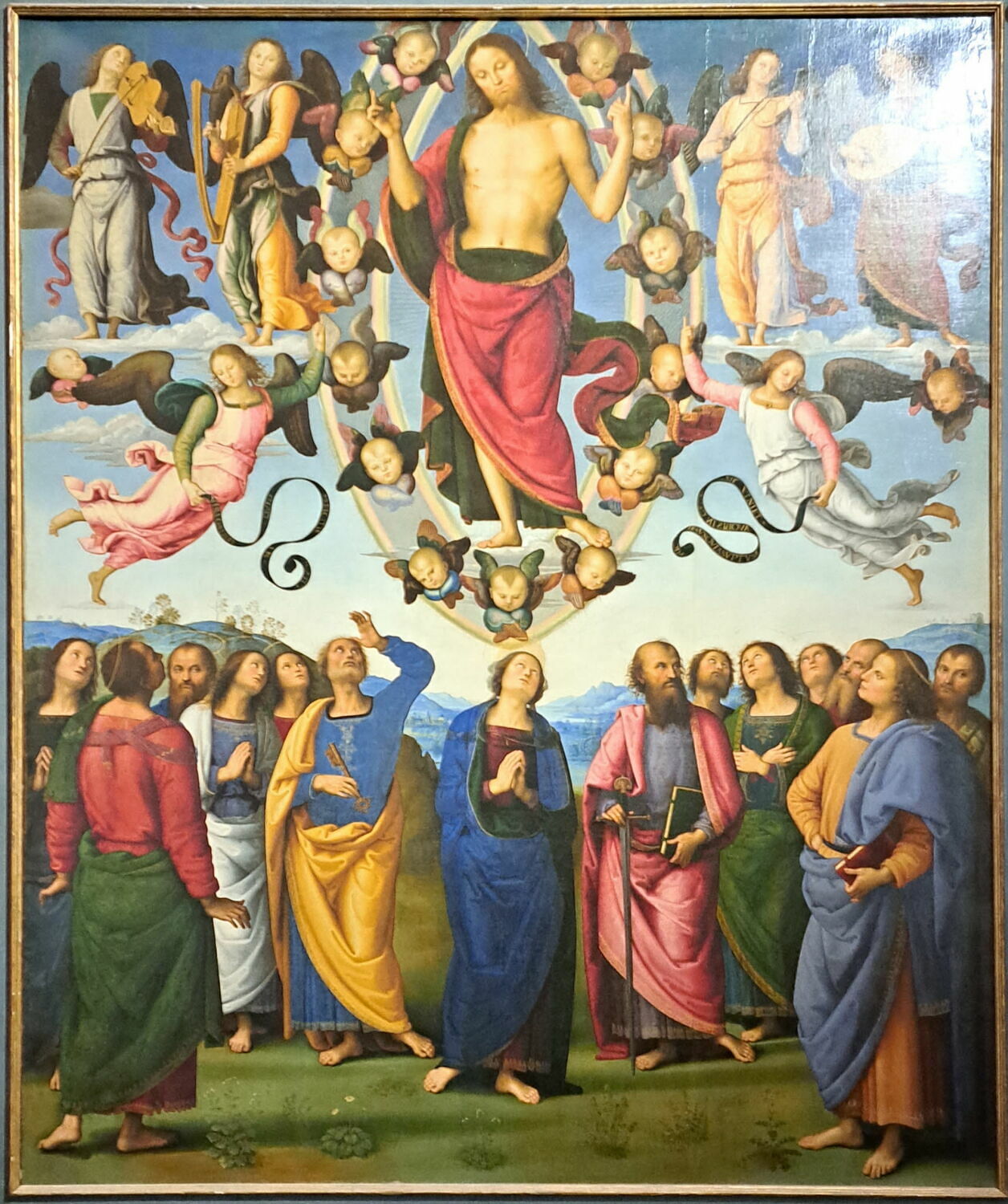
L'Ascension du Christ
May one see it?
Unknown

Paris, France
The owner is known; whether it is on view today is not.
- In this state since
- Source
- The museum
About the painting
Ascension of Christ is a c. 1496–1499 oil painting by Pietro Perugino, now in the musée des Beaux-Arts de Lyon. It was the prototype for his Sansepolcro Altarpiece. it has dimensions of 325 centimeters in height and 265 in width.
Particulars
- Accession number
- A 134
In the catalog
Sources
- Musée du Louvre
- Image: Musée du Louvre — © 2023 Musée du Louvre / Département des Peintures
Meanwhile, in the life of Pietro Perugino
The whole life1448
Born
c. 1470
Verrocchio's apprentice in Florence
Around 1470 (the date of his first stay in Florence is disputed) Perugino comes to the city and, according to Vasari, is apprenticed in the workshop of Andrea del Verrocchio alongside Leonardo da Vinci, Domenico Ghirlandaio, Lorenzo di Credi and Filippino Lippi; Piero della Francesca is thought to have taught him perspective. Together with the young Florentine artists he is among the first to take up oil painting, borrowed from the Flemish and still unknown in Umbria.
1472
Enrolled as a master in the Confraternity of St Luke
Perugino appears to have completed his apprenticeship: in 1472 he is enrolled as a master in the Confraternity of Painters of St Luke.
c. 1481
Summoned to Rome to paint the Sistine Chapel
Already a renowned master, Perugino is invited by Pope Sixtus IV to Rome, among the best artists of Italy — Botticelli, Ghirlandaio, Cosimo Rosselli, Luca Signorelli and others — to take part in painting the Sistine Chapel.
1486–1499
Two studios: in Florence and in Perugia
Between 1486 and 1499 Perugino works mainly between Florence and Perugia, maintaining a studio in each city. In the 1480s and 1490s he is one of the most celebrated artists of Italy.
1496
The money-changers' guild commissions the Cambio hall
The money-changers' guild of Perugia asks Perugino to decorate the Sala delle Udienze of the Collegio del Cambio, with the humanist scholar Francesco Maturanzio as consultant. The scheme — a vault with the seven planets and the signs of the zodiac, and sacred subjects on the walls — may have been finished by 1500; on the mid-pilaster Perugino placed his own bust-form portrait.