 William SimpsonBritish, 1823–1899
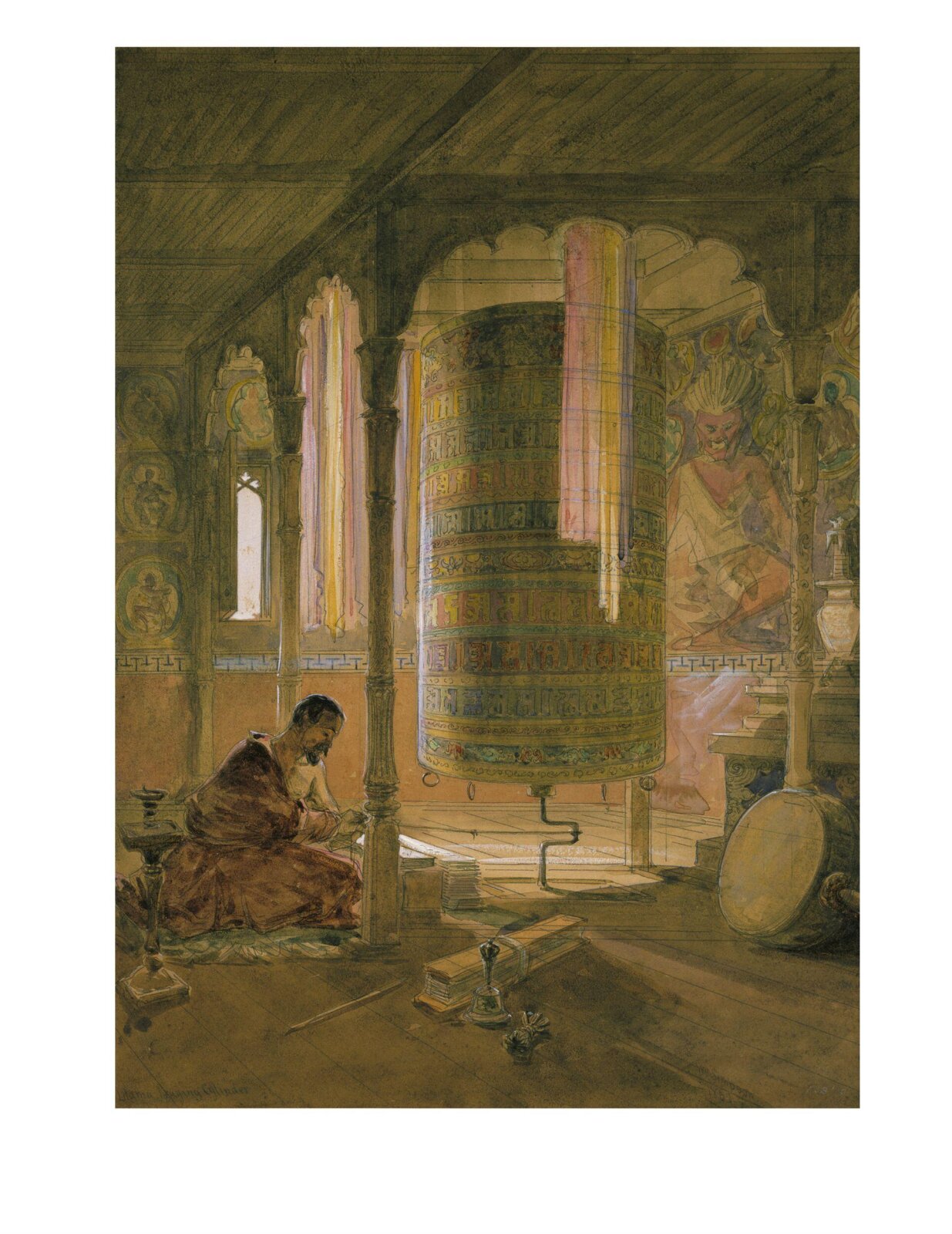
Lama Praying Cylinder
May one see it?
Not receiving at present

London, United Kingdom
It belongs to the collection, but is not on display at present.
- Checked
- In this state since
- Source
- The museum
About the painting
William Simpson (1823 - 1899) was a distinguished watercolourist and war artist. Having established his reputation by documenting the Crimean war in 1854, Day and Sons, the London lithography firm, commissioned him to sketch well-known sites in and around Delhi associated with the Revolt of 1857 by Indians against the rule of the British East India Company.
Simpson arrived in Calcutta (Kolkata) in 1859 and travelled widely. His rapid pencil drawings formed the preparatory studies for his finished watercolours done after his return to London in 1862. His detailed journal, sketches and pictures from India resulted in these highly coloured, evocative, and romantic interpretations of the landscape and architecture.
Read on
Simpson reimagined this painting from a sketch he made when he visited a monastery in 1861. In his book, the Buddhist praying-wheel (published in 1896), Simpson notes ‘The place was a monastery, and I had some trouble in finding my way in, but at last I gained admittance, and made a sketch of the room, including the cylinder and the monk. The cylinder might be about nine feet in height and four feet in diameter, with an iron spindle at each end; on the lower one there was a crank to which a string was attached, and by simply pulling this the machine went slowly round. It was gaudily painted with many bright colours, in which ornaments and Tibetan letters formed the designs; the walls of the room were also decorated with paintings of Buddhist figures.’
Victoria and Albert Museum
Particulars
- Accession number
- 1158-1869
In the catalog
Sources
- Victoria and Albert Museum
- Image: Victoria and Albert Museum — © Victoria and Albert Museum, London