 Margaret Bourke-WhiteAmerican, 1904–1971
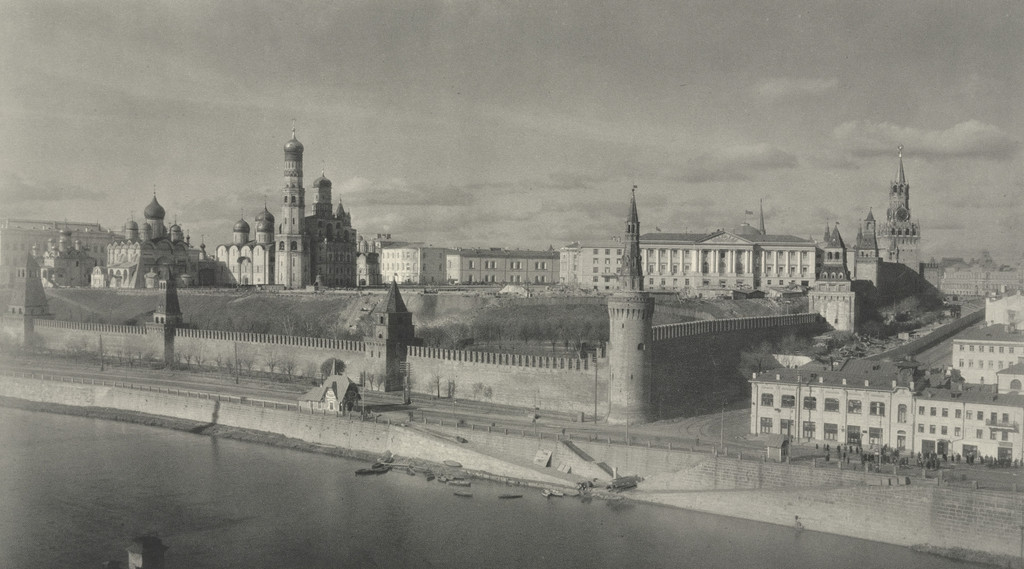
Kremlin: Moscow
May one see it?
Not on view at present
Where is “Kremlin: Moscow” now? Collection: The Museum of Modern Art, New York. Not on view at present. Checked September 22, 2026.

New York, United States
It belongs to the collection, but is not on display at present.
- Checked
- Source
- The museum
Particulars
- Accession number
- 393.1942.22
In the catalog
Sources
- The Museum of Modern Art
- Image: The Museum of Modern Art — © the artist or rights holder
Meanwhile, in the life of Margaret Bourke-White
The whole life1932–1934
The Soviet series: newspaper, portfolio, photomurals
The Soviet photographs run as a six-part series in The New York Times (1932), as a deluxe photo portfolio (1934) and as photomurals for the Soviet consulate in New York (1934); other frames circulate in exhibitions, books and periodicals around the globe, especially in Soviet magazines and postcards.
1934
Photographs Dust Bowl drought victims for Fortune
Like Dorothea Lange, she photographs the victims of the Dust Bowl drought. This Depression-era work marks the beginning of her shift from corporate photography to photojournalism.
mid-1930s
Meets Erskine Caldwell
She meets the bestselling novelist, who wrote about the poor rural communities of the South. He invites her to collaborate on a photojournalistic expedition through the South, which will produce the book You Have Seen Their Faces.
1936
The first woman photojournalist at Life
When Henry Luce launches his third magazine, the photograph-centred Life, he hires her as its first female photojournalist. She is a staff photographer until 1940, returns to the magazine in 1941–1942 and again from 1945, and also starts its first photography laboratory.
1937
The book “You Have Seen Their Faces”
Her book with Erskine Caldwell, seventy-five photographs of the lives of poor rural sharecroppers in the American South, is a commercial success and one of the major documentary works of the time to draw attention to the needs of the South.