 Kitagawa UtamaroJapanese, 1754–1806
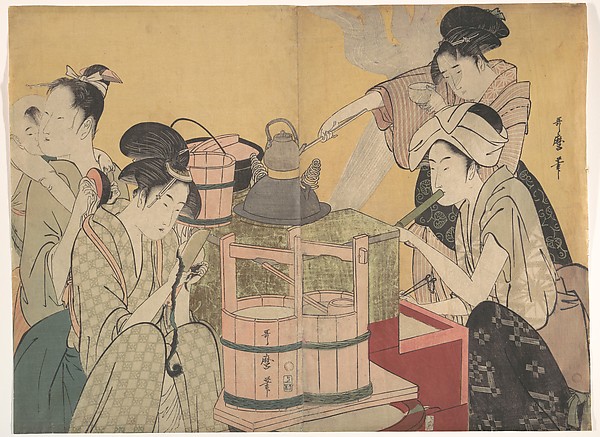
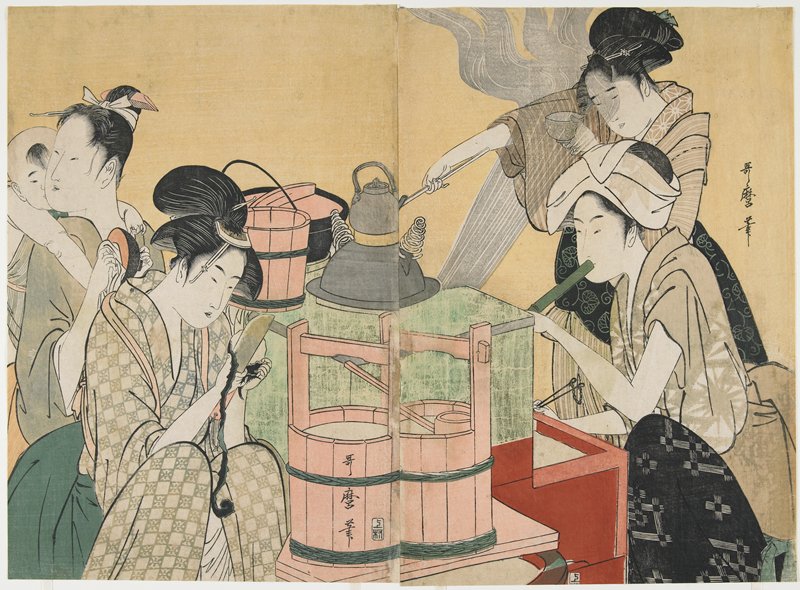
Kitchen Scene
May one see it?
Not receiving at present

Minneapolis Institute of Art
Minneapolis, United States
It belongs to the collection, but is not on display at present.
- Checked
- In this state since
- Source
- The museum
About the work
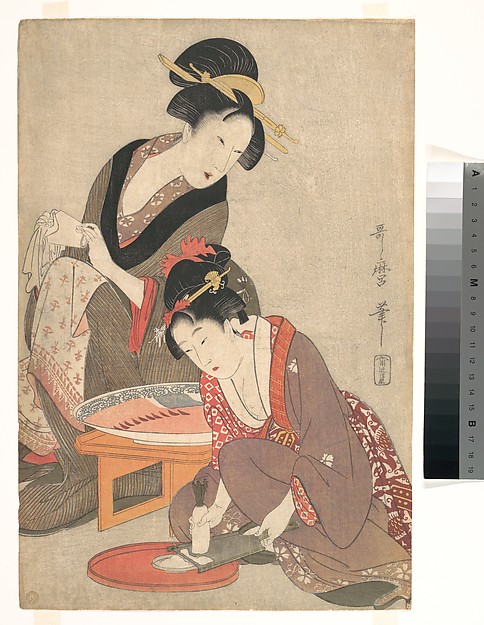
In addition to picturing the great beauty and perfection of the Floating World's greatest courtesans, Utamaro also rendered women of various classes, sometimes engaged in mundane tasks. In this print he shows women stoking a stove, peeling potatoes and washing dishes.
Minneapolis Institute of Art
Particulars
- Accession number
- 74.1.150a, b
In the catalog
Sources
- Minneapolis Institute of Art
- Image: Minneapolis Institute of Art — public domain
Meanwhile, in the life of Kitagawa Utamaro
The whole life1790–1801
Tightening censorship: seals on prints
From 1790 prints can be sold only with a censor's seal of approval; over the following decades censorship grows stricter, and violators can receive harsh punishments. From 1799 even preliminary drafts need approval, and in 1801 the works of a group of Utagawa-school offenders, including Toyokuni, are repressed.
1793
Recognition and the end of the arrangement with Tsutaya
In 1793 Utamaro achieves recognition as an artist, and his semi-exclusive arrangement with the publisher Tsutaya Jūzaburō ends. He then goes on to produce several well-known series featuring women of the Yoshiwara district, and becomes one of the few ukiyo-e artists to win fame throughout Japan in his lifetime.
1797
The death of his friend and patron Tsutaya Jūzaburō
In 1797 Utamaro's long-time friend and supporter, the publisher Tsutaya Jūzaburō, dies; the artist is apparently very upset by the loss, and some commentators feel that his work never reached its former heights afterwards. He later lives in Kyūemon-chō, then Bakuro-chō, and finally near the Benkei Bridge.