.png?width=96) Katsushika HokusaiJapanese, 1760–1849
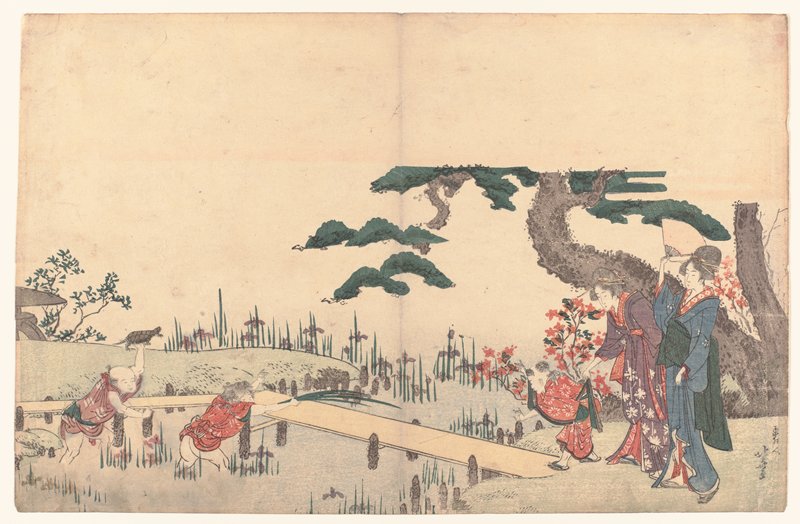
Katsushika HokusaiJapanese, 1760–1849Iris Garden
Can I see it?
Not on view at present
Where is “Iris Garden” now? Collection: Minneapolis Institute of Art, Minneapolis. Not on view at present. Checked September 29, 2026.

Minneapolis, United States
It belongs to the collection, but is not on display at present.
- Checked
- In this state since
- Source
- The museum
Details
- Accession number
- P.75.51.288
In the catalog
Sources
- Minneapolis Institute of Art
- Image: Minneapolis Institute of Art — public domain
In the life of Katsushika Hokusai
The whole life1798
Becomes an independent artist
Hokusai passed his name on to a pupil and, for the first time, set out as an independent artist tied to no school, taking the name Hokusai Tomisa.
1800
The name Katsushika Hokusai and his first landscape albums
Hokusai adopted the name by which the world knows him: Katsushika, after the district of Edo where he was born, and Hokusai, “north studio”, in honour of the North Star, symbol of a deity of his Nichiren Buddhist faith. That year he published Famous Sights of the Eastern Capital and Eight Views of Edo, and began to take pupils of his own — some fifty over his lifetime.
c. 1800
Daughter born: Katsushika Ōi
1804–1815
Illustrating the novels of Takizawa Bakin
Hokusai illustrated books by the popular novelist Takizawa Bakin; the fantasy novel Chinsetsu Yumiharizuki (Strange Tales of the Crescent Moon, 1807–1811), about Minamoto no Tametomo, made him especially famous. After thirteen works the partnership broke up, whether over clashing personalities or over how the illustrations should be drawn.
1811
Takes the name Taitō
At 51 Hokusai changed his name to Taitō and entered the period of the Hokusai Manga and his drawing manuals. The first of them, Quick Lessons in Simplified Drawing, appeared in 1812, meant to earn money and attract pupils.