Max ErnstFrench, 1891–1976
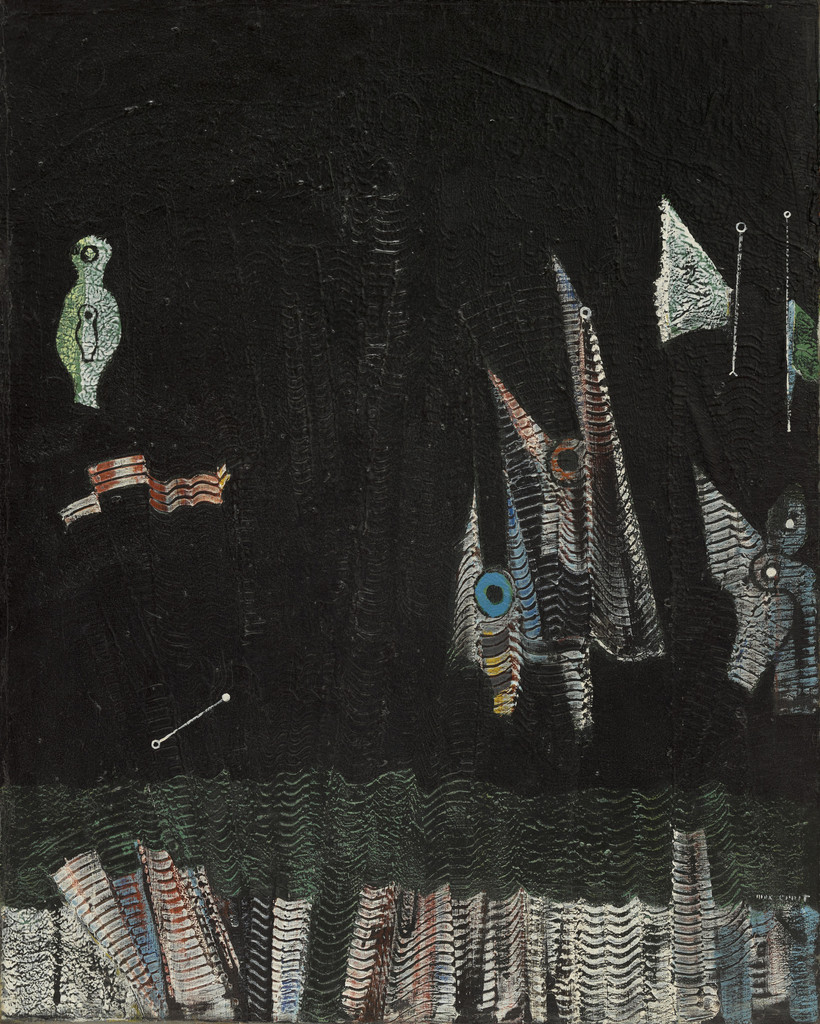
Human Figure with Two Birds
May one see it?
Yes, receiving visitors

On public display.
- Checked
- In this state since
- Source
- The museum
About the painting
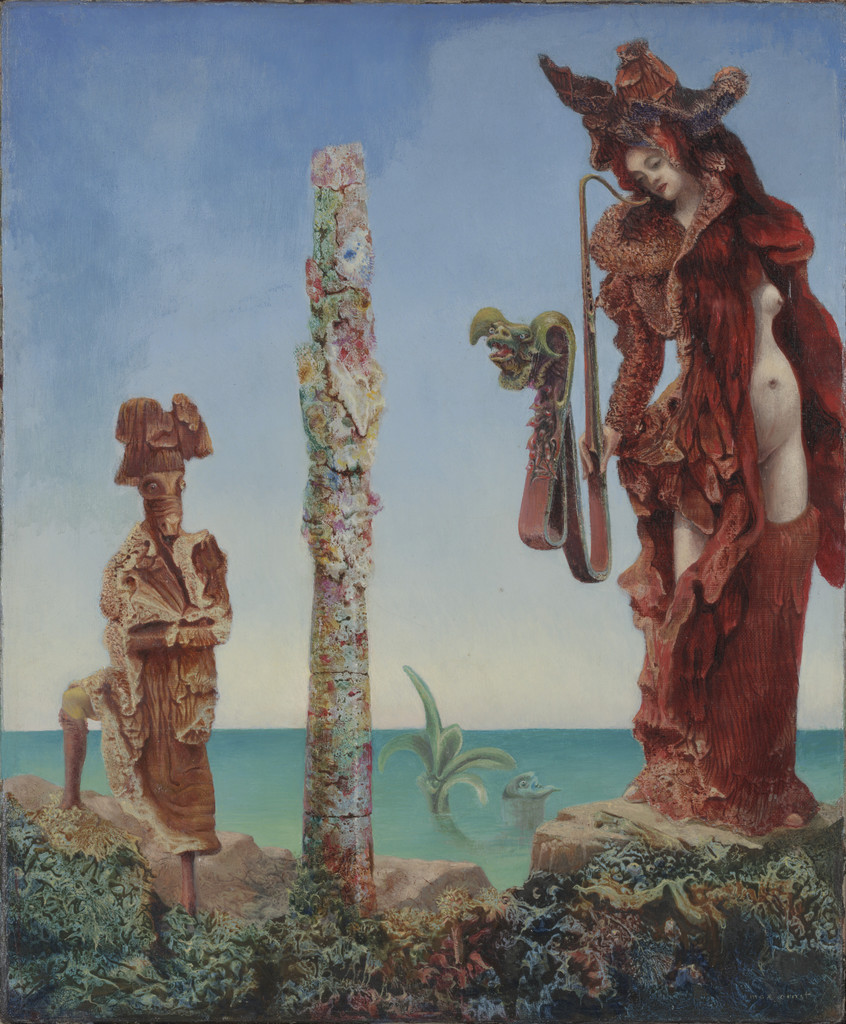
Like Constantin Brâncusi, Max Ernst was fascinated with birds, and among his earliest works incorporating this motif are some two dozen small, unconventional pictures made around 1925. One of these works was incorporated as a picture within a picture in Human Figure with Two Birds, a painting that set the stage for an extraordinary series of works that Ernst began in 1930, which featured a large, fantastic bird figure that the artist identified as Loplop. In these works, Loplop, the artist’s "private phantom attached to my person," generally holds up a picture for presentation. Here the rudimentary figure outlined in white is an early manifestation of Loplop, Ernst’s playful, surreal concept of self-portraiture by proxy.
Art Institute of ChicagoCC BY 4.0
Particulars
- Accession number
- 1989.386
In the catalog
Sources
- Art Institute of Chicago
- Image: Art Institute of Chicago — © the artist or rights holder
Meanwhile, in the life of Max Ernst
The whole life1923
The Salon des Indépendants: a warm welcome from the Cubists
In 1923 Ernst exhibited at the Salon des Indépendants: the critics ignored his work, but the Cubists Georges Braque, Juan Gris and Louis Marcoussis responded warmly. La belle jardinière, shown there, was bought the next year by the Düsseldorf exhibition centre and later removed at the Nazis’ demand; in 1937 Ernst saw it in a photograph of the “degenerate art” exhibition, and it was most likely destroyed.
1924
To Saigon after the Éluards
In March 1924 Paul Éluard abruptly left for Monaco and then for Vietnam. To raise the fare Ernst sold paintings to the gallery owner Johanna Ey; he met Éluard and Gala in Singapore and Saigon, but Gala stayed with Paul. Ernst went on exploring South-East Asia for several more months.
1926
“Histoire naturelle”: a portfolio of frottages
At Jeanne Bucher’s press Ernst published Histoire naturelle, a portfolio of drawings in the frottage technique, with an introduction by Hans Arp.
1926
The first large show at Galerie van Leer
In 1926 the Paris gallery van Leer held Ernst’s first large exhibition; in place of a preface the catalogue printed poems by Paul Éluard, Benjamin Péret and Robert Desnos.
1926
Diaghilev’s ballet and Breton’s scandal
In 1926 Ernst and Joan Miró designed Romeo and Juliet for Sergei Diaghilev’s company; Breton, indignant at the work with the Ballets Russes, made a scandal at the premiere, and in La Révolution surréaliste he and Aragon accused Ernst and Miró of belittling the idea of surrealism. The next issue, however, carried two of Ernst’s works with an apologia by Éluard.
1927
Married: Marie-Berthe Aurenche