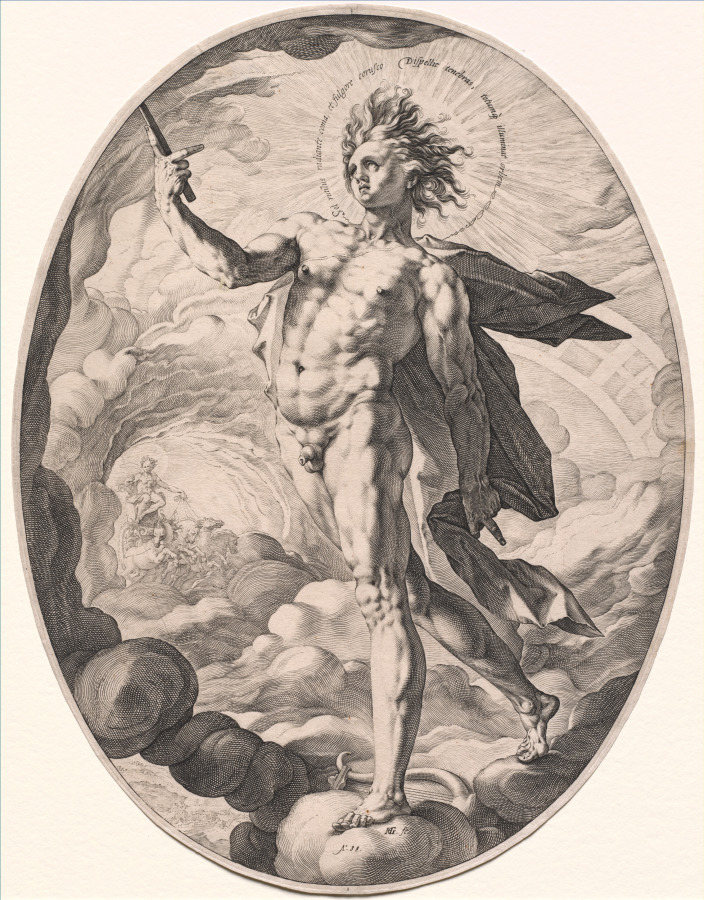
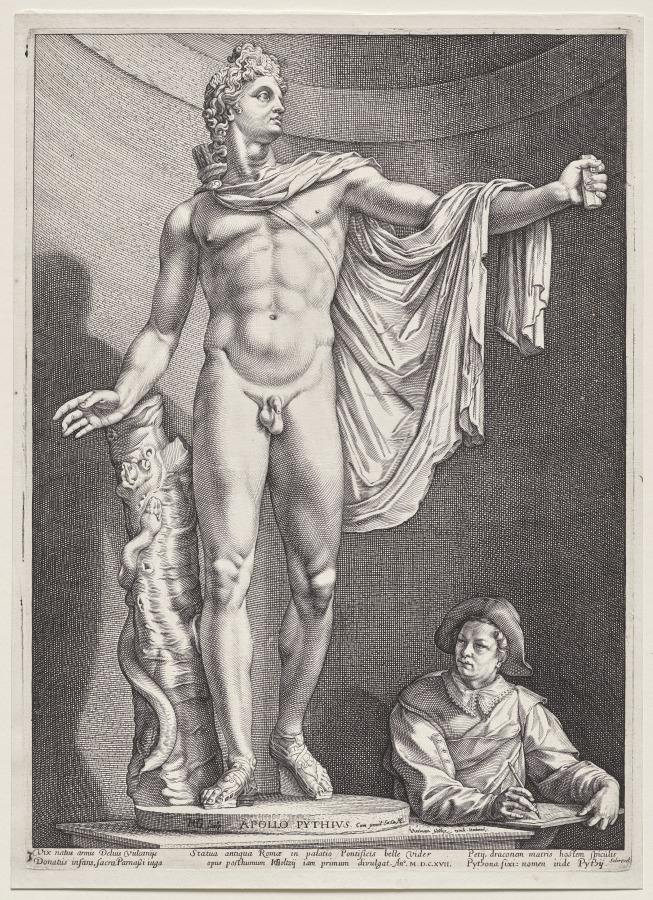
Hendrick GoltziusDutch, 1558–1617
Hercules and Telephos
Can I see it?
Not on view at present
Where is “Hercules and Telephos” now? Collection: Harvard Art Museums, Cambridge. Not on view at present. Checked September 29, 2026.

Cambridge, United States
It belongs to the collection, but is not on display at present.
- Checked
- In this state since
- Source
- The museum
Details
- Accession number
- G1666
In the catalog
Sources
- Harvard Art Museums
- Image: Harvard Art Museums — © President and Fellows of Harvard College
In the life of Hendrick Goltzius
The whole life1590
Departure for Italy
He fled from his wife and, despite his illnesses, set out for Italy — via Hamburg and Munich to Venice, Bologna and Florence. Part of the way he traveled on foot, passing himself off as a commoner, "partly out of a love of mystification."
January 1591
Eight months in Rome
He arrived in Rome in January 1591 and stayed eight months (with a brief sojourn in Naples). He discovered Raphael, was especially impressed by Michelangelo and Giambologna, and studied art from classical sculpture to the masters of the Renaissance.
August 1591
Return to Haarlem with a collection of drawings
He returned to Haarlem, bringing from Italy a large collection of drawings that he used for the rest of his life; from the Roman material three engravings of classical statues are known, including the Farnese Hercules.
mid-1590s
Turn toward classicism
In the mid-1590s his art underwent a gradual stylistic turn toward classicism; at the same time he began executing large finished pen drawings on parchment in a calligraphic technique imitating the methods of burin engraving.
c. 1600
Abandoning engraving for painting
Around 1600, partial paralysis of his right hand (maimed in childhood in a fall onto burning coals) forced Goltzius to give up engraving and turn to painting; he handed over his print publishing to his stepson Jacob Matham. About fifty surviving paintings are attributed to him.
1 January 1617
Died