 Hendrick GoltziusDutch, 1558–1617
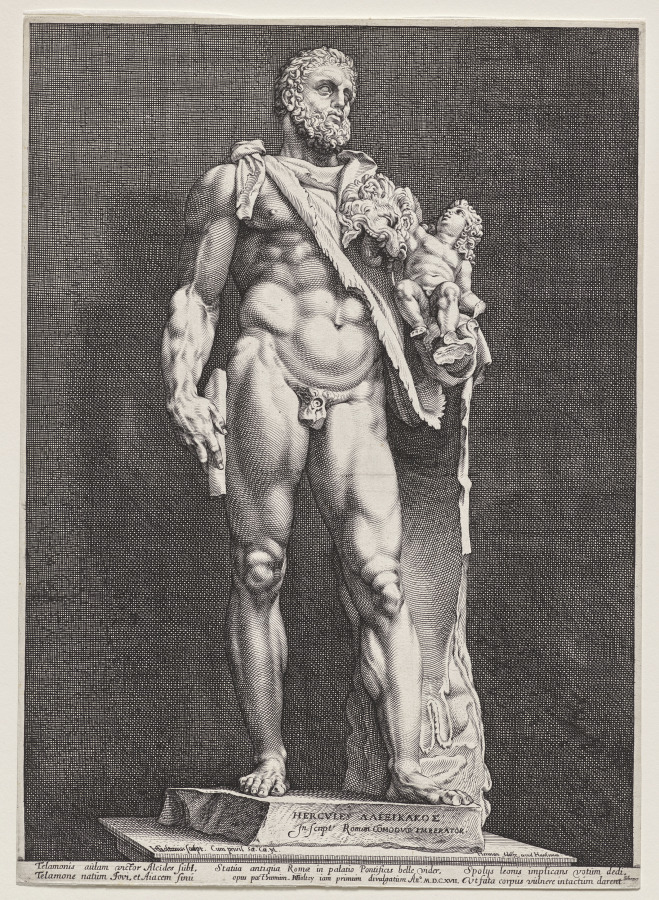
Hercules and Telephos
Can I see it?
Yes, on view now
Where is “Hercules and Telephos” now? The Cleveland Museum of Art, 101A Prints & Drawings, Cleveland. Yes, on view now. Checked September 29, 2026.

On public display.
- Checked
- In this state since
- Source
- The museum
About the work
Hendrick Goltzius was one of many late Renaissance artists who felt compelled to travel to Italy as part of his artistic training. He went with one purpose—to study antique sculpture. Goltzius made drawings on-site and then made engravings after his designs once he returned to Haarlem in 1591. He portrayed the Hercules Telephos from a low viewpoint to capture the awesome experience of first encountering the famous monument. It stands within a shadowed niche, which Goltzius filled with thousands of crossed engraved lines to create a dramatic recess that pushes the sculpture into the light. The engraving shows to excellent advantage the virtuosic technique that Goltzius developed, in which the swelling and tapering line exaggerates the heroic musculature of the figure.
The Cleveland Museum of Art
Details
- Accession number
- 2022.138
In the catalog
Sources
- The Cleveland Museum of Art
- Image: The Cleveland Museum of Art — Museum open access
In the life of Hendrick Goltzius
The whole life1590
Departure for Italy
He fled from his wife and, despite his illnesses, set out for Italy — via Hamburg and Munich to Venice, Bologna and Florence. Part of the way he traveled on foot, passing himself off as a commoner, "partly out of a love of mystification."
January 1591
Eight months in Rome
He arrived in Rome in January 1591 and stayed eight months (with a brief sojourn in Naples). He discovered Raphael, was especially impressed by Michelangelo and Giambologna, and studied art from classical sculpture to the masters of the Renaissance.
August 1591
Return to Haarlem with a collection of drawings
He returned to Haarlem, bringing from Italy a large collection of drawings that he used for the rest of his life; from the Roman material three engravings of classical statues are known, including the Farnese Hercules.