 Rockwell KentAmerican, 1882–1971
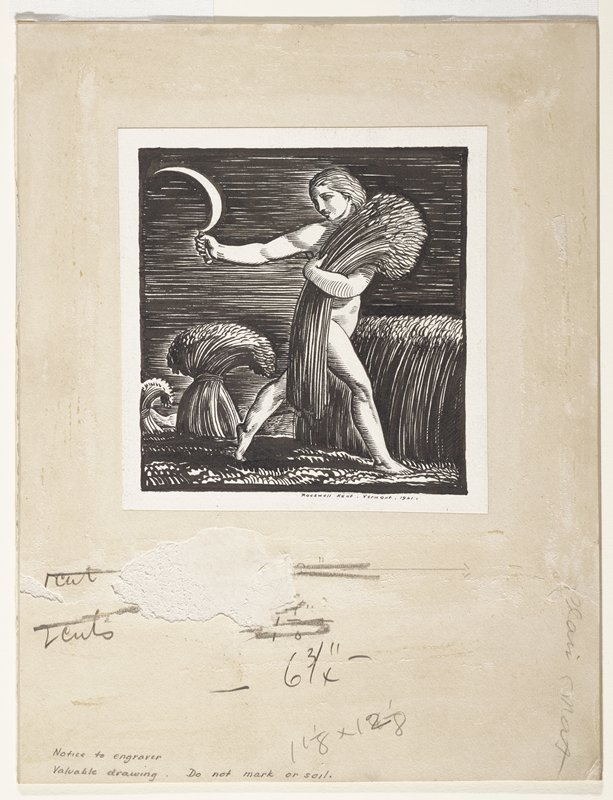
Harvester
May one see it?
Not receiving at present

Minneapolis Institute of Art
Minneapolis, United States
It belongs to the collection, but is not on display at present.
- Checked
- In this state since
- Source
- The museum
About the work
Rockwell Kent was an unusual combination of Transcendentalist, Symbolist, Modernist, and Socialist. This drawing made while he lived in Vermont depicts a laborer harvesting wheat. The abundance of nature and simplicity of life speaks to his roots in the mystical writings of Henry David Thoreau and Ralph Waldo Emerson. The anonymous, androgynous figure illuminated in a night landscape evokes his Symbolist bent. The simplified rhythmical lines are harbingers of Art Deco, and the theme of labor coupled with the gleaming sickle would be comfortable on a Soviet monument.
Read on
When Kent made this drawing, he was just gearing up his career as a printmaker. Indeed, the drawing is mounted on a card inscribed in pencil: Notice to engraver / Valuable drawing / Do not mark or soil. We know of no print derived from the drawing, but it did come into the possession of Mrs. Albert Sterner, whose husband, an artist, was among those encouraging Kent to engage with printmaking the early 1920s.
Minneapolis Institute of Art
Particulars
- Accession number
- 2018.96.28
In the catalog
Sources
- Minneapolis Institute of Art
- Image: Minneapolis Institute of Art — © Plattsburgh State Art Museum, Rockwell Kent Gallery and Collection
Meanwhile, in the life of Rockwell Kent
The whole life1918–1919
Alaska: Wintering on Fox Island with His Son
In late summer 1918 he set off with his nine-year-old son Rockwell for Fox Island in Alaska, where he created a series of paintings and prints devoted to that land.
1920
First Book: "Wilderness"
Kent's first book was published — an illustrated journal of his Alaskan winter, compiled from his letters home. The New Statesman called it the most remarkable book to come out of America since Leaves of Grass.
1920
The Alaska Works at Knoedler's
On his return from Alaska in March 1919, patrons led by George Palmer Putnam founded the corporation Rockwell Kent, Inc. to support the artist; the completed Alaska paintings and the Impressions studies were shown in 1920 at the Knoedler Gallery in New York.
1922–1923
Voyage to Tierra del Fuego
He made a voyage to Tierra del Fuego; his recollections of the expedition formed the book Voyaging Southward from the Strait of Magellan (1924).