 Kitagawa UtamaroJapanese, 1754–1806
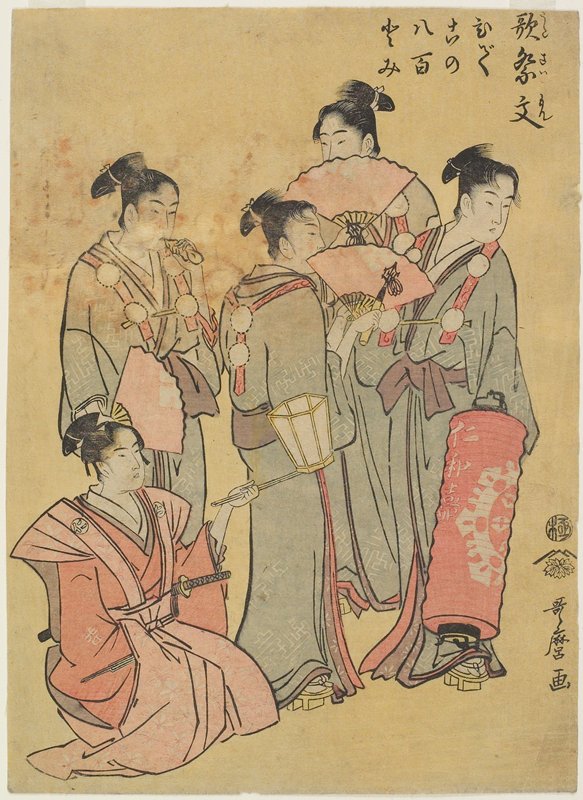
Group Singers
May one see it?
Not receiving at present

Minneapolis, United States
It belongs to the collection, but is not on display at present.
- Checked
- In this state since
- Source
- The museum
Particulars
- Accession number
- P.78.65.26
In the catalog
Sources
- Minneapolis Institute of Art
- Image: Minneapolis Institute of Art — public domain
Meanwhile, in the life of Kitagawa Utamaro
The whole lifeautumn 1782
A banquet for his new name, Utamaro
In the autumn of 1782, it is believed, Utamaro hosts a lavish banquet whose guests include the artists Kiyonaga, Kitao Shigemasa and Katsukawa Shunshō and the writers Ōta Nanpo and Hōseidō Kisanji. It is here that he is thought to have announced his new art name, handing out, as custom required, a specially made print, a self-portrait bowing deeply before a screen bearing his guests' names. By other accounts, he has used the pseudonym since 1781.
c. 1783 – 1788
Years in the publisher Tsutaya's house
Probably from 1783, Utamaro lives for about five years in the house of Tsutaya Jūzaburō and becomes one of the principal artists of the Tsutaya firm. Evidence of his prints from these years is sporadic: he mostly illustrates books of kyōka, “crazy verse”, a parody of the classical waka form.
c. 1791
Giving up book prints for half-length portraits of beauties
Around 1791 Utamaro gives up designing prints for books and concentrates on single portraits of women shown half-length, rather than the group scenes favoured by other ukiyo-e artists. He was the first in Japanese woodblock printing to use half-length compositions for women's portraits; none of his work from 1790–1792 has survived.
1797
The death of his friend and patron Tsutaya Jūzaburō
In 1797 Utamaro's long-time friend and supporter, the publisher Tsutaya Jūzaburō, dies; the artist is apparently very upset by the loss, and some commentators feel that his work never reached its former heights afterwards. He later lives in Kyūemon-chō, then Bakuro-chō, and finally near the Benkei Bridge.
1804
Arrest and fifty days in manacles
In 1804 Utamaro is imprisoned over prints of the sixteenth-century ruler Toyotomi Hideyoshi, depicted, in the authorities' view, “in an improper form”, and then manacled for fifty days, together with Tsukimaro, Toyokuni, Shuntei, Shun'ei and Jippensha Ikku; their publishers are heavily fined. It is probably the most famous case of censorship of the Edo period, and Utamaro appears to have been the most prominent of those punished.
31 October 1806
Died