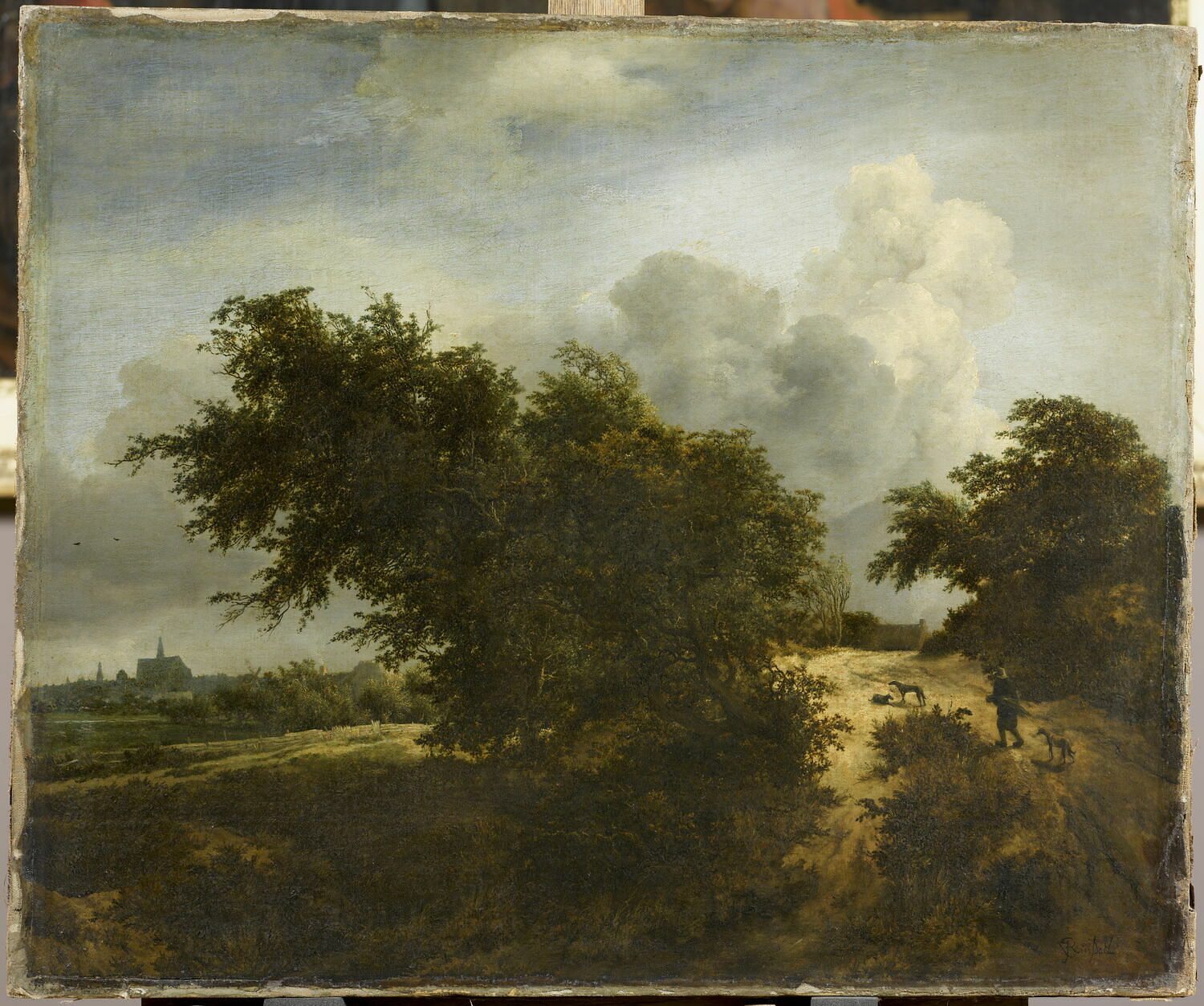
Jacob Isaacksz. van RuisdaelDutch, 1628–1682
Große Bäume
May one see it?
Unknown

Braunschweig, Germany
The owner is known; whether it is on view today is not.
- In this state since
- Source
- The museum
Particulars
What it shows
In the catalog
Sources
- Herzog Anton Ulrich Museum
- Image: Herzog Anton Ulrich Museum — CC BY-NC-SA 4.0
Meanwhile, in the life of Jacob Isaacksz. van Ruisdael
The whole life1646
First dated paintings and etchings
The earliest date on Ruisdael's paintings and etchings is 1646; the young man was strongly influenced by the Haarlem landscape painters Cornelis Vroom and Allart van Everdingen. Two years later he was admitted to the Haarlem Guild of St Luke.
1650
Journey to Germany with Nicolaes Berchem
With Nicolaes Berchem, one of the painters who would later add figures to his landscapes, Ruisdael travels to Bentheim and Steinfurt, just across the German border (other accounts date the trip to Westphalia to around 1650). Afterwards his landscapes take on a more heroic character, with larger and more prominent forms.
c. 1657
Moves to Amsterdam
Ruisdael moves to prosperous Amsterdam, which likely offered a bigger market for his work: his fellow Haarlem painter Allart van Everdingen had already moved there and found buyers. He lived there for the rest of his life (other accounts date the move to 1657).
1668
Witness at the wedding of his pupil Meindert Hobbema
In 1668 Ruisdael witnesses the marriage of Meindert Hobbema, his only registered pupil. He himself never married — according to Houbraken, to reserve time to serve his old father.
1672
Still comfortable after the Disaster Year
There is no record of Ruisdael owning land or shares, yet he appears to have lived comfortably even after the downturn of the disaster year 1672: in inventories of 1650–1679 his paintings averaged 40 guilders against 19 for attributed paintings generally. The legend that he died poor in a Haarlem almshouse confuses him with his cousin Jacob Salomonszoon.
10 March 1682
Died