.jpg?width=96) Vincent van GoghDutch, 1853–1890
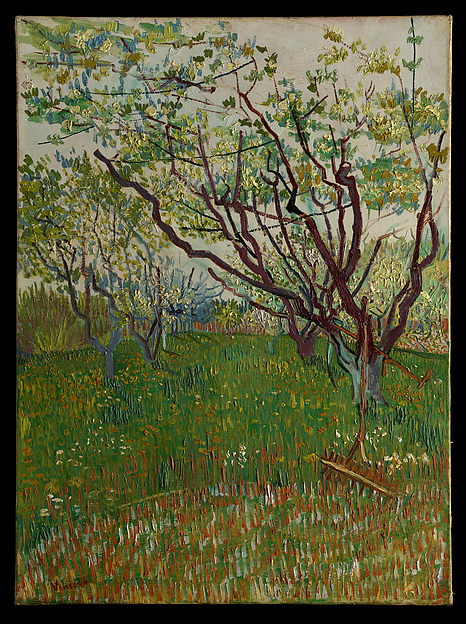
Vincent van GoghDutch, 1853–1890The Flowering Orchard
Can I see it?
Yes, on view now
Where is “The Flowering Orchard” now? The Metropolitan Museum of Art, Gallery 825, New York. Yes, on view now. Checked September 29, 2026.

New York, United States
Open now· until 5:00 PM
On public display.
- Checked
- In this state since
- Source
- The museum
Details
- Accession number
- 56.13
What it shows
In the catalog
Sources
- The Metropolitan Museum of Art
- Image: The Metropolitan Museum of Art — Open Access (CC0)
In the life of Vincent van Gogh
The whole lifeFebruary 1886
Moves to Paris to join his brother Theo
Van Gogh left Antwerp to join his brother Theo, an art dealer, in Paris. So began a very fruitful and eventful Paris period: he painted some two hundred and thirty pictures there, more than anywhere else.
February 1888
To Arles, dreaming of a “Studio of the South”
The public still neither accepted nor bought his paintings, and in February 1888 Van Gogh left for Arles in the south of France to found a “Studio of the South”, a brotherhood of like-minded artists in which he gave Gauguin the leading role. Theo backed the plan with money.
23 October 1888
Gauguin arrives in Arles
After much pleading Gauguin arrived in Arles, and in November the two painted together: Gauguin portrayed Van Gogh in “The Painter of Sunflowers”, and their first joint outing was to the Alyscamps. At Gauguin's suggestion Vincent painted from memory, producing “Memory of the Garden at Etten”.
23 December 1888
The severed ear
After an altercation on the evening of 23 December, Van Gogh, seemingly hearing voices, severed his left ear, wholly or in part, with a razor and delivered it, wrapped in paper, to a woman at a brothel. Next morning a policeman found him unconscious; in hospital he was diagnosed with “acute mania with generalised delirium”.
May 1889
Voluntarily into the Saint-Paul asylum
Van Gogh left Arles and voluntarily entered the Saint-Paul-de-Mausole asylum, a former monastery in Saint-Rémy-de-Provence, accompanied by the Protestant clergyman Frédéric Salles. Of his two cells with barred windows one became a studio, and the clinic and its garden became the main subjects of his paintings.
29 July 1890
Died