 Pablo PicassoSpanish, 1881–1973
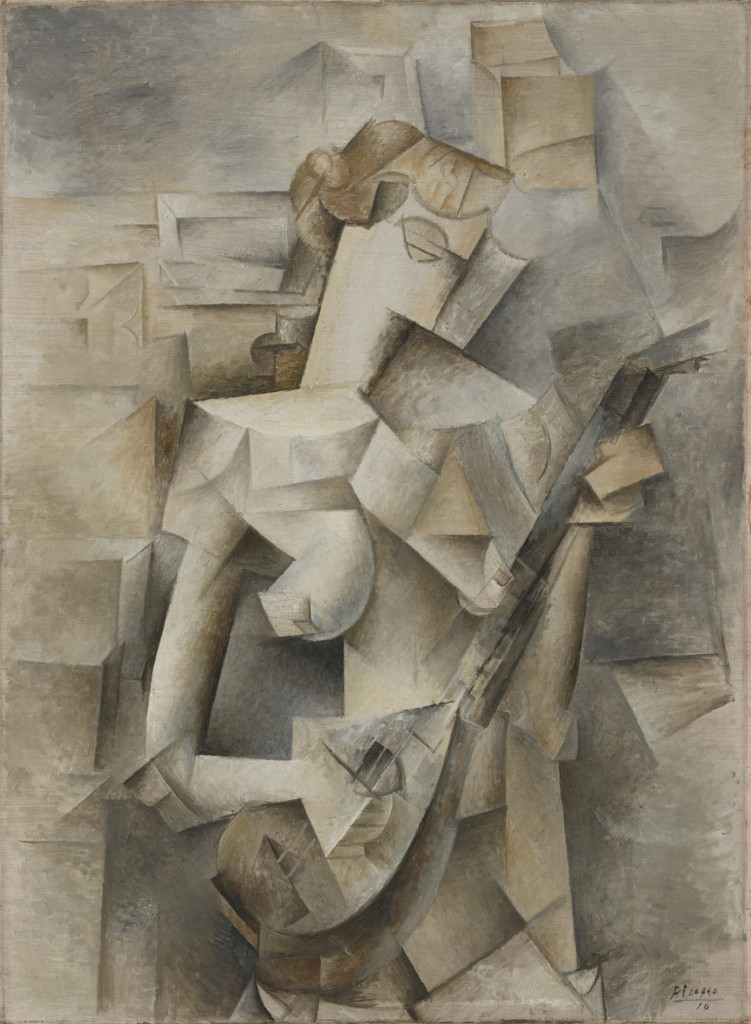
Girl with a Mandolin (Fanny Tellier)
May one see it?
Yes, receiving visitors

The Museum of Modern Art
RoomMoMA, Floor 5, 503New York, United States
On public display.
- Checked
- 11 days ago
- Source
- The museum's own collection data
About the painting
Girl with a Mandolin (Fanny Tellier) is a 1910 Cubist painting by Pablo Picasso. The artwork was one of Picasso’s early Analytic Cubist creations, through which he aimed to reduce organic forms to geometric shapes. It shows the model Fanny Tellier in the nude, with her hands on a mandolin. Tellier volunteered to model for Picasso but, according to the latter, eventually refused to continue sitting for him after the painting took longer to complete than she had expected. Picasso accordingly left the portrait unfinished, though later suggested that he could have done nothing further to improve it.
Read on
Picasso painted Girl with a Mandolin late in the spring of 1910, shortly before leaving Paris for the Catalan town of Cadaqués. It was a response to Woman with a Mandolin, a more abstract treatment of the same theme by his friend Georges Braque, and followed two other works by Picasso under the same title. It has been analysed as a partial move away from naturalism, though comparatively legible and close to the visible form by contrast with later Cubist works, and as an important step in Picasso's movement towards focusing on the study of geometric planes. It has also been interpreted both as a de-eroticised nude and as containing autoerotic implications. The art historian T. J. Clark called it "the most ingenious of Picasso's portraits".
The painting was owned by Picasso's German-born friend Wilhelm Uhde. It was exhibited at the Armory Show of 1913, and confiscated by the French state during the First World War as "enemy property". Its later owners included the art dealer Paul Rosenberg, the poet André Breton, and Picasso's friend Roland Penrose. Penrose sold it to Nelson Rockefeller, the future Vice President of the United States, who bequeathed it to the Museum of Modern Art in New York City; it has been held there since Rockefeller's death in 1979.
Particulars
- Accession number
- 966.1979
Sources
- The Museum of Modern Art: the museum's own open data · fetched 11 days ago
- Image: The Museum of Modern Art — © the artist or rights holder