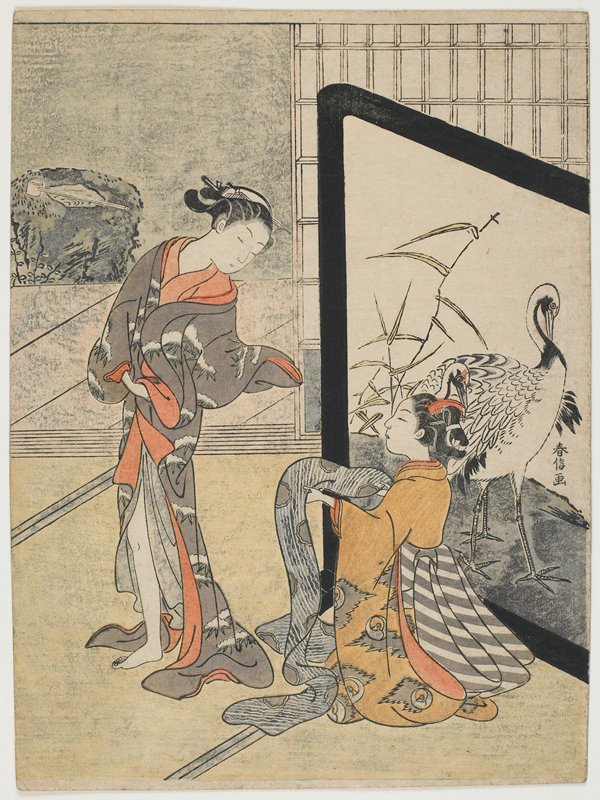
Trained in painting at the Kanō school, Harunobu began in the manner of the Torii school — skilful but undistinguished — and found his own style fairly late, only after becoming involved with a circle of literati samurai. In 1764, thanks to his social connections (he was close to many of the period’s prominent artists and scholars and to friends of the shōgun), he was chosen to help these amateurs create e-goyomi — calendar prints that worked the calculations of the lunar calendar into their images and were exchanged at gatherings in Edo.
1765
The first full-colour nishiki-e prints
The calendar prints became the first nishiki-e (“brocade prints”), and their origin is traced to 1765: Harunobu printed a single image from several separate blocks, up to ten colours on a sheet, and was the first ukiyo-e artist to use more than three colours consistently; notches and wedges held the paper in place so that the successive printings stayed in register. Paid for by wealthy patrons, he used the best materials — cherry wood instead of catalpa and more expensive colours applied more thickly for a more opaque effect.
1765–1770
Five years at his peak: 20 books and a thousand prints
Between 1765 and 1770 Harunobu created over twenty illustrated books, over one thousand colour prints (other accounts give more than eight hundred works) and a number of paintings.
1765–1770
Recognised as the master of ukiyo-e and widely imitated
In the last years of his life Harunobu came to be regarded as the master of ukiyo-e and was widely imitated: many artists copied his style during his lifetime.
late 1760s
Master of bijin-ga and scenes of Edo life
Harunobu became one of the primary producers of pictures of beautiful women (bijin-ga) and scenes of urban life for the Edo print connoisseur market: his prints include not only geisha, courtesans and sumo wrestlers but also street vendors and errand boys. Accounts differ on portraits of kabuki actors: by some he was among the first to paint them, by others he scornfully refused the subject.