 Berenice AbbottAmerican, 1898–1991
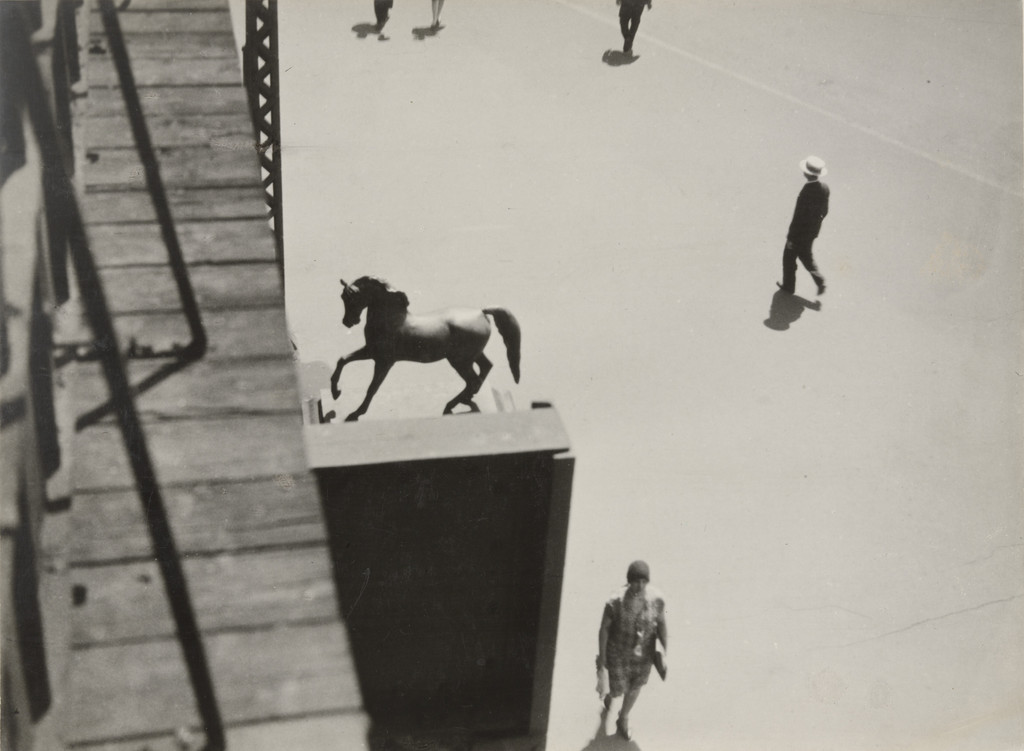
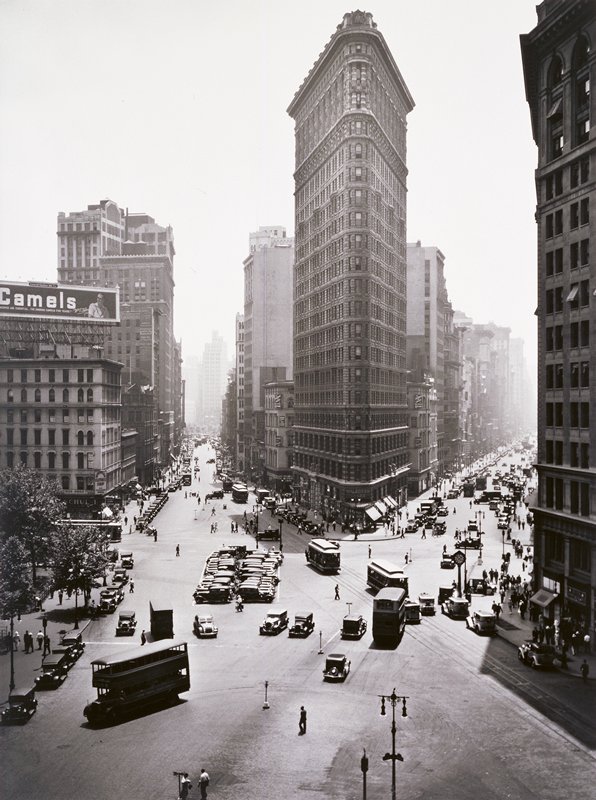
Flatiron Building, Manhattan
Can I see it?
Not on view at present
Where is “Flatiron Building, Manhattan” now? Collection: Minneapolis Institute of Art, Minneapolis. Not on view at present. Checked September 29, 2026.

Minneapolis, United States
It belongs to the collection, but is not on display at present.
- Checked
- In this state since
- Source
- The museum
Details
- Accession number
- 86.108.38
In the catalog
Sources
- Minneapolis Institute of Art
- Image: Minneapolis Institute of Art — © Berenice Abbott
In the life of Berenice Abbott
The whole lifeJune 1928
Buys the remainder of Atget’s archive
The government has already acquired much of Atget’s archive — he had sold 2,621 negatives in 1920, and his friend and executor André Calmettes sold 2,000 more immediately after his death; in June 1928 Abbott buys the remainder and quickly starts work on its promotion. Because of a lack of funding she has to sell a one-half interest in the collection to Julien Levy for $1,000.
early 1929
Travels to New York to find a publisher for Atget
In early 1929 she visits New York, ostensibly to find an American publisher for Atget’s photographs, and on seeing the city again recognises its photographic potential.
September 1929
Closes her Paris studio and returns to New York
Back in Paris she closes up her studio and in September 1929 returns to New York, where over the next decade she focuses on documentary photography and on portraying the city as it transforms into a modern metropolis. She brings over a large part of Atget’s archive; her first photographs are taken with a hand-held Kurt-Bentzin camera, soon replaced by a Century Universal producing 8 × 10-inch negatives.
1930
The book “Atget, photographe de Paris” is published
An early tangible result of her efforts is the 1930 book “Atget, photographe de Paris”, in which she is described as photo editor.
1934
Museum exhibition brings patrons and a co-author
An exhibition she prepares at the Museum of the City of New York in 1934 helps her find serious patrons (the Federal Art Project begins to fund the project) and a co-author, the art critic Elizabeth McCausland, who becomes a close friend.
1935
The Federal Art Project hires her as project supervisor
In 1935 the Federal Art Project (FAP) hires her as project supervisor for “Changing New York”: she continues to photograph the city while assistants help in the field and in the office, leaving her all her time for producing, printing and exhibiting her photographs. By the time she resigns from the FAP in 1939 she has produced 305 photographs, deposited at the Museum of the City of New York.