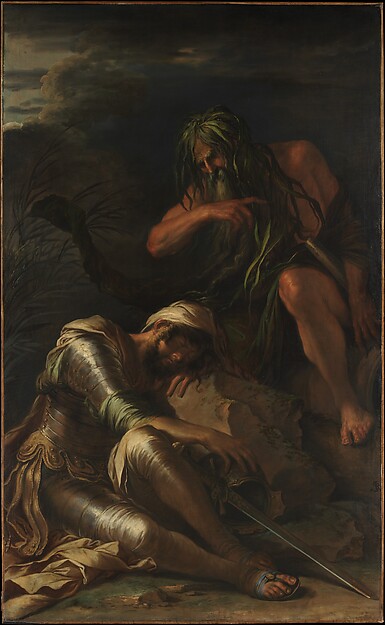
Salvator RosaItalian, 1615–1673
Five River-gods
May one see it?
Not receiving at present

Cambridge, United States
It belongs to the collection, but is not on display at present.
- Checked
- In this state since
- Source
- The museum
Particulars
- Accession number
- G3372
In the catalog
Sources
- Harvard Art Museums
- Image: Harvard Art Museums — © President and Fellows of Harvard College
Meanwhile, in the life of Salvator Rosa
The whole life1640–1649
Florentine Period at the Medici Court
After scandalous quarrels with Bernini and his failure to gain admission to the Accademia di San Luca, he moved to Florence at the invitation of Giovanni Carlo de' Medici, where he remained until 1649.
1640s
Founding of the Accademia dei Percossi in Florence
In Florence he founded the Accademia dei Percossi — a combination of studio and salon of poets, playwrights, and painters, where satires and comedies were read at dinners.
1640s
The Satires "Music," "Poetry," "Painting," and "War"
While staying with the Maffei brothers in Volterra, he wrote four satires — Music, Poetry, Painting, and War; at the same time he painted the picture Philosophy (now in the National Gallery, London).
1650
Return to Rome, Seclusion
He returned to Rome, kept to himself, and accepted no commissions, devoting himself to battle scenes and enigmatic landscapes, which he sold through his friend, the banker Carlo de Rossi.
1650s
Scandal over the "Allegory of Fortune"
The painting Allegory of Fortune provoked a storm of indignation among the religious and secular authorities, who saw in it a satire on themselves; Rosa came close to arrest and published a text offering innocuous interpretations of its imagery.
1656
Plague in Naples: Death of His Son and Relatives
Under pressure from his enemies in Rome, he sent Lucrezia and his son Rosalvo to relatives in Naples; the plague epidemic that broke out claimed the lives of Rosalvo, his brother, his sister, his brother-in-law, and their children — Lucrezia survived and returned to Rome alone.