 Jean François MilletFrench, 1814–1875
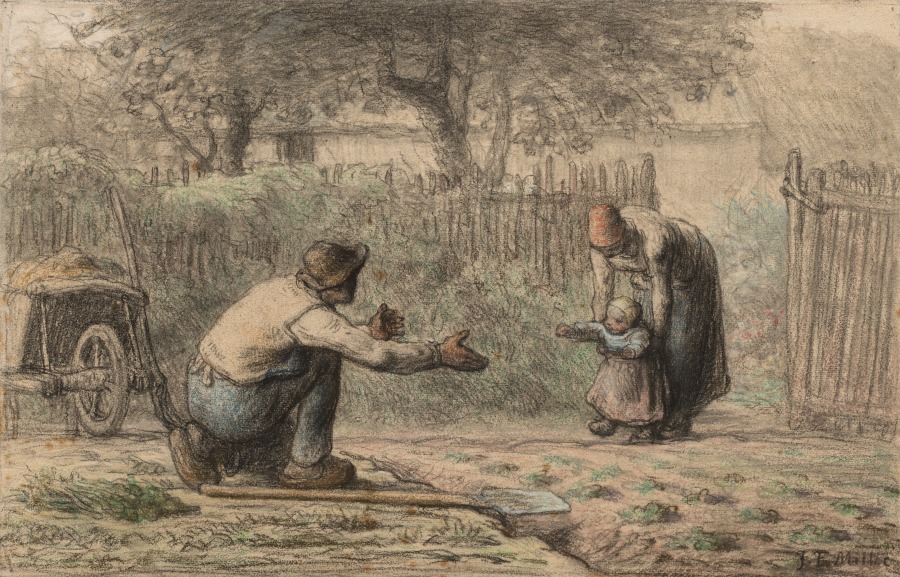
First Steps
May one see it?
Not receiving at present

The Cleveland Museum of Art
Cleveland, United States
It belongs to the collection, but is not on display at present.
- Checked
- In this state since
- Source
- The museum
About the work
In the 1860s Jean-François Millet began to add pastel to his black chalk drawings of peasants and rural life, with the hope that the addition of color would make his monochromatic drawings more marketable. Between 1865 and 1869, he worked almost exclusively in pastel, producing more than 100 works. The taste for “enhanced” or “pastelled drawings,” as Millet described them, grew among collectors and artists, and inspired a revival of the medium in the 1870s and 1880s. Here, in a fenced-in garden behind a house, parents encourage their child to walk for the first time. Delicate passages of blue, green, yellow, and red enliven the composition.
The Cleveland Museum of Art
Particulars
- Accession number
- 1962.407
In the catalog
Sources
- The Cleveland Museum of Art
- Image: The Cleveland Museum of Art — Museum open access
Meanwhile, in the life of Jean François Millet
The whole life1857
“The Gleaners” at the Salon: a hostile public
In 1857 he submitted “The Gleaners” to the Salon to an unenthusiastic, even hostile, public.
1857
Son born: Charles Millet
early 1860s
A contract for 25 works in return for a monthly stipend
At the beginning of the 1860s he contracted to paint 25 works in return for a monthly stipend for the next three years.
1865
The first public showing of “The Angelus”
“The Angelus” was displayed to the public for the first time in 1865; it changed hands several times, increasing only modestly in value, since some considered the artist’s political sympathies suspect.
1867
A major showing at the 1867 Exposition Universelle
In 1867 the Exposition Universelle hosted a major showing of his work, with “The Gleaners”, “The Angelus” and “Potato Planters” among the paintings exhibited.
1868
Hartmann commissions “Four Seasons” for 25,000 francs
In 1868 Frédéric Hartmann commissioned “Four Seasons” from him for 25,000 francs.