Mario GiacomelliItalian, 1925–2000
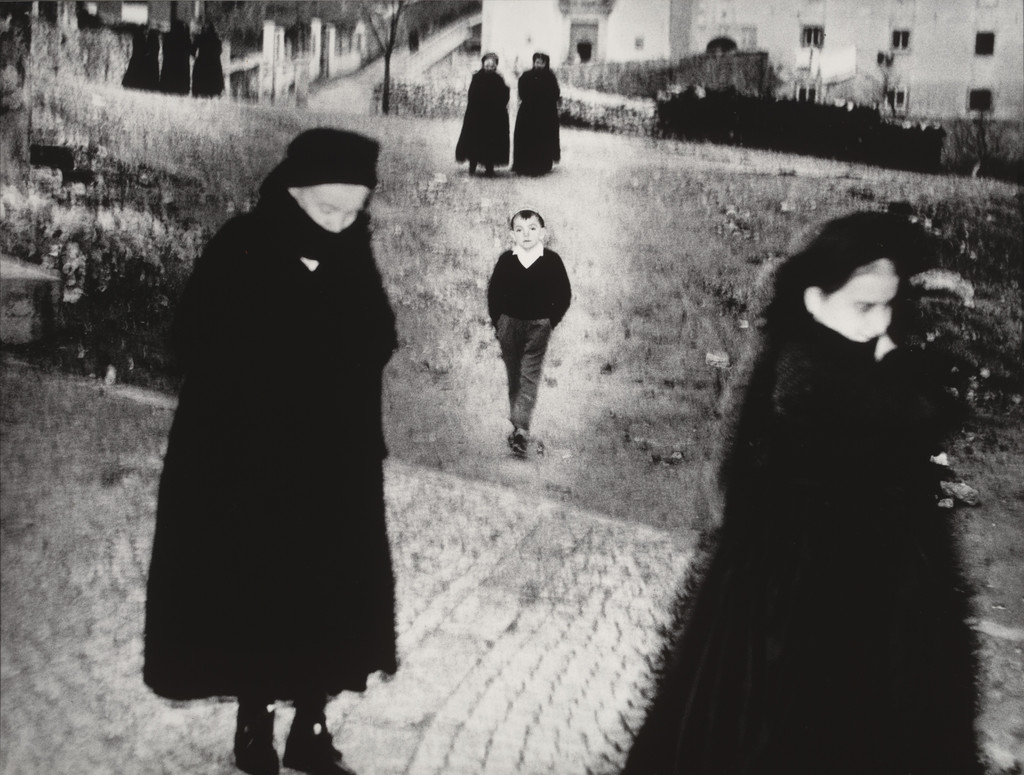
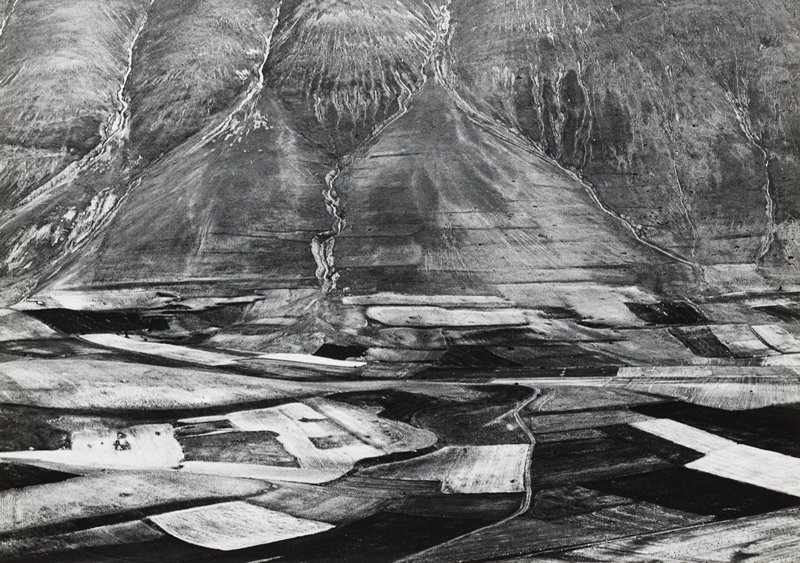
Febbraio
May one see it?
Not receiving at present
J. Paul Getty Museum
Los Angeles, United States
It belongs to the collection, but is not on display at present.
- Checked
- In this state since
- Source
- The museum
About the work
Italy’s Marche region is characterized by rolling hills, small farms, and *frazioni* (hamlets), all of which were among the first motifs that Giacomelli photographed. As with his portraits and figure studies from this period, the compositions of his early landscapes were fairly conventional, with foreground, middle-ground, and background elements organized around a clearly discernible horizon line. As he refined his technique, however, Giacomelli often positioned himself at the top of a hill pointing his camera downward or at the base aiming it upward, thereby eliminating the horizon and creating a disorienting patchwork of geometric shapes. His development of the negative, use of high-contrast paper, and manipulations in the darkroom further enhanced the distinctively graphic qualities of his images.
Read on
It was not uncommon for him to scratch forms into his negatives to add dramatic counterpoints. Over the years, Giacomelli returned to certain sites multiple times, documenting them during different seasons and crop rotations. He would later incorporate photographs made for one purpose into a series that had other ambitions, most notably to function as commentary on the capacity of both natural occurrences and human interventions to change the character of the land. Virginia Heckert, J. Paul Getty Museum, Department of Photographs 2021
J. Paul Getty Museum
Particulars
- Accession number
- 2016.179.51
In the catalog
Sources
- J. Paul Getty Museum
- Image: J. Paul Getty Museum — ; In Copyright