Winslow HomerAmerican, 1836–1910
Fall Games—the Apple-Bee
Can I see it?
Not on view at present
Where is “Fall Games—the Apple-Bee” now? Collection: Art Institute of Chicago, Chicago. Not on view at present. Checked September 29, 2026.

Chicago, United States
It belongs to the collection, but is not on display at present.
- Checked
- In this state since
- Source
- The museum
Details
- Accession number
- 2001.761
In the catalog
Sources
- Art Institute of Chicago
- Image: Art Institute of Chicago — CC0
In the life of Winslow Homer
The whole life1857
Freelance illustrator: “I have had no master”
By 1857 Homer, having turned down an offer to join the staff of Harper's Weekly, was working as a freelance illustrator, drawing Boston and rural New England life for Ballou's Pictorial and Harper's Weekly, and opened his own studio in Boston. “From the time I took my nose off that lithographic stone,” he later said, “I have had no master, and never shall have any.”
1859
Moves to New York
Until 1859 Homer lived with his family in Belmont, where his uncle's mansion inspired a number of his early illustrations and paintings, including croquet scenes. In 1859 he moved to New York, the artistic and publishing capital of the country, and opened a studio in the Tenth Street Studio Building.
1860
“Skating in Central Park” on show
In 1860 Homer's watercolour “Skating in Central Park” was shown at the National Academy of Design, where he attended classes in 1859, 1860 and 1863. That same year he was eager to go to Europe, but the Civil War put the plans off.
1861
Oil-painting lessons with Rondel
In 1861 Homer learned to paint in oils, taking private lessons from the painters Frederick Rondel and Thomas Seir Cummings. Rondel taught him only the basics, and after about a year of teaching himself Homer was producing excellent oil work.
October 1861
At the front of the Civil War
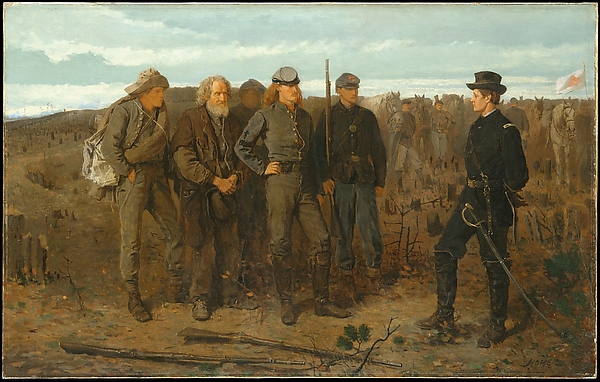
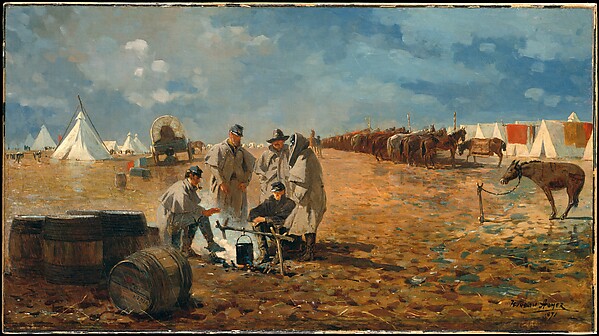
His mother tried to raise family funds to send him to Europe to study, but instead Harper's sent Homer to the front lines of the Civil War; his first sketches were of the camp, commanders and army of General George B. McClellan on the banks of the Potomac in October 1861. The work was dangerous and exhausting, but his drawings of battles and camp life mark his growth from illustrator to painter.