 Utagawa KuniyoshiJapanese, 1797–1861
Ensei
May one see it?
Not receiving at present

Minneapolis Institute of Art
Minneapolis, United States
It belongs to the collection, but is not on display at present.
- Checked
- In this state since
- Source
- The museum's own collection data
About the work
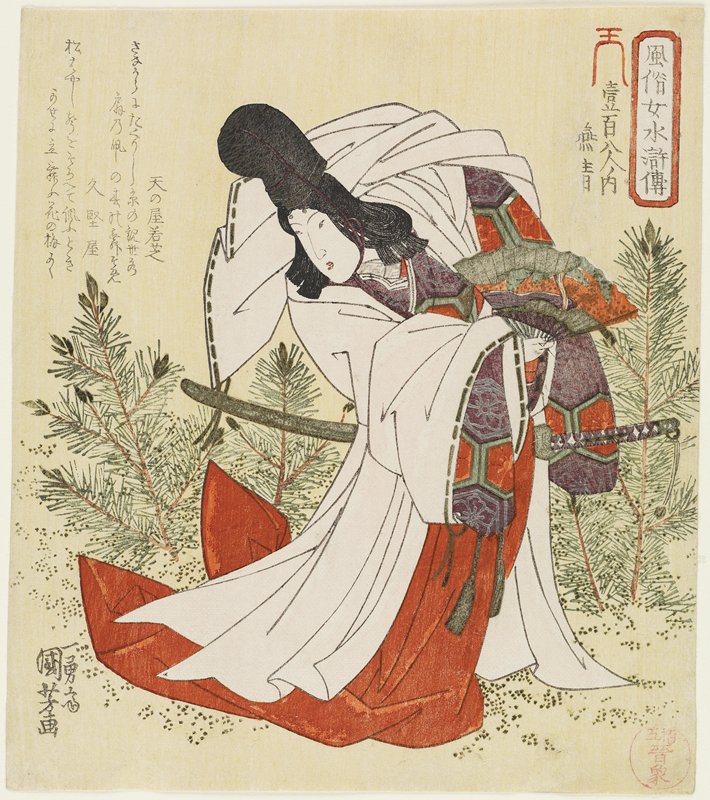
The poetry circle Hisakataya and Kuniyoshi together created two different series picturing the heroes of the Chinese epic Water margin as beautiful women. This print belongs to the later of the two series, published around 1829. The woman depicted here represents Ensei (Yan Qing, in Chinese), one of the youngest among the 108 heroes-a good-looking, fair-skinned man who excelled in music and dance. Her white wide-sleeved robe and lacquered hat are typical attire of shirabyøshi, female song-and-dance entertainers at temple and court festivals during the 12th and the 13th centuries.
Minneapolis Institute of Art
Particulars
- Accession number
- 81.133.154
In the catalog
Sources
- Minneapolis Institute of Art: the museum's own open data · fetched 7 days ago
- Image: Minneapolis Institute of Art — public domain
Meanwhile, in the life of Utagawa Kuniyoshi
The whole life1818–1826
Years of want: hardly any commissions
Only a few publishers agree to print his work, and he earns his living mostly by stuffing and repairing tatami mats; other accounts extend these years to 1827. He lives in constant need.
1818–1827
A meeting with Kunisada
At a desperate moment, when he has to sell used tatami mats, he happens to meet his prosperous fellow pupil Kunisada, whom he felt inferior in talent, and redoubles his efforts; there is no lasting ill feeling, and they later collaborate on a number of series.
1818–1827
Beauties and experiments with Western light and shadow
In these years he draws beautiful women (bijin-ga) and experiments with the large textile patterns and light-and-shadow effects found in Western art, though his attempts show more imitation than real understanding of these principles.
1827
Commission for “108 Heroes of the Suikoden”
The publisher Kagaya Kichibei commissions five sheets from him for the print series “108 Heroes of the Suikoden”; the sheets sell well, and Kuniyoshi is given all the remaining “heroes” of the series.