.png?width=96) Katsushika HokusaiJapanese, 1760–1849
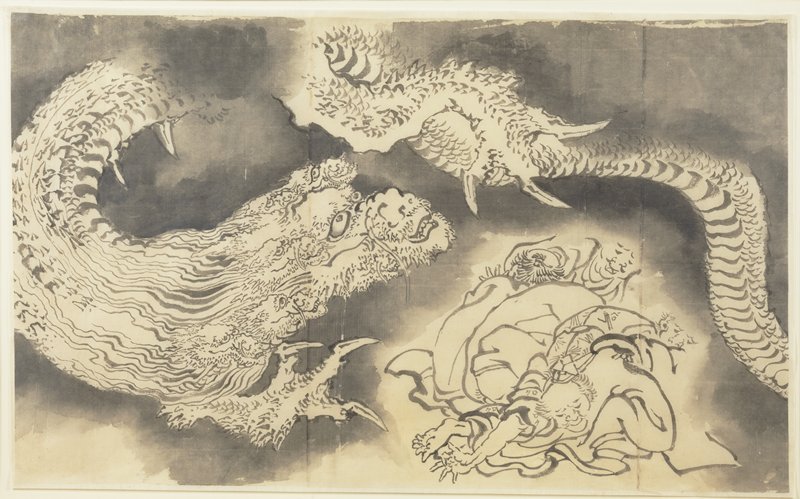
Katsushika HokusaiJapanese, 1760–1849Dragon
May one see it?
Not receiving at present

Minneapolis, United States
It belongs to the collection, but is not on display at present.
- Checked
- In this state since
- Source
- The museum
Particulars
- Accession number
- 2015.79.123.1
In the catalog
Sources
- Minneapolis Institute of Art
- Image: Minneapolis Institute of Art — public domain
Meanwhile, in the life of Katsushika Hokusai
The whole life1798
Becomes an independent artist
Hokusai passed his name on to a pupil and, for the first time, set out as an independent artist tied to no school, taking the name Hokusai Tomisa.
1800
The name Katsushika Hokusai and his first landscape albums
Hokusai adopted the name by which the world knows him: Katsushika, after the district of Edo where he was born, and Hokusai, “north studio”, in honour of the North Star, symbol of a deity of his Nichiren Buddhist faith. That year he published Famous Sights of the Eastern Capital and Eight Views of Edo, and began to take pupils of his own — some fifty over his lifetime.
1814
The first volume of the Hokusai Manga
The first 54-page volume of the Manga, signed Tamekazu, appeared in Edo and Nagoya and sold out within about a week. This diary in drawings — city scenes, people, animals — grew to twelve volumes in the artist's lifetime and is called an “encyclopedia of the Japanese people”.
1839
Fire destroys his studio
A fire destroyed Hokusai's studio and much of his work. By then his career was beginning to fade as younger artists such as Andō Hiroshige grew more popular.
10 May 1849
Last words: “Just another five years…”
On his deathbed the 88-year-old Hokusai is said to have exclaimed: “If only Heaven will give me just another ten years… just another five more years, then I could become a real painter.” Shortly before he died he wrote a haiku: “Though as a ghost, I shall lightly tread the summer fields.” He was buried at the Seikyō-ji temple in Edo.
10 May 1849
Died