Hendrick GoltziusDutch, 1558–1617
Dirck Volckertsz. Coornhert (without frame)
Can I see it?
Not on view at present
Where is “Dirck Volckertsz. Coornhert (without frame)” now? Collection: Art Institute of Chicago, Chicago. Not on view at present. Checked September 29, 2026.

Chicago, United States
It belongs to the collection, but is not on display at present.
- Checked
- In this state since
- Source
- The museum
About the work
In this print Hendrick Goltzius simultaneously paid homage to his teacher while also displaying his own virtuosic talent for engraving. By manipulating the difficult process, which includes sculpting directly into a metal plate with a chisel-like tool called a burin, Goltzius achieved an astonishing degree of realism. To underscore the aim of this portrait, Goltzius included the inscription Ad Vivum Depictus (Drawn from Life).
Art Institute of ChicagoCC BY 4.0
Details
- Accession number
- 1961.878
In the catalog
Sources
- Art Institute of Chicago
- Image: Art Institute of Chicago — CC0
In the life of Hendrick Goltzius
The whole lifelate 1580s
Depression and consumption
From the late 1580s he suffered from depression and consumption; his family life was unhappy.
1590
Departure for Italy
He fled from his wife and, despite his illnesses, set out for Italy — via Hamburg and Munich to Venice, Bologna and Florence. Part of the way he traveled on foot, passing himself off as a commoner, "partly out of a love of mystification."
January 1591
Eight months in Rome
He arrived in Rome in January 1591 and stayed eight months (with a brief sojourn in Naples). He discovered Raphael, was especially impressed by Michelangelo and Giambologna, and studied art from classical sculpture to the masters of the Renaissance.
August 1591
Return to Haarlem with a collection of drawings
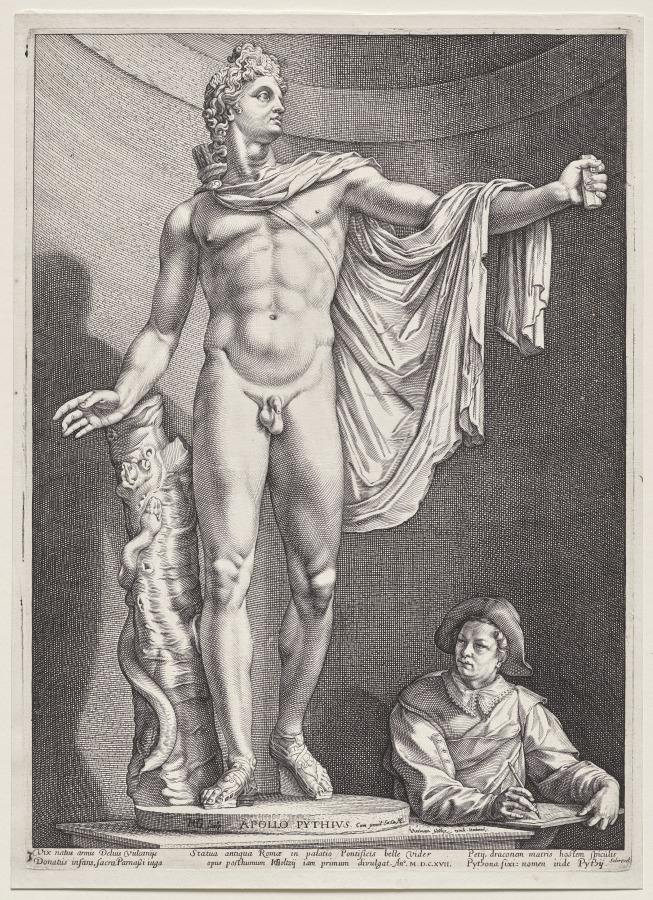
He returned to Haarlem, bringing from Italy a large collection of drawings that he used for the rest of his life; from the Roman material three engravings of classical statues are known, including the Farnese Hercules.