 Francisco de GoyaSpanish, 1746–1828
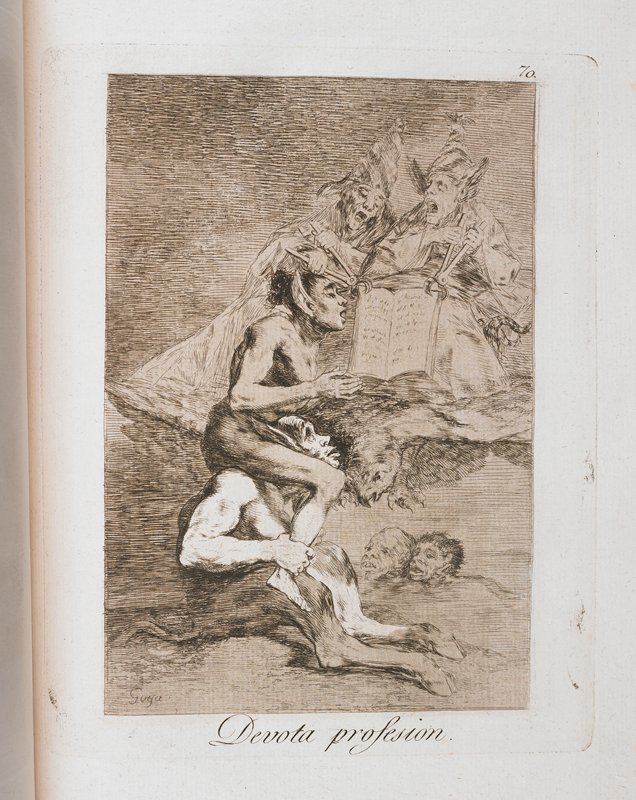
Devota profesion
Can I see it?
Not on view at present
Where is “Devota profesion” now? Collection: Minneapolis Institute of Art, Minneapolis. Not on view at present. Checked September 29, 2026.

Minneapolis, United States
It belongs to the collection, but is not on display at present.
- Checked
- In this state since
- Source
- The museum
About the work
Francisco Goya’s series Los Caprichos contains layers of meaning that even today challenge the modern viewer. Mia’s copy is a rare presentation proof containing early printings of all eighty images. In the first half, Goya explored themes of superstition, sensuality, greed, and violence with scenes set in Spanish brothels, salons, and prisons. The second half is given over to fantastic images from the artist’s dreams and nightmares. Even though Goya tried to disguise his attacks on Spanish society, he withdrew the set from sale because he had been reported to the Inquisition, a tribunal that ruled with lethal authority.
Minneapolis Institute of Art
Details
- Accession number
- P.83.57.70
In the catalog
Sources
- Minneapolis Institute of Art
- Image: Minneapolis Institute of Art — public domain
In the life of Francisco de Goya
The whole life1773–1823 · Workplace
Madrid
1795
Director of Painting at the Academy
He was elected Director of Painting at the Academy of San Fernando with a salary of 4,000 reales; that same year he painted portraits of the Duke and Duchess of Alba.
January – May 1796
Journey to Andalusia and the Sanlúcar Album
He traveled to Andalusia with the royal court; in May he stayed at the Alba family palace in Sanlúcar, where the Sanlúcar Album with his first studies from life came into being.
February 1799
Publication of "Los Caprichos"
The series of 80 etchings "Los Caprichos" was published and sold in a perfume shop on the Calle del Desengaño; owing to the intervention of the Inquisition, only 27 sets were sold.
31 October 1799
First Court Painter
He was appointed First Court Painter with a salary of 50,000 reales a year — the highest rank for a Spanish court painter.