 Edvard MunchNorwegian, 1863–1944
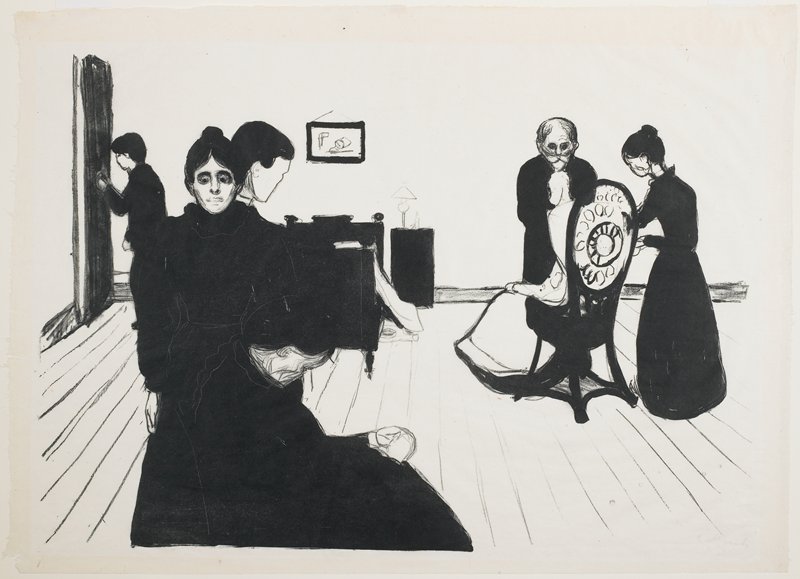
Death in the Sickroom
Can I see it?
Not on view at present
Where is “Death in the Sickroom” now? Collection: Minneapolis Institute of Art, Minneapolis. Not on view at present. Checked September 29, 2026.

Minneapolis, United States
It belongs to the collection, but is not on display at present.
- Checked
- In this state since
- Source
- The museum
About the work
Death in the Sickroom depicts the death from tuberculosis of the artist's sister Sophie in 1877. Standing behind his other two sisters in the foreground, Munch himself faces back towards the wicker chair where Sophie has just passed away. The immense feelings of despair over Sophie's death, an event that occured almost twenty years prior to the creation of this lithograph, is heightened by the stark black and white composition and the frozen poses of Munch's family. One of the most eloquent of Symbolist prints, it shows Munch's mastery in converting personal tragedy into a universal theme of death and mourning.
Minneapolis Institute of Art
Details
- Accession number
- P.12, 550
In the catalog
Sources
- Minneapolis Institute of Art
- Image: Minneapolis Institute of Art — © Minneapolis Institute of Art
In the life of Edvard Munch
The whole life1896
Meetings with Gauguin and the Symbolists in Paris
During an important stay in Paris he met Gauguin, Émile Bernard, Maurice Denis, and Symbolist poets, notably Mallarmé. At this time he turned to etching, woodcut, and lithography.
May 1896
Exhibition at the Maison de l'Art Nouveau
Siegfried Bing showed 60 of Munch's works, including "The Kiss," "The Scream," "Madonna," and "The Sick Child." The exhibition introduced the French public to the artist's work.
1898
Beginning of the Affair with Tulla Larsen
An affair began with Tulla (Mathilde) Larsen, a wealthy young Norwegian woman. Initially warm, the relationship in time began to weigh on Munch because of Tulla's ardor and possessiveness.
1902
The Revolver Incident
After Tulla Larsen's suicide attempt and a mysterious quarrel, Munch shot himself through the hand and was hospitalized. The relationship with Tulla ended, but the artist's mental wellbeing was badly shaken.
1902
"The Frieze of Life" Complete at the Berlin Secession
"The Frieze of Life" was exhibited for the first time in the form the artist had conceived, at the gallery of the Berlin Secession; Munch wrote of the show's "symphonic effect." Here he gained long-standing patrons, Albert Kollmann and Max Linde.
autumn 1908
Nervous Breakdown and Dr. Jacobson's Clinic
Amid heavy drinking, hallucinations, and persecution mania, Munch entered Daniel Jacobson's clinic in Copenhagen, where he spent about eight months. The treatment stabilized his condition; after his return to Norway in 1909 his painting became lighter and more optimistic.