Paul KleeGerman, 1879–1940
Dancing Girl
About the painting
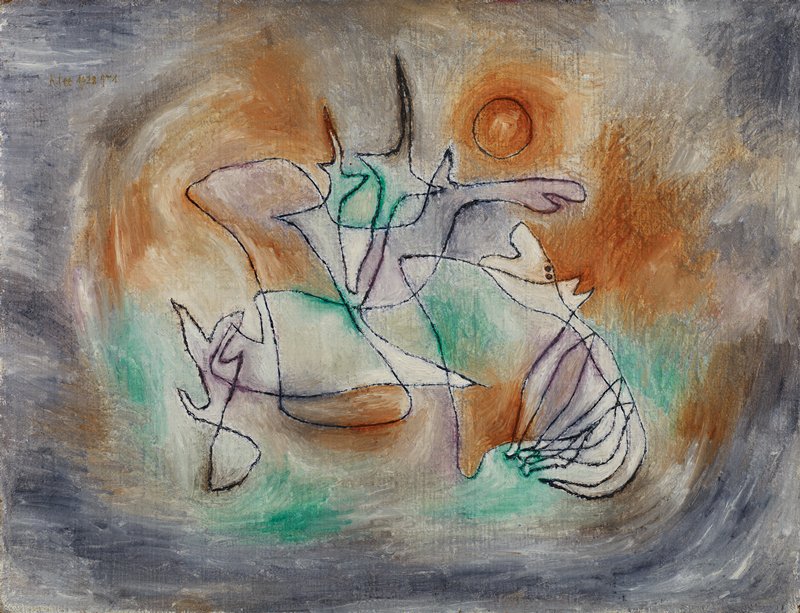
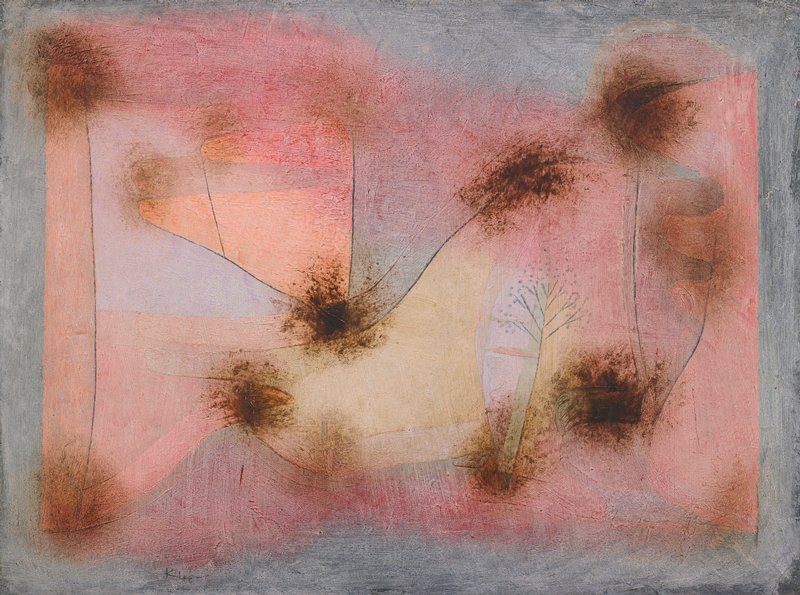
Directly affected by the Nazis’ ascent to power, Paul Klee was dismissed in 1933 from his teaching post at Dusseldorf Academy, where he had spent two years after leaving the Bauhaus. Exiled to Switzerland, Klee suffered physically and psychologically, and his artistic output diminished significantly. Between 1937 and 1940, however, Klee regained artistic momentum and produced several hundred paintings and over 1,500 drawings. In these later works, Klee continued to experiment with unusual media and techniques to produce multidimensional effects. Dancing Girl also reveals Klee’s limitless humor—his signature at the lower right was made by a monogrammed handkerchief, which he laid over the surface to begin his painting.
Art Institute of ChicagoCC BY 4.0

Particulars
- Accession number
- 1959.172
Meanwhile, in the life of Paul Klee
The whole life1936–1939
From 25 works in 1936 to 1,254 in 1939
After falling ill Klee turned to simpler, larger designs with heavier lines, geometric forms and fewer, larger blocks of colour, and his output rose: about 25 works in 1936, 264 in 1937, 489 in 1938 and 1,254 in 1939, a career high. His health recovered somewhat and he was encouraged by a visit from Kandinsky and Picasso.
1939
“Twittering Machine” goes to MoMA
The painting “Twittering Machine”, removed from the National Gallery and vilified at the Munich “Degenerate Art” exhibition, was bought by the Buchholz Gallery in New York; in 1939 it passed to the Museum of Modern Art.
1940
The last large exhibition in his lifetime
In 1940 Zurich hosted the last large exhibition of Klee’s work in his lifetime.
29 June 1940
Death in Muralto: illness and citizenship
Klee died in Muralto, near Locarno, of scleroderma, without having received Swiss citizenship despite being born in Switzerland: the authorities thought his art too revolutionary, even degenerate, and granted his request only six days after his death.
29 June 1940
Died