 William SimpsonBritish, 1823–1899
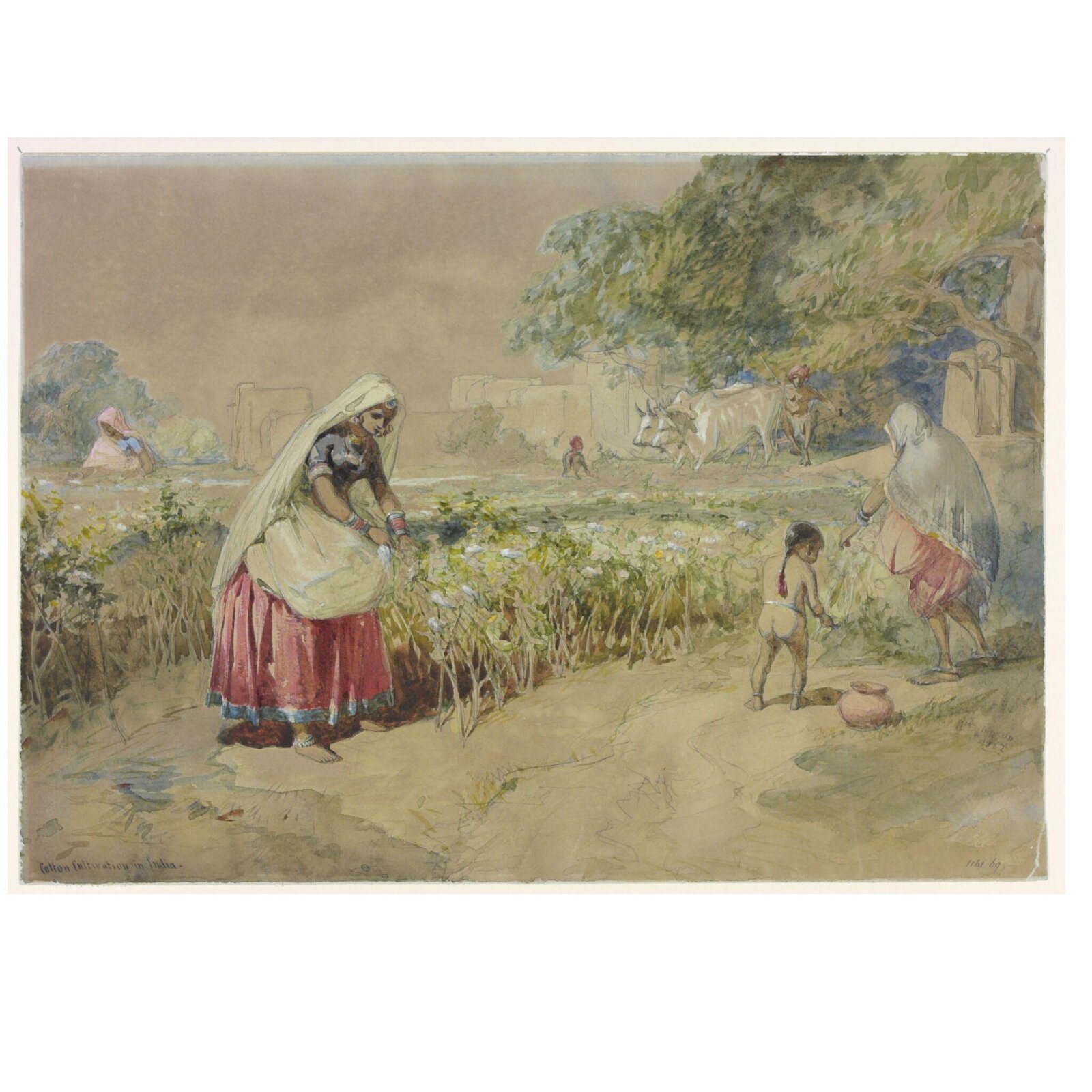
Cotton cultivation in India
Can I see it?
Not on view at present
Where is “Cotton cultivation in India” now? Collection: Victoria and Albert Museum, London. Not on view at present. Checked September 25, 2026.

London, United Kingdom
It belongs to the collection, but is not on display at present.
- Checked
- In this state since
- Source
- The museum
About the painting
William Simpson was born in Glasgow in 1823. At the age of 14 he joined a printing firm, where he learned the art of lithography. In 1859, the London publishing firm William Day and Son commissioned Simpson to visit India and make drawings for a book illustrating well-known places associated with the so-called ‘Indian mutiny’ of 1857, when the Indian army rose against their British officers.
Read on
Thus began Simpson’s long connection with India and the first of four visits over the next 25 years. He saw Upper India, the Himalayas, central, southern and western India, and he took an interest in a great range of subjects, making numerous rapid pencil drawings in sketchbooks, often heightened with colour washes. Many formed preparatory studies for his finished watercolours, most of which he worked up after returning to London. But unfortunately, during his absence, Day and Son had experienced financial problems, and in 1867 they went into liquidation. Two years later, 250 of his watercolours were sold as bankrupt stock – ‘the big disaster of my life’, as he put it.
This painting depicts women engaged in harvesting cotton, probably in Rajasthan in north-west India. Cotton is known to have been harvested in India from the second millennium BC. For the Greeks and Romans it was a highly prized luxury fabric, which they imported from India in large quantities. Printed and painted cotton fabric was subsequently a major part of trade with south-east Asia and from the 1660s onwards large quantities of chintz – printed cotton with a glazed finish – were exported to Europe.
Victoria and Albert Museum
Details
- Accession number
- 1161-1869
What it shows
In the catalog
Sources
- Victoria and Albert Museum
- Image: Victoria and Albert Museum — © Victoria and Albert Museum, London