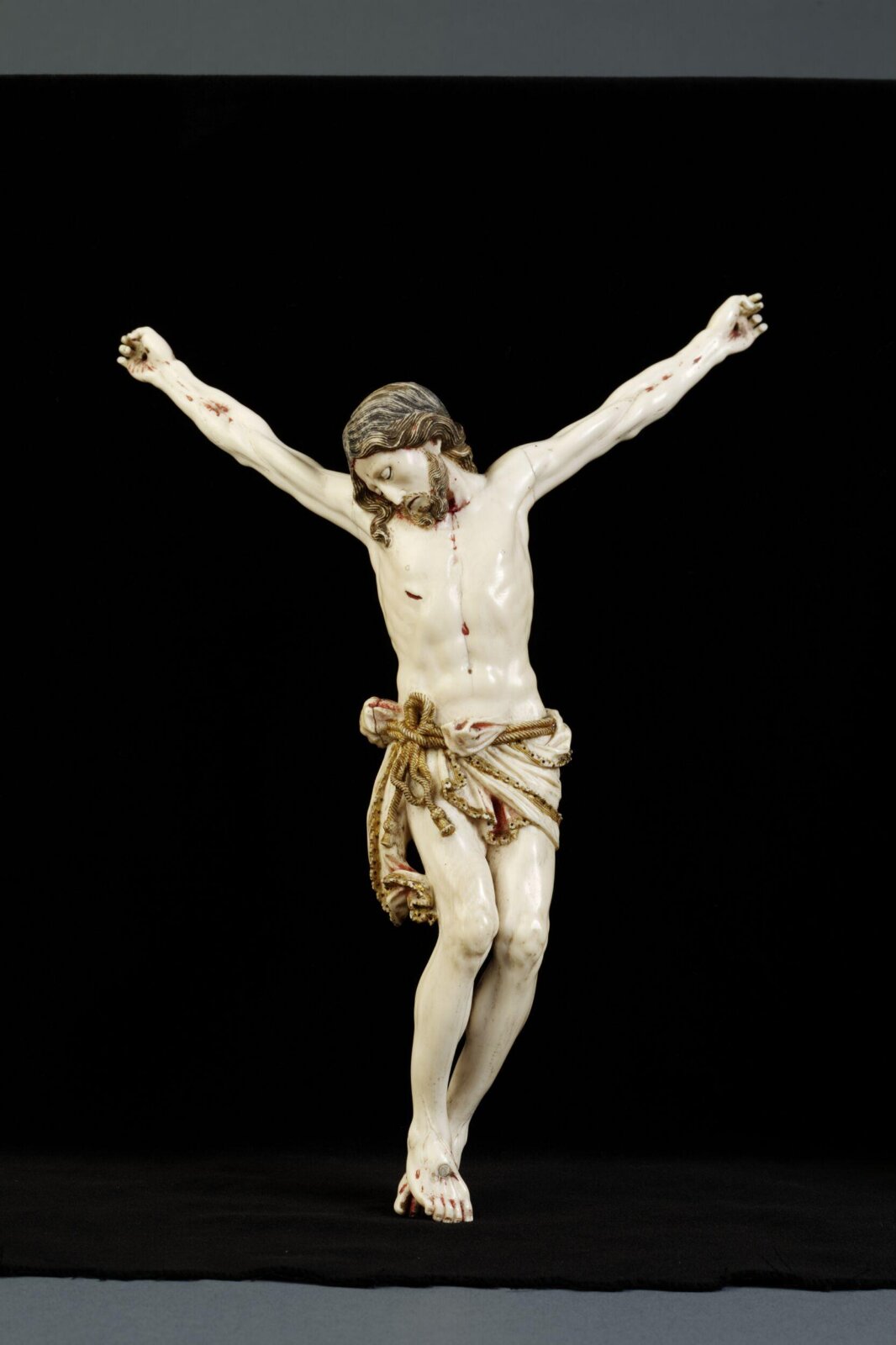
Christ on the Cross
May one see it?
Not receiving at present

Victoria and Albert Museum
London, United Kingdom
It belongs to the collection, but is not on display at present.
- Checked
- In this state since
- Source
- The museum
About the sculpture
This ivory statuette was made about 1700 in Goa. It was formerly attributed to Spain, as the treatment of the hair, drapery, ornamental detail and use of pigment recalled the Virgin of the Immaculate Conception (V&A Mus. no. 183-1864), then thought to be from Valencia and therefore attributed the present piece to the same workshop (Museum records). However similarities with other ivories thought to be Indo-Portuguese, from Goa, suggest the same origins for both the present piece and the Immaculate Conception cited above. Goa was the second base in India to be established by the Portuguese, having been conquered by Alfonso de Albuquerque (about 1453-1515) during the reign of Manuel I of Portugal initially in 1510, and then reconquered in 1512. Portugal was interested first and foremost in trade, and the discovery of India was
Read on
motivated by a desire to dominate trade-routes. But the Christian settlers and missionaries were also keen to convert the native populace to Christianity, and religious images in ivory were commissioned to assist in this. Some were exported to Europe, but others evidently remained and were used for evangelical purposes.
Victoria and Albert Museum
Particulars
- Accession number
- A.20-1949