 Albrecht DürerGerman, 1471–1528
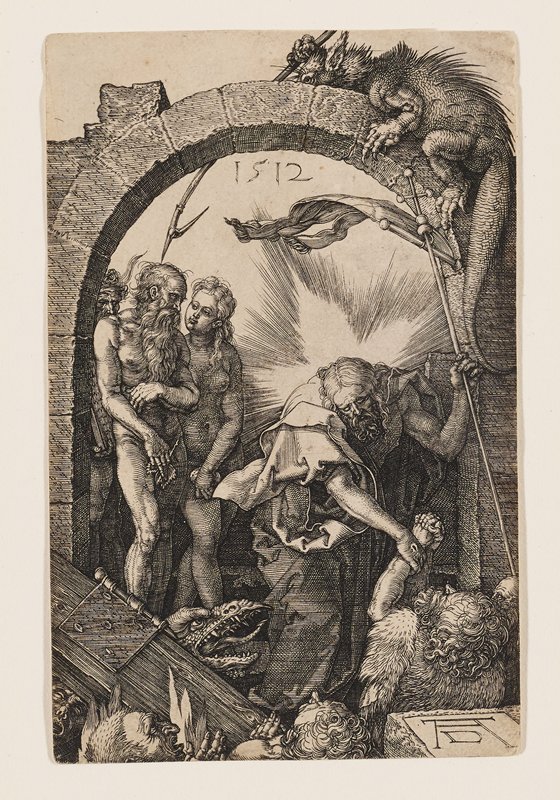
Christ in Limbo
Can I see it?
Not on view at present
Where is “Christ in Limbo” now? Collection: Minneapolis Institute of Art, Minneapolis. Not on view at present. Checked September 29, 2026.

Minneapolis, United States
It belongs to the collection, but is not on display at present.
- Checked
- In this state since
- Source
- The museum
About the work
Durer executed the Engraved Passion during the years 1507-1512, while in his mid-twenties. In the fifteen plates, Durer sought out difficult problems, such as extreme foreshortening. There is a marked darkening of the whole image, while the figures are accented by a restrained, yet expressive light that adds drama to the sombre events. The consistent placement of figures in the foreground unifies the series. Durer customarily sold them as a set, which seems to have been intended for the connoisseur collector.
Read on
Christ in Limbo, also entitled the Harrowing of Hell, depicts a passage in the Aprcrophal text of the Bible, the Gospel of Nicodemus. After his Resurrection, Christ descended into Limbo (a border region of Hell, where the just awaited Christ's Redemption), and led the patriarchs, the Old Testament prophets, and Adam and Eve to salvation. The figure of Christ, holding his cross and standard, is seen literally wrenching a good soul from flames and devils.
Minneapolis Institute of Art
Details
- Accession number
- P.135
In the catalog
Sources
- Minneapolis Institute of Art
- Image: Minneapolis Institute of Art — public domain
In the life of Albrecht Dürer
The whole life1507–1528 · Workplace
Nuremberg
1511
Publishes the Great Passion and the Life of the Virgin
Dürer published two woodcut series as books, the Great Passion and the Life of the Virgin, with a second edition of the Apocalypse and the 37 woodcuts of the Little Passion. His post-Venetian woodcuts developed chiaroscuro modelling.
1512
Emperor Maximilian I becomes his chief patron
From 1512 Emperor Maximilian I was Dürer's chief patron. For him Dürer and his workshop produced the Triumphal Arch, a giant woodcut 295 × 357 cm printed from 192 blocks and modelled on the triumphal arches of ancient Rome.
3 January 1512
Nuremberg's privilege against forgeries
Nuremberg's city council granted Dürer a privilege for the sale of his prints, with penalties for anyone who forged them.
1513–1516
Three years without painting
Complaining that painting did not pay enough to justify the time compared with his prints, Dürer produced no paintings from 1513 to 1516.
1514
Death of his mother
In the year of Melencolia I and St Jerome in His Study, the artist's mother, Barbara Holper, died.
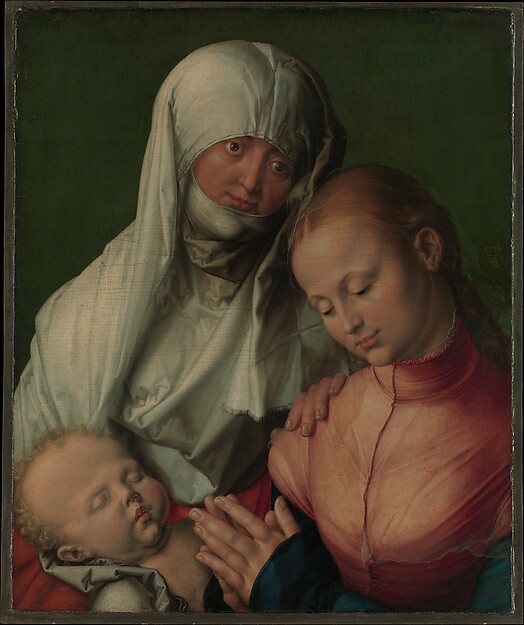
![Madonna and Child [obverse], Albrecht Dürer, c. 1496/1499](https://api.nga.gov/iiif/878db7e6-10ae-4cae-ba5d-6d6f5c413ae8/full/!2400,2400/0/default.jpg)
![Lot and His Daughters [reverse], Albrecht Dürer, c. 1496/1499](https://api.nga.gov/iiif/7565a449-f82a-414b-9bda-c93f55a51b4d/full/!2400,2400/0/default.jpg)