Joseph Mallord William TurnerBritish, 1775–1851
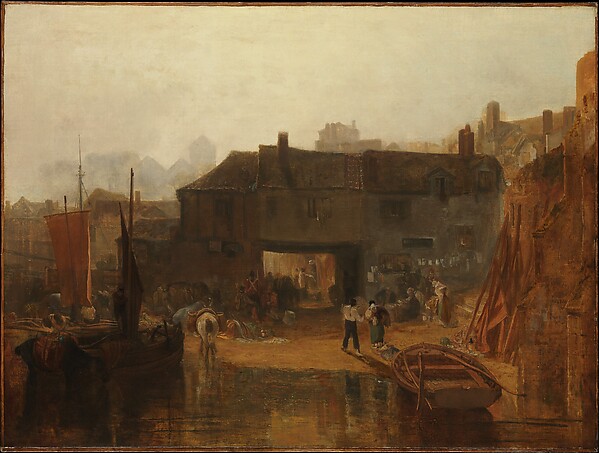
Chichester Canal
Can I see it?
Unknown
Where is “Chichester Canal” now? Collection: The National Gallery, London. Unknown.

London, United Kingdom
The owner is known; whether it is on view today is not.
- In this state since
- Source
- The museum
About the painting
Chichester Canal is a painting by the English Romantic landscape painter, watercolourist and printmaker J. M. W. Turner. It was painted in 1828 and was commissioned by George Wyndham, 3rd Earl of Egremont. It is now in the Tate Collection.
The work depicts the Chichester Canal in Sussex, southern England. The ship is probably a collier brig, as this serene scene had commercial purpose. Its brilliant colours may have been influenced by atmospheric ash from the eruption of Mount Tambora in Indonesia (see also Year Without a Summer).
The painting is an initial version of the final composition in Petworth House.
Details
- Accession number
- NG560
In the catalog
Sources
- Wikidata
- Image: The National Gallery — J. M. W. Turner · Public domain · Wikimedia Commons
In the life of Joseph Mallord William Turner
The whole life1820s
Print series for publishers
In the 1820s he worked on several topographical print commissions: “Picturesque Views on the Southern Coast of England” (1814–1826) and “The Rivers of England” (1822–1826) for the Cooke brothers, “Picturesque Views in England and Wales” (1824–1838) for Charles Heath and “The Ports of England” (1825–1828) for Thomas Lupton.
1829
The death of his father
His father, who had lived with him for thirty years and worked as an assistant in his studio, died in 1829; the loss strongly affected Turner, who began to suffer fits of depression afterwards, and he finally abandoned his own gallery.
1829
Paris, Normandy and Brittany
In the twenty-year period from 1821 to 1844 he visited several European countries, studying the old masters and taking long hikes into the countryside: in 1829 Paris, Normandy and Brittany, and three years later Paris for the second time.
1830–1840s
Criticism in the 1830s–1840s and Ruskin’s defence
His innovative works, bordering on abstraction, gave him a reputation for madness: the Victorian public preferred realism and sentimentality, and Queen Victoria refused to knight him. John Ruskin came to his defence, calling him “the greatest artist of all time”.