 David HockneyBritish, 1937–2026
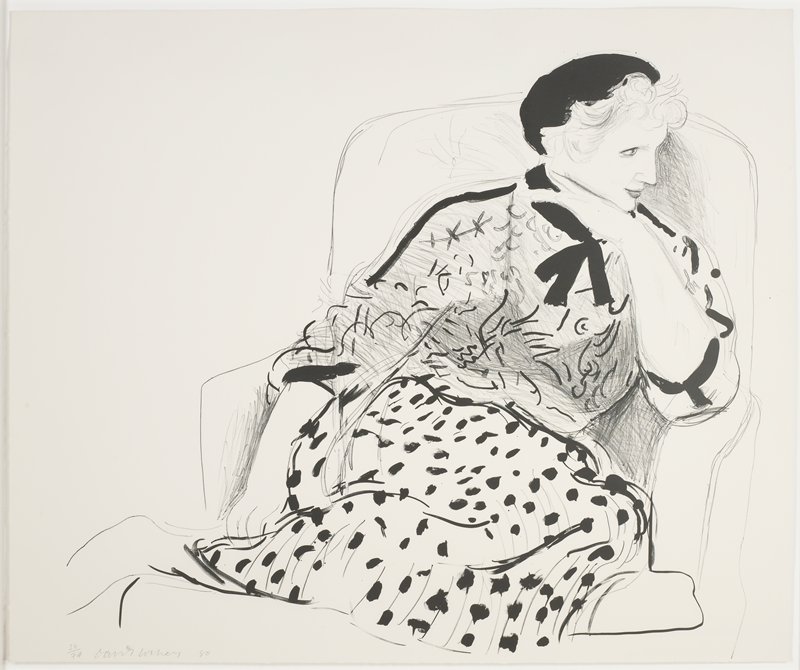
Celia in an Armchair
Can I see it?
Not on view at present
Where is “Celia in an Armchair” now? Collection: Minneapolis Institute of Art, Minneapolis. Not on view at present. Checked September 29, 2026.

Minneapolis, United States
It belongs to the collection, but is not on display at present.
- Checked
- In this state since
- Source
- The museum
Details
- Accession number
- 2010.94.1
In the catalog
Sources
- Minneapolis Institute of Art
- Image: Minneapolis Institute of Art — © David Hockney / Gemini G.E..L.
In the life of David Hockney
The whole life1966–1978
Stage designer: “Ubu Roi” and the Glyndebourne operas
Hockney’s first stage designs are for “Ubu Roi” at London’s Royal Court Theatre (1966), followed by Stravinsky’s “The Rake’s Progress” (1975) and “The Magic Flute” (1978) for the Glyndebourne Festival Opera. It is the start of the opera work that will go on in New York, Los Angeles, Chicago and London.
1979
A founder of the Museum of Contemporary Art, Los Angeles
In 1979 Hockney is a founder of the Museum of Contemporary Art, Los Angeles.
1979
Hearing aids from 1979
Hockney’s hearing has been failing since the 1970s: he realised he was going deaf several years before he began using hearing aids in 1979. He also described synaesthetic associations between sound, colour and shape.
1980–1983
Designing for the Metropolitan Opera
In 1980 Hockney agrees to design sets and costumes for a French triple bill at the Metropolitan Opera — Satie’s “Parade”, Poulenc’s “Les Mamelles de Tirésias” and Ravel’s “L’enfant et les sortilèges” — and in 1981 for a second one, of Stravinsky’s “Le sacre du printemps”, “Le rossignol” and “Oedipus Rex”. The reimagined set of “L’enfant et les sortilèges” from the 1983 exhibition “Hockney Paints the Stage” became a permanent installation at the Spalding House branch of the Honolulu Museum of Art.