Anton Raphael MengsGerman, 1728–1779
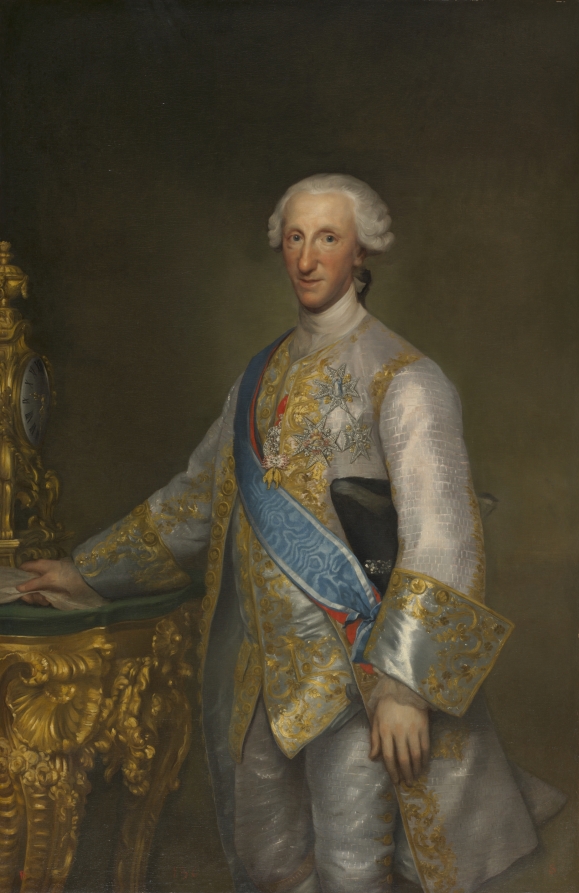
Carlos III
May one see it?
Unknown

Madrid, Spain
The owner is known; whether it is on view today is not.
- In this state since
- Source
- The museum
About the painting
In the museum's own words — in Spanish
De más de medio cuerpo, de perfil hacia la izquierda, viste armadura, banda y fajín, y en la mano derecha la bengala de general. Sobre el pecho, el Toisón de oro, pendiente de una cinta. La cabeza se gira hacia el espectador con una sonrisa cordial. En el fondo, a la dercha, una gran cortina recogida con cordón y borlas.
Lázaro Galdiano Museum
Particulars
What it shows
In the catalog
Sources
- Lázaro Galdiano Museum
- Image: Lázaro Galdiano Museum — In Copyright
Meanwhile, in the life of Anton Raphael Mengs
The whole lifelate 1759
Naples: an altarpiece for Caserta and royal portraits
At the end of 1759 Mengs came to Naples to paint the altarpiece “The Presentation of the Virgin in the Temple” for the Royal Chapel at Caserta and portraits of the royal family, among them a portrait of Ferdinand I (1759). When the King of Naples left the city to take the Spanish throne in Madrid, Mengs returned to Rome.
1761
To Madrid at Charles III's invitation: working with Tiepolo
In 1761 Mengs went to Madrid at the invitation of Charles III, where together with Giovanni Battista Tiepolo he decorated the New Royal Palace and also worked at Aranjuez and La Granja; the fees of both masters at the Spanish court were unusually high. He was supported in Madrid and Rome by his friend, the Spanish diplomat and patron José Nicolás de Azara.
1761 · Workplace
Rome
1761 · Workplace
Madrid
1762
“Thoughts on Beauty and Taste in Painting”
The book, dedicated to Winckelmann, was among the first to formulate the principles of the “new classical style”: in place of traditional styles Mengs spoke of “taste” — high, sweet or middle — with high taste marked by the selection of the best of everything in the best proportion. Published in Zurich, it was reprinted in the author's lifetime in 1765 and 1774 and served as a textbook in many academies.