 Max ErnstFrench, 1891–1976
Capricorn
Can I see it?
Not on view at present
Where is “Capricorn” now? Collection: National Gallery of Art, Washington, D.C. Not on view at present. Checked November 16, 2026.

Washington, D.C., United States
It belongs to the collection, but is not on display at present.
- Checked
- In this state since
- Source
- The museum
About the sculpture
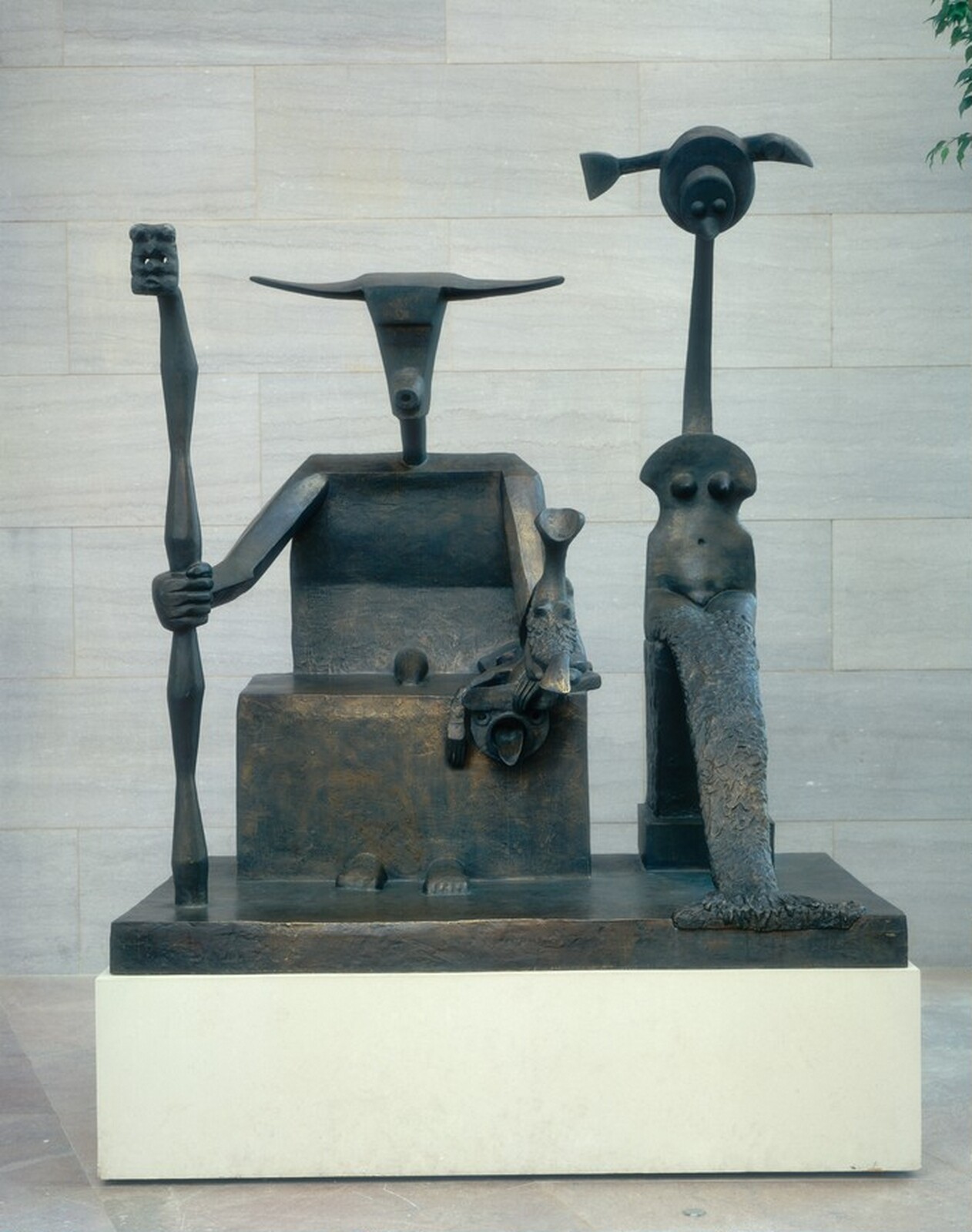
Max Ernst modelled Capricorn in 1947; the bronze at Washington's National Gallery of Art was cast in 1975. A horned king and a mermaid queen share the attributes of the zodiac sign between them. The original, made from cement and scrap iron, stood outside Ernst and Dorothea Tanning's house in Sedona. Everyday objects supplied moulds for parts of the figures, including an egg crate for the mask on the king's sceptre.
Details
- Accession number
- 1979.30.1
What it shows
In the catalog
Sources
- National Gallery of Art
- Image: National Gallery of Art — © the artist or rights holder
In the life of Max Ernst
The whole lifeOctober 1946
A double wedding in Hollywood with Man Ray
Ernst and Dorothea Tanning went to Hollywood to marry, asking Man Ray and his friend Juliet Browner to be their witnesses; the two decided to marry as well, and the result was a double ceremony in Beverly Hills.
1946–1953
Sedona: a house and “Capricorn” built with his own hands
Ernst built the house himself, helped by a young admirer and short of money, and made the 2.4-metre Capricorn, a seated bull-man, from empty bottles, springs and cement; the property became known as Capricorn Hill. The couple took an interest in the rites of the local Native American tribes, Ernst buying objects and masks from them, and friends visited only occasionally.
1948
The book “Beyond Painting”
In 1948 Ernst published the large essay Beyond Painting, compiled in Sedona; as a result of the book and its publicity he began to achieve financial success.
1950–1953
Return to France
By some accounts Ernst went back to France in 1950 and settled in Paris; by others he lived in Sedona until 1953. From the 1950s he lived mainly in France and achieved financial success.
1954
The Grand Prize at the Venice Biennale
In 1954 Ernst was awarded the Grand Prize for painting at the Venice Biennale.
1 April 1976
Died