Édouard ManetFrench, 1832–1883
Bullfight
May one see it?
Yes, receiving visitors

Art Institute of Chicago
Room225Chicago, United States
On public display.
- Checked
- 5 hours ago
- In this state since
- Aug 19, 2026
- Source
- The museum's own collection data
About the painting
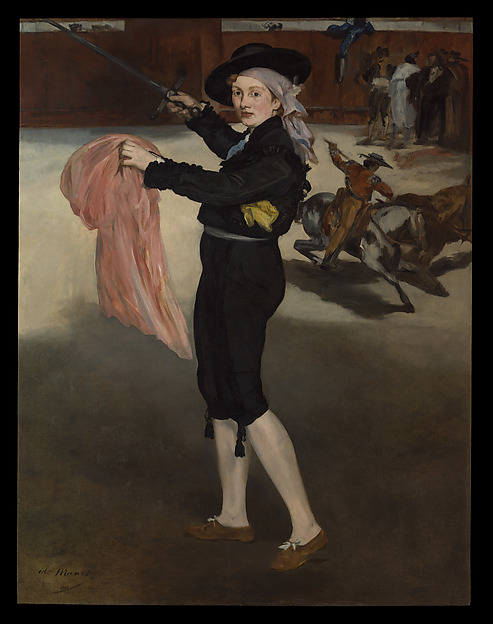
Bullfight – Death of the Bull (French: Corrida: la mort du taureau) is an oil on canvas painting by Édouard Manet, executed c. 1865. It is now in the Art Institute of Chicago.
With Bullfight (now known as The Fall of the Bullfighter, Musée d'Orsay) and The Fall of the Picador (watercolour, private collection), it forms part of a series of works painted after Manet's return from Spain.
Particulars
- Accession number
- 1937.1019
What it shows
In the catalog
Sources
- Art Institute of Chicago: the museum's own open data · fetched 4 days ago
- Image: Art Institute of Chicago — CC0
Meanwhile, in the life of Édouard Manet
The whole life1863
“The Luncheon on the Grass” at the Salon des Refusés
The Salon of 1863 rejected “The Luncheon on the Grass” (originally “Le Bain”), and Manet exhibited it at the Salon des Refusés, a parallel exhibition initiated by Napoleon III after a public outcry, the jury having accepted only 2,217 of more than 5,000 submissions. The juxtaposition of dressed men and a nude woman and the sketch-like handling caused a scandal; one critic compared the brushwork to a “floor mop”.
1863
Marries Suzanne Leenhoff
In 1863, a year after his father's death, Manet married Suzanne Leenhoff at a Protestant church: a Dutch-born piano teacher two years his senior with whom he had been romantically involved for about ten years. Auguste Manet had employed her to teach his sons the piano, and she may also have been Auguste's mistress.
1863
Married: Suzanne Manet
1865
“Olympia” at the Salon: a scandal
In 1865 the Salon accepted “Olympia”, and the frank depiction of a self-assured prostitute created a scandal; according to Antonin Proust, only the precautions taken by the administration prevented the painting from being punctured and torn. The popular press caricatured it, while the avant-garde, including Courbet, Cézanne and Monet, championed it.
1865
Flight to Spain: El Greco, Velázquez, Goya
The persecution after “Olympia” forced Manet to flee, almost literally, to Spain, where he spent his time to good purpose, getting to know the works of El Greco, Velázquez and Goya and finding in them a justification of his own aesthetic taste.
1867
His own pavilion near the Pont de l'Alma
In 1867, during the World's Fair in Paris, Manet set up his own pavilion near the Pont de l'Alma and showed fifty of his best works of the past ten years. Possibly this step led to his works being accepted at the next two Salons.