 William SimpsonBritish, 1823–1899
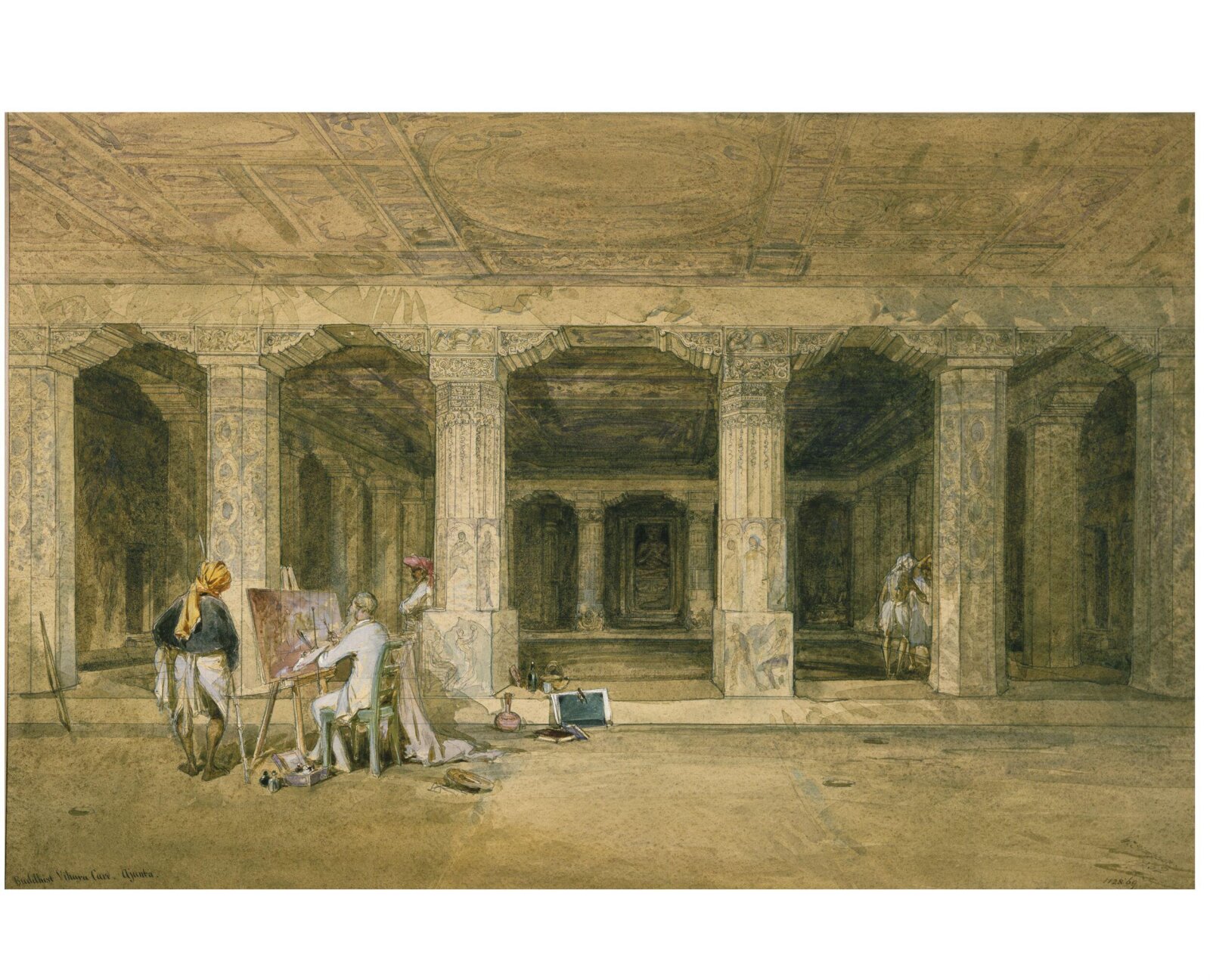
Buddhist vihara cave, Ajanta
May one see it?
Not receiving at present

London, United Kingdom
It belongs to the collection, but is not on display at present.
- Checked
- In this state since
- Source
- The museum
About the painting
William Simpson was born on 28 October 1823 in Glasgow. Following a seven-year apprenticeship with a specialist lithographic firm, he moved to London in February 1851 and found employment with Day and Sons. In 1859 the firm commissioned Simpson to visit India and make drawings for a book illustrating well-known places associated with the 1857-58 uprising. Thus began Simpson's long association with India, and the first of his four visits to the subcontinent over the next twenty-five years. During these journeys he made numerous rapid pencil drawings in sketchbooks, often heightened with colour washes. Many formed preparatory studies for his finished watercolours, most of which he worked up after returning to London. The plan was for Day and Son to select 250 of these finished watercolours to be lithographed as illustrations in the projected volume.
Read on
While Simpson was away in India, however, Day and Son had been drifting into debt. In 1867, before it finally went into liquidation at the end of the year, he was made a company shareholder as part payment. But, as he expressed it, 'the great work on India, on which I bestowed so much time and labour, never came into existence'. Two years later, Simpson's collection of 250 watercolours was sold off as bankrupt stock: 'This was the big disaster of my life', as he ruefully remarked. This painting by Simpson depicts fellow artist Major Robert Gill (1804-79) copying wall-paintings inside the Buddhist Vihara cave at Ajanta. In 1846 the Royal Asiatic Society had commissioned Gill to make a pictorial record of the caves, and despite ill-health and the hostility of the local inhabitants he continued to live there, even after his wife had returned to England and he had taken an Indian mistress. Sadly, twenty-five of Gill’s copies were destroyed by fire in 1866.
Victoria and Albert Museum
Particulars
- Accession number
- 1128-1869
What it shows
In the catalog
Sources
- Victoria and Albert Museum
- Image: Victoria and Albert Museum — © Victoria and Albert Museum, London